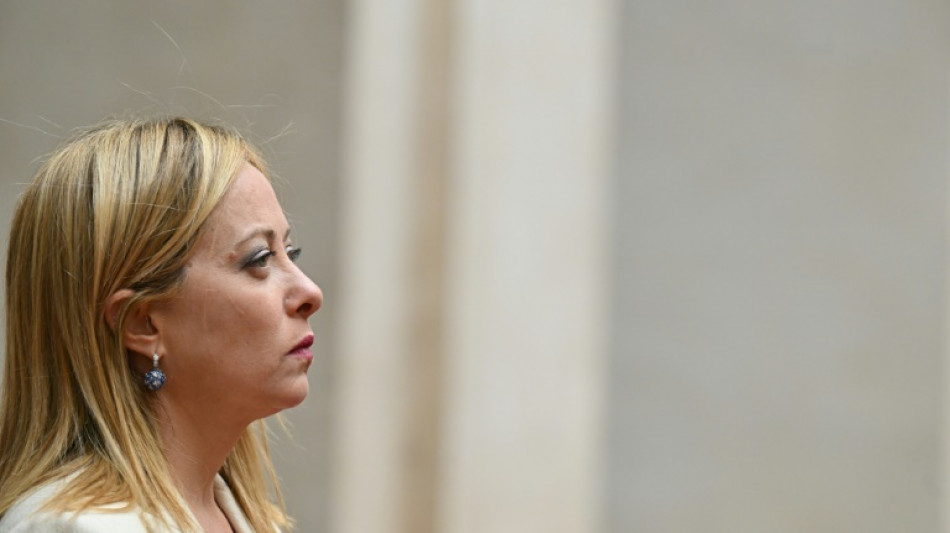
Bank tax hits investor confidence in Italian govt / Photo: Alberto PIZZOLI - AFP

 Nigeria's Tinubu confirms 32 dead after military plane crash
 'Reckless' AI firms can't control models, says whistleblower

 Switching on brain cells: the Nobel-winning science of optogenetics

 Quebec votes as separatist surge poses test for Canada PM

 Euro slides as concerns about French debt mount
 Former Trump press secretary Leavitt joins Fox News

 Djokovic advances to China Open final as Medvedev out for hitting fan with ball

 Disgraced former US House speaker dies at 84
 Euro slides as worries about French debt grow
 US withdraws all bomber aircraft from UK airbase

 Drone hits Ethiopia IDP camp as fears grow of regional war

 US-German trio wins medicine Nobel for illuminating the brain
 England captain Kane driven by desire for records says Tuchel
 N.Irish court hears challenge to disputed Orangemen parade

 Talking points from the Bahrain Grand Prix in Malaysia

 Yemen, Saudi Arabia target Houthis in new campaign as war escalates

 US-German trio wins medicine Nobel for work on optogenetics
 Swiatek, Zheng survive three-set tests in China Open third round

 Hasan says Test cricket momentum turning for Bangladesh
 Intense heat puts births in jeopardy, UN tells Fiji talks
 US arrests woman accused of spying for China on Taiwan leader's family

 Yemen military announces broad strikes against Houthis

 Zuckerberg skewered again on screen in 'The Social Reckoning'
 Fiji urges 'just' climate transition, financing at pre-COP gathering

 Thailand's Jeeno overcomes late wobble to win Lotte Championship

Italian Prime Minister Giorgia Meloni's government watered down its surprise windfall tax on banks this week after a brutal market reaction, but the damage to investor confidence was done.
"The most damaging impact... will not be the hit to the earnings of Italian banks but the higher risk premium that investors will demand to compensate them for the risk of future government intervention," noted Johann Scholtz, analyst at Morningstar.
Meloni's hard-right government announced out of the blue on Monday night that it would levy a 40-percent tax on banks' "surplus profits" generated by interest rate hikes, due to last one year.
Shares in Italian banks plunged the next day on the Milan exchange, losing 9.5 billion euros ($10.5 billion) in capitalisation -- a figure well in excess of the money Rome had hoped to raise from the tax.
That evening, the government announced the levy would be capped at 0.1 percent of the total assets of a bank, causing them to recover some of their lost ground in trading on Wednesday and Thursday.
But ratings agency Moody's said on Thursday that the one-off tax would "lower profits systemwide and significantly reduce the benefit of increased interest rates to the sector".
Parliament must still approve the decree law but if implemented in its current form, the levy would represent "about 15 percent" of Italian banks' net income in 2022, it said.
- 'Haphazard manner' -
It was Meloni's first showdown with the markets since she took office in October, after her far-right Brothers of Italy party came top in September's general election.
Initial alarm at the potential for radical change in the eurozone's third-largest economy gave way to relief as Meloni mostly followed the path set by her predecessor, former European Central Bank chief Mario Draghi.
One of Draghi's ministers, Giancarlo Giorgetti of the far-right League party, stayed on as Meloni's economy minister.
He reassured banks in June that a windfall tax was not on the cards -- but was absent on Monday when the measure was unveiled by League leader Matteo Salvini.
"An economy minister who does not show up for a press conference in such an occasion gives a very bad image of the country," noted Francesco Giavazzi, a former economic advisor to Draghi.
"The haphazard manner of the announcement, where the government changed the terms of the tax at least three times in one day, will do little to restore investor confidence," added Scholtz.
- 'Populist target' -
While Meloni left the announcement of the tax to Salvini, her deputy prime minister, she defended it in a video posted on social media on Wednesday.
She criticised the "unfair margins" of the banks, and said the money raised would help "fund measures of support for households and businesses" struggling with record inflation.
Italian banks, like their European counterparts, saw their net interest income soar in the wake of the European Central Bank's rise in interest rates.
According to the Italian media, Meloni agreed with Salvini to introduce the measure to help appease their right-wing electorate.
The government -- which also includes the Forza Italia party of late former premier Silvio Berlusconi -- has been criticised for cutting an anti-poverty mechanism and blocking opposition calls for a minimum wage.
"Banks are an easy populist target and their bashing can only attract political support," said Lorenzo Codogno, former chief economist at the Italian Treasury.
But he warned that "a Soviet-style tax" such as this week's levy "risks producing permanent damage to the attractiveness of Italy’s economy".
R.Halabi--SF-PST