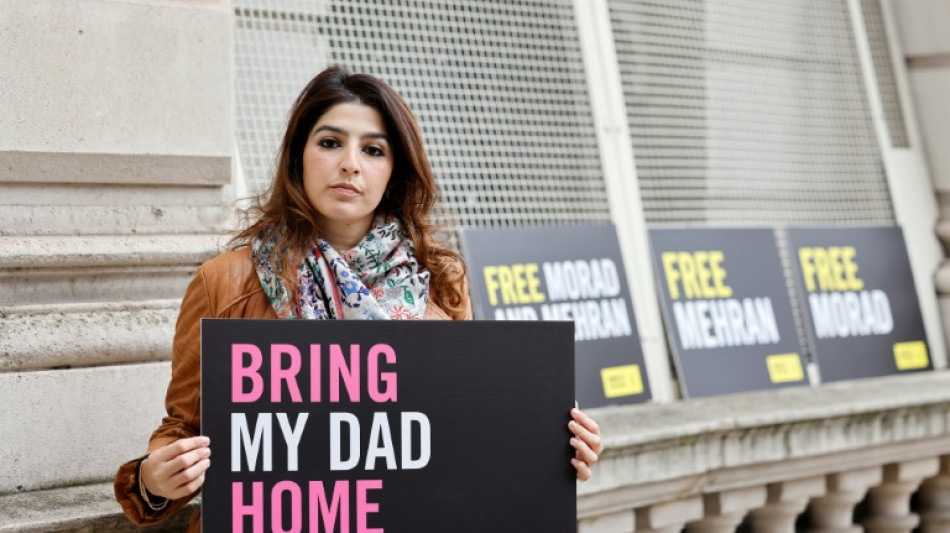
Iran moves Americans to house arrest in first step of release deal / Photo: Tolga Akmen - AFP/File

 Nigeria's Tinubu confirms 32 dead after military plane crash

 'Reckless' AI firms can't control models, says whistleblower

 Switching on brain cells: the Nobel-winning science of optogenetics
 Quebec votes as separatist surge poses test for Canada PM

 Euro slides as concerns about French debt mount
 Former Trump press secretary Leavitt joins Fox News

 Djokovic advances to China Open final as Medvedev out for hitting fan with ball

 Disgraced former US House speaker dies at 84
 Euro slides as worries about French debt grow
 US withdraws all bomber aircraft from UK airbase
 Drone hits Ethiopia IDP camp as fears grow of regional war

 US-German trio wins medicine Nobel for illuminating the brain
 England captain Kane driven by desire for records says Tuchel
 N.Irish court hears challenge to disputed Orangemen parade

 Talking points from the Bahrain Grand Prix in Malaysia

 Yemen, Saudi Arabia target Houthis in new campaign as war escalates

 US-German trio wins medicine Nobel for work on optogenetics
 Swiatek, Zheng survive three-set tests in China Open third round

 Hasan says Test cricket momentum turning for Bangladesh
 Intense heat puts births in jeopardy, UN tells Fiji talks
 US arrests woman accused of spying for China on Taiwan leader's family

 Yemen military announces broad strikes against Houthis
 Zuckerberg skewered again on screen in 'The Social Reckoning'
 Fiji urges 'just' climate transition, financing at pre-COP gathering

 Thailand's Jeeno overcomes late wobble to win Lotte Championship

Iran has moved five Americans from jail to house arrest, officials and family members said Thursday, in the first step of a delicate deal that would unfreeze billions of dollars in Iranian funds and allow the prisoners to leave the Islamic republic.
The progress on the prisoners -- one of them detained for nearly eight years -- comes after quiet, exhaustive diplomacy between the longtime adversaries whose separate talks on restoring a nuclear deal broke down.
Sources familiar with the negotiations said that the next step would be the transfer of $6 billion frozen in South Korea to a special account administered in Qatar which Iran could use for humanitarian purchases such as food and medicine.
If all goes as planned, the prisoners could leave Iran sometime in September, one source said on condition of anonymity.
Four of the prisoners -- Siamak Namazi, Emad Sharqi and Morad Tahbaz, and another who preferred to remain anonymous -- were taken Thursday out of Tehran's notorious Evin prison, a day after President Joe Biden's administration informed their families of a breakthrough in talks.
The four were escorted to a hotel where they will remain held under guard by Iranian officials, a lawyer for one of the prisoners said.
Sources said that a fifth American, a woman, was also part of the discussions and had already been moved in recent weeks to house arrest.
"While this is a positive change, we will not rest until Siamak and others are back home; we continue to count the days until this can happen," Babak Namazi, Siamak's brother, said in a statement.
A spokeswoman for the US National Security Council called the release to house arrest "an encouraging step" but said Iran should never have arrested the five Americans.
"Of course, we will not rest until they are all back home in the United States," said the spokeswoman, Adrienne Watson.
"Negotiations for their eventual release remain ongoing and are delicate," she said.
A lawyer for the Namazi family, Jared Genser, also welcomed the step but cautioned: "This is at best the beginning of the end and nothing more."
- Unfreezing funds -
Neither government has publicly disclosed details of the impending agreement.
But a source said discussions centered on the unblocking of the $6 billion in Iranian funds frozen in South Korea.
Tehran earned the money from oil sales but Seoul blocked the funds to comply with US sanctions imposed under former president Donald Trump.
While stressing that the arrangement was not final, the source said Iran would be allowed to use the money administered by Qatar for non-sanctionable trade and that no funds would be transferred directly to Iran.
Former president Barack Obama faced heated criticism from his Republican opponents for sending $400 million in cash -- also funds belonging to Iran -- as he secured the release of a previous batch of prisoners while concluding a landmark nuclear accord with Tehran in 2015.
In the latest deal, Iran has also been seeking the release of its own prisoners held by the United States for violations of sanctions.
The progress with Iran comes despite the breakdown in talks between the Biden administration and Tehran on restoring the nuclear deal, from which Trump pulled out.
There were no indications of forward movement on the nuclear deal, with Biden earlier bluntly dismissing prospects for its revival following a crackdown by Iran's clerical leaders and mass protests led by women.
- Hostility with Iran -
The United States has repeatedly negotiated with adversaries to free American prisoners. The Biden administration has brokered prisoner swaps with Russia despite freezing most high-level contact since Moscow's invasion of Ukraine.
All five US citizens in the deal are of Iranian descent. Iran does not recognize dual nationality and has had hostile relations with the United States since the 1979 Islamic revolution toppled the pro-Western shah.
Namazi, a businessman, was arrested in October 2015. He was accused of spying on what his family calls laughable evidence such as past affiliations with US think tanks.
His father, former UNICEF official Baquer Namazi, was himself arrested as he went to help his son but was finally released last year as his health deteriorated.
Tahbaz, an Iranian-American who also holds British nationality, was arrested alongside other environmentalists in January 2018 and sentenced to 10 years in jail for "conspiring with America."
Tahbaz was briefly put under house arrest last year during a deal with Britain that led to the freedom of two other dual nationals including the aid worker Nazanin Zaghari-Ratcliffe.
Sharqi is a venture capitalist who was also sentenced to 10 years on spying charges.
J.Saleh--SF-PST