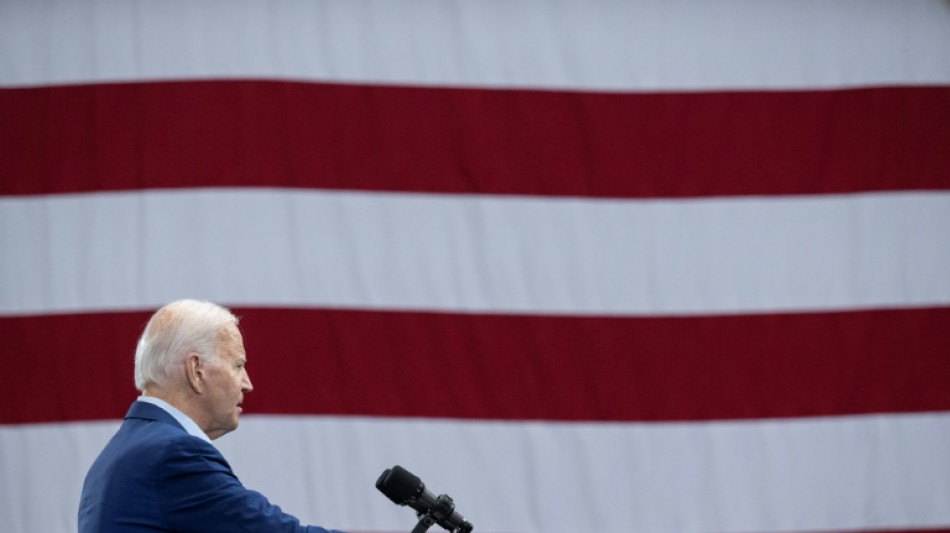
Biden announces curbs on US investments in China / Photo: Jim WATSON - AFP

 Nigeria's Tinubu confirms 32 dead after military plane crash

 'Reckless' AI firms can't control models, says whistleblower

 Switching on brain cells: the Nobel-winning science of optogenetics

 Quebec votes as separatist surge poses test for Canada PM

 Euro slides as concerns about French debt mount
 Former Trump press secretary Leavitt joins Fox News

 Djokovic advances to China Open final as Medvedev out for hitting fan with ball

 Disgraced former US House speaker dies at 84

 Euro slides as worries about French debt grow

 US withdraws all bomber aircraft from UK airbase

 Drone hits Ethiopia IDP camp as fears grow of regional war

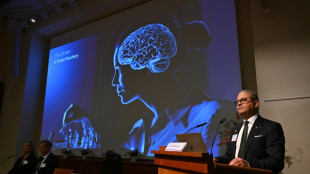
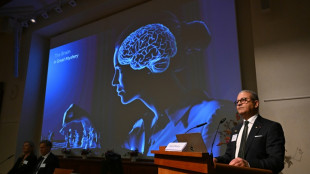 US-German trio wins medicine Nobel for illuminating the brain

 England captain Kane driven by desire for records says Tuchel

 N.Irish court hears challenge to disputed Orangemen parade

 Talking points from the Bahrain Grand Prix in Malaysia

 Yemen, Saudi Arabia target Houthis in new campaign as war escalates

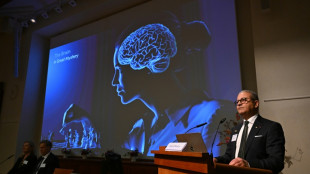 US-German trio wins medicine Nobel for work on optogenetics
 Swiatek, Zheng survive three-set tests in China Open third round
 Hasan says Test cricket momentum turning for Bangladesh

 Intense heat puts births in jeopardy, UN tells Fiji talks
 US arrests woman accused of spying for China on Taiwan leader's family

 Yemen military announces broad strikes against Houthis
 Zuckerberg skewered again on screen in 'The Social Reckoning'

 Fiji urges 'just' climate transition, financing at pre-COP gathering

 Thailand's Jeeno overcomes late wobble to win Lotte Championship

US President Joe Biden on Wednesday issued an executive order aimed at restricting certain American investments in sensitive high-tech areas in China -- a move that could further strain ties between the world's top two economies.
The long-anticipated rules, expected to be implemented next year, target sectors like semiconductors and artificial intelligence, as Washington seeks to limit access to key technologies.
"The commitment of the United States to open investment is a cornerstone of our economic policy and provides the United States with substantial benefits," Biden said in a letter to Congressional leaders announcing the executive order.
"However, certain United States investments may accelerate and increase the success of the development of sensitive technologies and products in countries that develop them to counter United States and allied capabilities."
The program is set to prohibit new private equity, venture capital and joint ventures investments in advanced semiconductors and some quantum information technologies in China, according to the Treasury Department.
"The outbound investment program will fill a critical gap in the United States' national security toolkit," a senior government official said on condition of anonymity.
"What we're talking about is a narrow and thoughtful approach as we seek to prevent (China) from obtaining and using the most advanced technologies to promote military modernization and undermining US national security."
The Treasury is considering a notification requirement for US investments in Chinese entities involved in less advanced semiconductors, and activities relating to certain types of artificial intelligence.
China could exploit US investments to further its ability to produce sensitive technologies critical to military modernization, the Treasury Department said.
But it anticipates creating an exception for certain US investments into publicly traded securities and transfers from US parents to subsidiaries.
- Chilling effect? -
While the volume of dollars or numbers of transactions covered by a ban or notification regime are likely to be quite small, it does not necessarily mean the overall impact will be limited, said Emily Benson, director of the Project on Trade and Technology at the Center for Strategic and International Studies (CSIS).
"It's possible that while they're not directly subject to bans, companies will rethink the nature of their investments and that could have a chilling effect on bilateral investment over time," Benson told AFP.
The latest restrictions come shortly after visits by several high-level US officials to China as Washington and Beijing aim to stabilize ties.
During Treasury Secretary Janet Yellen's trip to the Chinese capital last month, officials from both sides talked about what such curbs might look like, and she told reporters that any new moves would be implemented in a transparent way.
"I emphasized that it would be highly targeted and clearly directed narrowly at a few sectors where we have specific national security concerns," Yellen said at the time.
She added that she wanted to allay fears that Washington would implement measures with broad-based impacts on the Chinese economy.
Nicholas Lardy, nonresident senior fellow at the Peterson Institute for International Economics (PIIE), noted that "the share of investment in China that's been financed by foreign capital in recent years is about one to two percent."
"If you want to have an impact, you've got to get other countries that are making these kinds of investments in China to have a similar regime," he said.
On Wednesday, a senior government official said key allies and partners have recognized the importance of this issue and "some are seeking to align" their policy approaches.
Outbound investment curbs would not represent an all-out effort to prevent Washington and Beijing from cooperating more deeply, Benson noted.
But "the administration has been trying to land high-level meetings with Chinese officials and it will fall on the US to really demonstrate through targeted language that this is not going to cause huge disruption in investment," she said.
O.Farraj--SF-PST