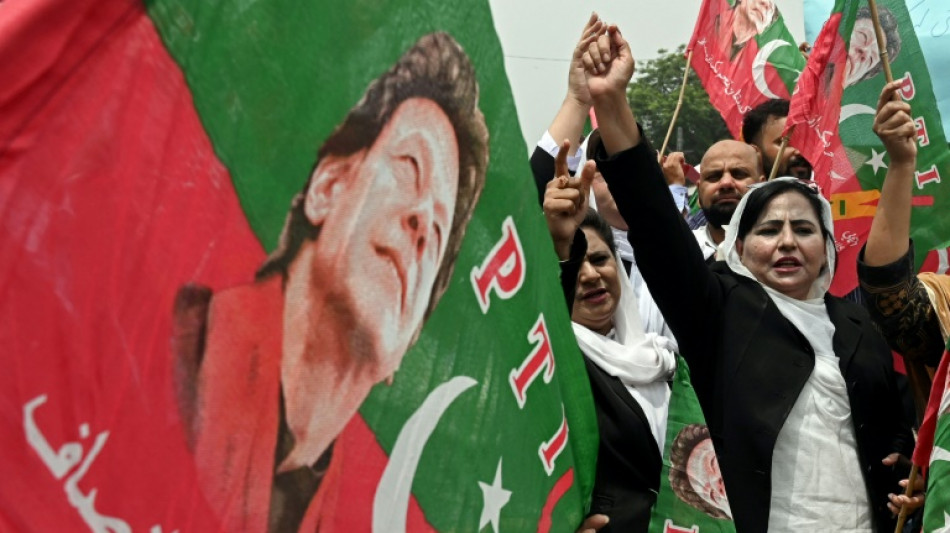
Pakistan parliament holds last session before an election without ex-PM Khan / Photo: Arif ALI - AFP

 Nigeria's Tinubu confirms 32 dead after military plane crash

 'Reckless' AI firms can't control models, says whistleblower
 Switching on brain cells: the Nobel-winning science of optogenetics
 Quebec votes as separatist surge poses test for Canada PM

 Euro slides as concerns about French debt mount
 Former Trump press secretary Leavitt joins Fox News

 Djokovic advances to China Open final as Medvedev out for hitting fan with ball
 Disgraced former US House speaker dies at 84
 Euro slides as worries about French debt grow
 US withdraws all bomber aircraft from UK airbase
 Drone hits Ethiopia IDP camp as fears grow of regional war

 US-German trio wins medicine Nobel for illuminating the brain
 England captain Kane driven by desire for records says Tuchel
 N.Irish court hears challenge to disputed Orangemen parade

 Talking points from the Bahrain Grand Prix in Malaysia

 Yemen, Saudi Arabia target Houthis in new campaign as war escalates
 US-German trio wins medicine Nobel for work on optogenetics
 Swiatek, Zheng survive three-set tests in China Open third round
 Hasan says Test cricket momentum turning for Bangladesh
 Intense heat puts births in jeopardy, UN tells Fiji talks
 US arrests woman accused of spying for China on Taiwan leader's family
 Yemen military announces broad strikes against Houthis
 Zuckerberg skewered again on screen in 'The Social Reckoning'
 Fiji urges 'just' climate transition, financing at pre-COP gathering

 Thailand's Jeeno overcomes late wobble to win Lotte Championship
Pakistan will have a new interim government in days after parliament concluded its last session late Wednesday, with an upcoming election that will not include the country's most popular politician, Imran Khan.
The country has been in political turmoil since the former international cricket star was booted from power in April last year, culminating in his being jailed for graft at the weekend following a months-long crackdown on his party.
"In the past 16 months, our government tried its best to improve the situation and served the nation with full conviction," outgoing Prime Minister Shehbaz Sharif said in his last address to the cabinet.
"This country can’t progress until we have national unity," he said.
The new interim prime minister must be announced within three days of parliament's formal dissolution by the president, and elections held within 90 days -- but the outgoing government has already warned they are likely to be delayed.
The unlikely coalition between Pakistan's usually feuding dynastic parties -- which came together to kick out Khan -- has won little popular support while at the helm of the world's fifth-most populous country.
The economy is still in the doldrums despite a new International Monetary Fund bailout, with crippling foreign debt, soaring inflation and widespread unemployment from factories idled because they lack foreign currency to buy raw materials.
"Economic decisions are invariably tough and often unpopular, requiring a government with a longer tenure to effectively implement them," said Ahmed Bilal Mehboob, president of the Pakistan Institute of Legislative Development and Transparency think tank.
"This election holds significance as it will result in a five-year term for a new government, which ideally should be empowered to make essential decisions vital for economic recovery."
- Election date question mark -
There has been speculation for months that there could be a delay to elections as the establishment grapples to stabilise the country, which is facing overlapping security, economic and political crises.
Data from the latest census carried out in May was finally published at the weekend and the government says the election commission needs time to redraw constituency boundaries -- a sore point for several political parties.
Michael Kugelman, director of the South Asia Institute at the Wilson Center, told AFP that any delay could give time to the main coalition partners, the Pakistan Muslim League-Nawaz (PML-N) and Pakistan Peoples Party (PPP), to figure out how to address the challenge of Khan's Pakistan Tehreek-e-Insaf (PTI) party.
"But in reality, delaying the election could simply anger the public more and galvanise an opposition that has already suffered through months of crackdowns," he said.
The United States said Wednesday it was watching with concern the prospect of election violence.
"We're obviously concerned about any actions -- particularly violent actions -- that can contribute to instability in Pakistan or, frankly, any other country with whom we share a set of common interests when it comes to counterterrorism," said John Kirby, spokesman for the White House National Security Council.
Behind any election in Pakistan lurks the military, which has staged at least three successful coups since the country was forged from the partition of India in 1947.
Khan enjoyed genuine widespread support when he came to power in 2018 but analysts say it was only with the blessing of Pakistan's powerful generals -- with whom he reportedly fell out in the months before his ousting.
He later waged a risky campaign of defiance, accusing the military of meddling in politics and even naming an intelligence officer as being behind a November assassination attempt in which Khan was shot in the leg.
He heaped pressure on the government to hold early elections by staging mass rallies and pulling his MPs from parliament but his gambit ultimately failed.
- Khan crackdown -
Khan, who has been hit with more than 200 legal cases in recent months, has said the charges against him are politically motivated and designed to prevent him from contesting elections.
His first arrest and brief detention in May sparked days of sometimes-violent protests, with unprecedented anger directed towards the military.
It was met with a fierce crackdown that crushed his street power.
An interim government, expected to be made up largely of technocrats, will face a tough task.
"Ultimately, the biggest challenge will be for the caretaker administration to stay above the partisan fray and not be dragged into the political battles being waged between the politicians and the military," Kugelman said.
"It is after all a hyperpartisan and hyperpolarised moment -- not an easy environment for an apolitical caretaker to navigate."
A.Suleiman--SF-PST