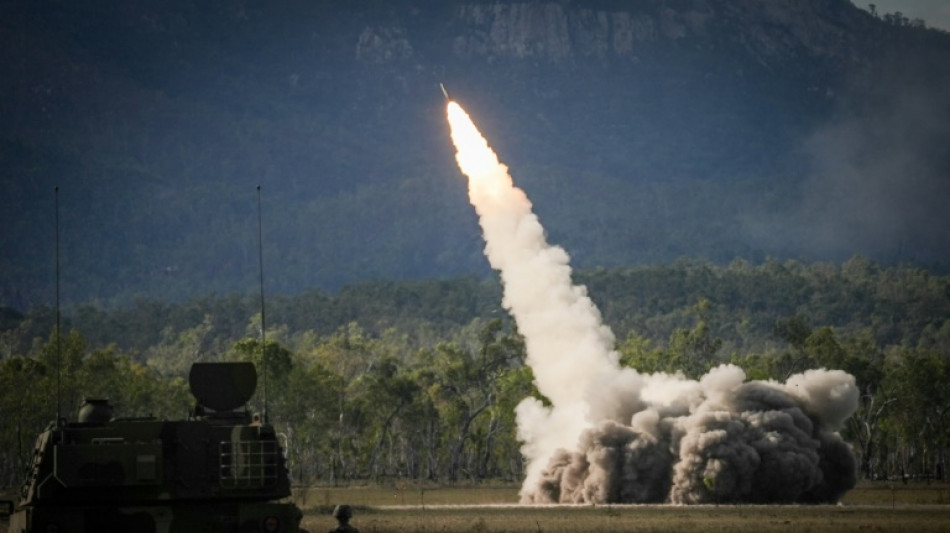
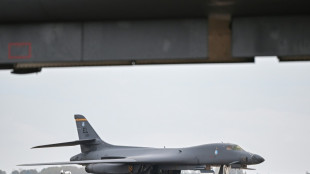
Pentagon eyes missile testing role for Australia / Photo: ANDREW LEESON - AFP/File

 Nigeria's Tinubu confirms 32 dead after military plane crash

 'Reckless' AI firms can't control models, says whistleblower

 Switching on brain cells: the Nobel-winning science of optogenetics

 Quebec votes as separatist surge poses test for Canada PM

 Euro slides as concerns about French debt mount

 Former Trump press secretary Leavitt joins Fox News

 Djokovic advances to China Open final as Medvedev out for hitting fan with ball
 Disgraced former US House speaker dies at 84

 Euro slides as worries about French debt grow

 US withdraws all bomber aircraft from UK airbase

 Drone hits Ethiopia IDP camp as fears grow of regional war

 US-German trio wins medicine Nobel for illuminating the brain

 England captain Kane driven by desire for records says Tuchel

 N.Irish court hears challenge to disputed Orangemen parade

 Talking points from the Bahrain Grand Prix in Malaysia

 Yemen, Saudi Arabia target Houthis in new campaign as war escalates

 US-German trio wins medicine Nobel for work on optogenetics

 Swiatek, Zheng survive three-set tests in China Open third round

 Hasan says Test cricket momentum turning for Bangladesh

 Intense heat puts births in jeopardy, UN tells Fiji talks

 US arrests woman accused of spying for China on Taiwan leader's family

 Yemen military announces broad strikes against Houthis

 Zuckerberg skewered again on screen in 'The Social Reckoning'

 Fiji urges 'just' climate transition, financing at pre-COP gathering

 Thailand's Jeeno overcomes late wobble to win Lotte Championship

Australia could be a testing ground for US hypersonic and other long-range precision weapons under the AUKUS pact, a top Pentagon official told AFP on Wednesday.
US Secretary of the Army Christine Wormuth said Australia's contribution to the three-way AUKUS agreement, which includes Britain, "doesn't always have to be dollars".
The pact was signed in late 2021 and is seen as a way of countering China's growing clout in the Asia-Pacific region.
Work under AUKUS has so far focused on supplying Australia with nuclear-powered submarines, a fleet capable of travelling stealthily over vast distances and striking foes at long range.
But the pact is increasingly focused on developing advanced capabilities such as long-range precision firing, artificial intelligence and hypersonic weapons.
Wormuth said Australia could be a proving ground for these weapons.
"One thing Australia has in spades is long distances and relatively unpopulated land," she told AFP in a telephone interview from Washington.
"A challenge for us in the United States when it comes to hypersonics or even some of our things like the precision strike missile -- which is not a hypersonic weapon but has very long ranges in some of its increments -- for us to find open spaces in the United States where we can actually test these weapons, it's a challenge.
"Australia obviously has a tremendous amount of territory where that testing is a little bit more doable -- so I think that's a unique thing, as an example, that the Australians bring to the table."
China has denounced the AUKUS pact as undermining peace in the region -- a charge that Washington, Canberra and London reject.
But critics have also asked whether it is truly cooperative, or whether the United States, because of its size and overwhelming military power, will dominate.
Wormuth said she expected the two smaller partners to pitch in and "have skin in this game -- and they do".
"The sense I got certainly from talking to senior Australian officials is they're not doing this to make us happy, they're not doing this just for fun," said the Pentagon official, who visited Australia last week for the Talisman Sabre multinational military exercise.
"They're doing this because they see it as in their own national interest in terms of being able to meet the different challenges that they see in the theatre."
- 'Prohibitively expensive' -
Facing Russia's war in Europe, threats from North Korea and a more bellicose China, the United States has sought to bolster its defence alliances and put more advanced capabilities into the hands of allies like Australia, Ukraine and Taiwan.
For much of the Cold War, it was Washington's policy to be able to fight two major wars at once.
Wormuth admitted that today, budget constraints, US public opinion and the relative strength of Russia and China make such a doctrine impossible.
"I think there is a recognition that when you look at the size of our military, when you look at the size of the defence budget that the American taxpayer is willing to pay for, we... don't plan to fight more than one major war at a time," she said.
Instead, the United States hopes its alliance and nuclear arsenal will "discourage opportunistic aggression".
"Given the sophistication of the Russian military and the Chinese military today, to try to size our military to hypothetically handle two wars at a time would be prohibitively expensive".
B.Mahmoud--SF-PST