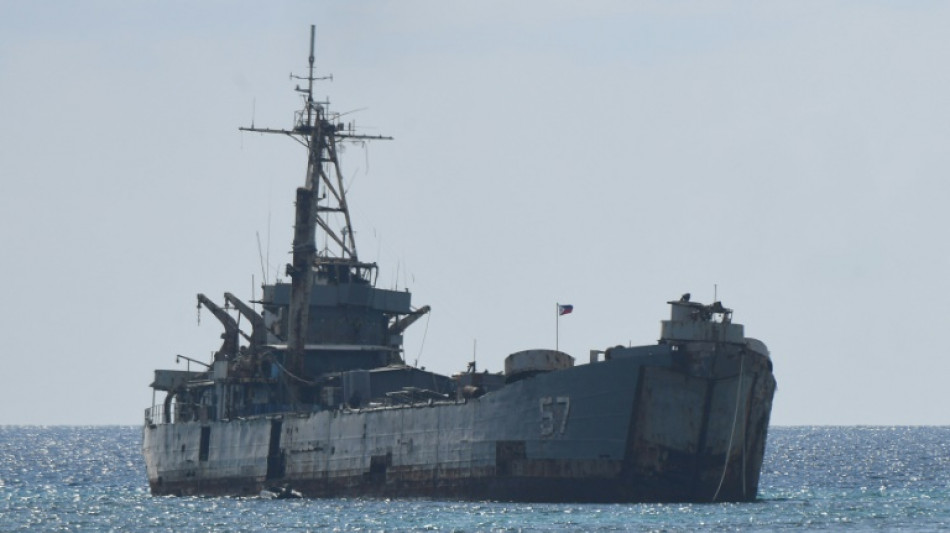
Why is a rusty Philippine warship involved in the South China Sea dispute? / Photo: Ted ALJIBE - AFP

 Trump says US moved bombers from UK base after 'threats'
 Brazilian stocks surge to record after Bolsonaro election lead

 Leaders to visit Pacific atoll at frontline of climate change

 ICC gives more details about arrest warrants for Taliban ministers
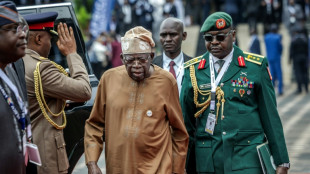 Nigeria's Tinubu confirms 32 dead after military plane crash

 'Reckless' AI firms can't control models, says whistleblower

 Switching on brain cells: the Nobel-winning science of optogenetics

 Quebec votes as separatist surge poses test for Canada PM

 Euro slides as concerns about French debt mount
 Former Trump press secretary Leavitt joins Fox News

 Djokovic advances to China Open final as Medvedev out for hitting fan with ball
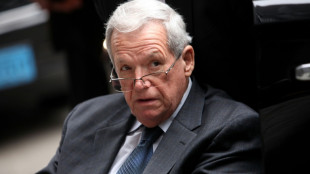 Disgraced former US House speaker dies at 84

 Euro slides as worries about French debt grow
 US withdraws all bomber aircraft from UK airbase
 Drone hits Ethiopia IDP camp as fears grow of regional war

 US-German trio wins medicine Nobel for illuminating the brain
 England captain Kane driven by desire for records says Tuchel

 N.Irish court hears challenge to disputed Orangemen parade

 Talking points from the Bahrain Grand Prix in Malaysia

 Yemen, Saudi Arabia target Houthis in new campaign as war escalates

 US-German trio wins medicine Nobel for work on optogenetics

 Swiatek, Zheng survive three-set tests in China Open third round

 Hasan says Test cricket momentum turning for Bangladesh

 Intense heat puts births in jeopardy, UN tells Fiji talks

 US arrests woman accused of spying for China on Taiwan leader's family

A crumbling World War II-era Philippine navy vessel stranded on a submerged reef in the South China Sea has long been a flashpoint between Manila and Beijing in their territorial dispute over the waters.
Tensions flared again on Saturday when the China Coast Guard allegedly blocked and fired water cannon at Philippine vessels seeking to deliver food, fuel and water to Filipino troops stationed on the BRP Sierra Madre at Second Thomas Shoal.
AFP looks at how a rusting hulk named after a Philippine mountain range ended up at the centre of the latest diplomatic spat over the South China Sea.
- What is the Sierra Madre? -
The 100-metre (328-foot) BRP Sierra Madre vessel began its life as the US tank-landing ship USS LST-821, which served in World War II.
It was later renamed the USS Harnett County and deployed during the Vietnam War, where it was used as a helicopter gunship base, according to the United States Naval Institute.
After the war, it was acquired by the Philippine Navy and later renamed the BRP Sierra Madre.
- Why is it stuck on a reef? -
The Philippine military deliberately grounded the BRP Sierra Madre on Second Thomas Shoal in the late 1990s in an effort to check the advance of China in the hotly contested waters.
The unorthodox tactic to establish Philippine presence on the shoal was in response to China's occupation of the nearby and then-uninhabited Mischief Reef, also claimed by Manila, a few years earlier.
Beijing has turned Mischief Reef and other reefs and outcrops into artificial, militarised islands to assert its claims in the waters.
Second Thomas Shoal, located in the Spratly Islands, is about 200 kilometres west of the western Philippine island of Palawan and more than 1,000 kilometres from China's nearest major landmass of Hainan island.
- What's happening there? -
China claims almost the entire South China Sea, which includes Second Thomas Shoal, and deploys hundreds of vessels there to patrol the waters and swarm reefs.
Beijing has ignored a 2016 international court ruling that its assertion has no legal basis.
Manila says China's coast guard and navy vessels routinely block or shadow Philippine ships patrolling the waters.
They also regularly attempt to disrupt re-supply operations to the tiny Philippine garrison on Second Thomas Shoal, according to Manila.
The handful of Philippine marines deployed on the BRP Sierra Madre depend upon those resupply missions to survive their remote assignment.
The Philippine Coast Guard fears China will seek to occupy Second Thomas Shoal if the military detachment leaves.
- Why does all this matter? -
The South China Sea is seen as a powder keg and many fear a miscalculation or accident could ignite a military conflict.
The Philippines is poorly armed, but the United States has said it would defend its longtime ally in the South China Sea under a decades-old mutual defence pact.
The US has no territorial claim over the waters, but has persisted in conducting its own patrols there, angering Beijing.
Washington says this is to ensure what it terms "freedom of navigation" in the sea, through which trillions of dollars in trade passes annually.
J.AbuShaban--SF-PST