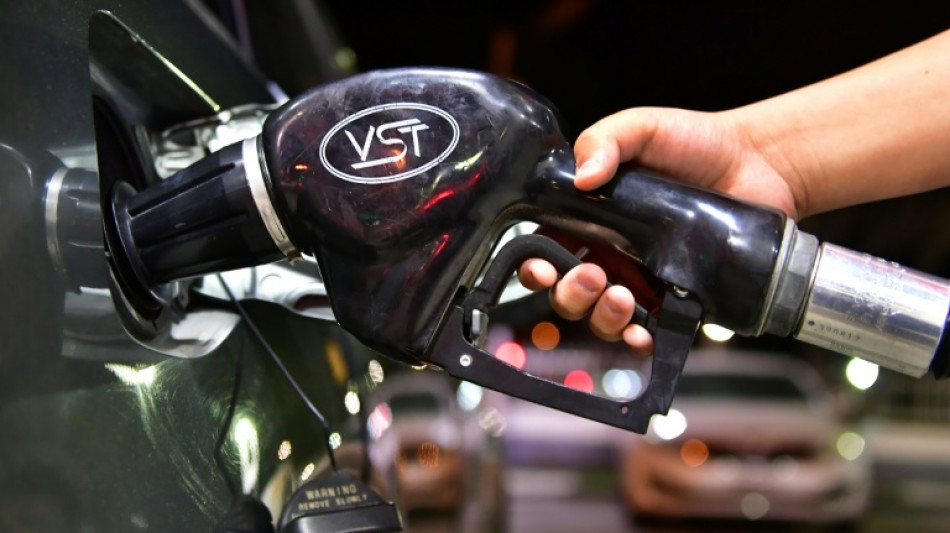
Russian oil price cap under growing scrutiny as prices rise / Photo: Frederic J. BROWN - AFP

 Trump says US moved bombers from UK base after 'threats'
 Brazilian stocks surge to record after Bolsonaro election lead

 Leaders to visit Pacific atoll at frontline of climate change

 ICC gives more details about arrest warrants for Taliban ministers
 Nigeria's Tinubu confirms 32 dead after military plane crash

 'Reckless' AI firms can't control models, says whistleblower

 Switching on brain cells: the Nobel-winning science of optogenetics

 Quebec votes as separatist surge poses test for Canada PM

 Euro slides as concerns about French debt mount

 Former Trump press secretary Leavitt joins Fox News

 Djokovic advances to China Open final as Medvedev out for hitting fan with ball

 Disgraced former US House speaker dies at 84

 Euro slides as worries about French debt grow
 US withdraws all bomber aircraft from UK airbase

 Drone hits Ethiopia IDP camp as fears grow of regional war

 US-German trio wins medicine Nobel for illuminating the brain
 England captain Kane driven by desire for records says Tuchel

 N.Irish court hears challenge to disputed Orangemen parade

 Talking points from the Bahrain Grand Prix in Malaysia

 Yemen, Saudi Arabia target Houthis in new campaign as war escalates

 US-German trio wins medicine Nobel for work on optogenetics

 Swiatek, Zheng survive three-set tests in China Open third round

 Hasan says Test cricket momentum turning for Bangladesh

 Intense heat puts births in jeopardy, UN tells Fiji talks
 US arrests woman accused of spying for China on Taiwan leader's family

When the West rolled out its unprecedented price cap on Russian oil late last year, it hoped to starve Moscow of much-needed revenue while minimising the impact on other countries.
Eight months on, it is seen in Western capitals as a successful part of the squeeze on Russian President Vladimir Putin, but a policy that has yet to be properly tested, according to energy analysts.
With oil prices on the rise after months in the doldrums, the cap's impact -- and limits -- could now come into clearer focus.
"We also know, like with all of our measures, Russia will attempt to evade the price cap," Eric Van Nostrand, the US Treasury's acting assistant secretary for economic policy, said in a speech Thursday.
"We remain vigilant in monitoring oil markets and the whole coalition remains focused on enforcing our sanctions."
The mechanism, a price ceiling of $60 per barrel on Russian oil, was agreed and introduced by the European Union, G7 and Australia, in early December.
Companies based in EU and G7 member states and Australia are banned from providing services enabling maritime transport, such as insurance, of oil above that price.
It aims to restrict Russia's revenue as punishment for its invasion of Ukraine, while making sure Moscow keeps supplying the global market.
"Russia's revenue is, you know, nearly 50 percent lower than it was a year ago," a senior US official told reporters Tuesday.
"We're not evaluating the success of this policy based on how many molecules of oil are actually traded under $60," he added.
"We're evaluating the success of this based on whether Russia's aggregate revenue is suffering relative to an unrestricted market."
- 'Not been tested' -
"The G7 price cap has done what it was designed to do -- restrict Russian revenues while keeping oil in the market," Matthew Holland, an analyst at Energy Aspects, told AFP.
Helge Andre Martinsen, an analyst at DNB, noted Russian oil export volumes have been "surprisingly stable" and the price cap had "really not been tested due to a softening oil market".
Moscow had taken its own steps to soften the impact of the price cap, including before its introduction eight months ago.
The US official noted it had offered steeply discounted long-term contracts, around 30 percent below Brent Crude prices, to buyers in southeast Asia and India, ahead of December 2022.
Since then North Sea Brent Crude, the key benchmark for Europe, has remained below the $90 mark, while its US equivalent, the West Texas Intermediate (WTI), has not exceeded $85 a barrel.
Meanwhile Russian Urals, Moscow's oil benchmark, has mostly traded below the mandated $60-a-barrel price.
However, prices have been on the rise in recent weeks, with production cuts by Russia and other members of OPEC+ blamed in part.
In mid-July, Urals crude broke the $60-a-barrel barrier, according to reports based on data from pricing agency Argus Media.
- 'Nervous' -
Stephen Innes, analyst at SPI Asset Management, said the Russian production cut was "payback" on the West for its support for Ukraine.
"They knew it would drive oil prices higher in the middle of peak driving US season while China was filling every teapot refinery to the brim," he added.
But with prices on the rise, "it might be the first real test of the price cap", he added -- a forecast echoed by Martinsen.
Holland argues Urals breaching the cap "will reduce interest in Russian oil from some buyers", citing India in particular, which the analyst said gets "nervous about sanctions risks".
Moreover, the cap has also forced Russia to build up a fleet that exists outside of the G7 to transport its oil.
"Investments the Russian government makes into the shadow fleet or into its own insurance companies in order to sell above the cap, for example, draw funding away from its war chest as the Kremlin's cost of continuing the war in Ukraine continues to rise," said Van Nostrand.
For Han Tan, analyst at Exinity, "the true results from this price cap, as desired by the West, will only be manifested if there's a meaningful pullback in Russia's war efforts".
L.Hussein--SF-PST