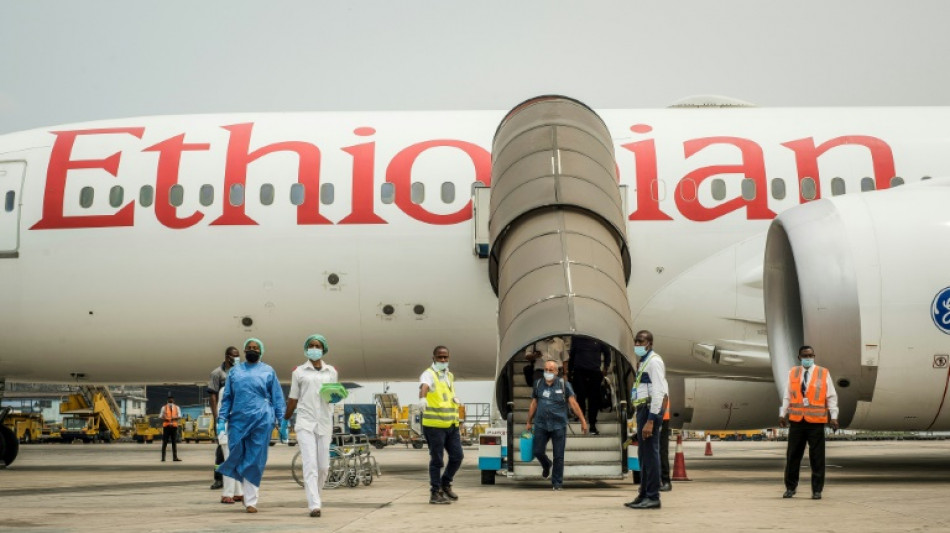
Ethiopian Airlines facing 'real challenges' despite Covid success / Photo: Arsene MPIANA - AFP

 Leaders visit Pacific atoll at frontline of climate change

 Yemen's Houthis claim striking Riyadh airport, other Saudi sites

 Best-selling British author Jeffrey Archer dies aged 86

 Military plane crash kills 32 in Nigeria

 Olise powers France to win over Belgium in Nations League

 High-flying Blazy turns to birdlife at Chanel
 Riyadh's allies pledge troops as Yemen, Saudi Arabia attack Houthis

 Clashes erupt outside Kosovo parliament over war crimes court

 Milan's Saelemaekers suffers ankle setback, faces lengthy spell out

 Rubio arrives in Iceland to push for greater US presence in Arctic

 Putin allows Italy's UniCredit to sell part of Russian business

 Djokovic into China Open final as Medvedev out for hitting fan with ball

 ICC unseals arrest warrants for Taliban education ministers

 Modric hopes fans back Croatia against Spain after England shame

 Bolsonaro rides right-wing surge into Brazil's election runoff

 Turkey blocks X account of British reporter

 Ukraine says using AI robot guns to shoot down new Russian drones
 At Oct 7 memorial, Netanyahu says will be no Hamas rule in Gaza

 Ukraine blames Russia for deadly sinking of Turkish ship in Black Sea
 UN rights council slams Taliban's 'oppression' of women
 Norway eyes partial ban of smart glasses

 Two dead after ship catches fire, sinks in Black Sea

 Spain's PM calls snap election after housing bill defeat

 STARCARES Equips Seven Foster Homes for Children and Young People in Tanzania

 Alleged Indian leader of neo-Nazi child abuse ring goes on trial in Paris

Ethiopian Airlines successfully weathered the Covid pandemic by shifting its strategy, but Africa's only profitable carrier still faces "real challenges" in sourcing parts and staying competitive at a time of inflation, its CEO told AFP.
The 2022-2023 financial year ending June 30 "was a very successful year," Mesfin Tasew said in an interview in Ethiopia's capital Addis Ababa.
"We carried 13.7 million passengers, which is a 57-percent growth compared to the previous year and 10 percent higher than pre-Covid. We also carried 740,000 tonnes of cargo, which is nearly double pre-Covid," he said.
The state-owned company generated $6.1 billion in revenue, up 20 percent compared to the previous year and nearly 50 percent more than pre-Covid earnings.
The airline turned to freight when passenger traffic fell, including converting some of its passenger aircraft to transport cargo.
"The figures indicate that we have fully recovered from the impacts of Covid," said Mesfin, who was appointed to the job in March 2022.
But, he said, the pandemic's effects can still be felt in the form of "high inflation... which translates into high operating costs for us (and) high fuel price."
The disruption to the global supply chain caused by Covid-19 has also led to a shortage of spare parts required for repairs.
"Sometimes we have difficulty flying all airplanes, we have to ground some of the aircrafts until we get the parts", he said.
He added that he expects the problem to be resolved within three years, "but today it is a real challenge."
- Court case -
As the industry recovers from coronavirus and more planes take to the skies, potential overcapacity may lead to a fall in airfares, he said.
The company "will have to re-evaluate its cost structure and... work very hard on our cost-saving initiative to stay still competitive," he said.
Ethiopian Airlines is also facing other challenges, including a lawsuit filed by a rights group that claims the carrier discriminated against travellers from the war-scarred region of Tigray.
The airline resumed air links between the capital Addis Ababa and Tigray after a peace deal was signed in November 2022 ending two years of conflict between the federal government and Tigrayan rebels.
Mesfin declined to answer any questions related to the case. The airline has previously denied claims that it had transported soldiers and weapons to Tigray during the war.
The controversies have not dented the carrier's bottom line, with Mesfin saying the airline intended to "attain certain key milestones by 2035".
The objectives include increasing its annual passenger traffic to over 60 million, expanding its list of international destinations from 130 to 207 and nearly doubling its fleet to 271 planes.
- Carbon footprint -
The company is also developing a sustainability strategy to meet the industry's target of net zero emissions by 2050, he said.
"The studies so far indicate that more than 60 percent of this carbon reduction will come from use of sustainable aviation fuel," he said.
But the limited availability and high cost of SAF, which is made from sources such as municipal waste and agricultural waste, are major hurdles.
"Today it is twice as expensive as a jet fuel -- jet fuel today constitutes for us about 40 percent of our total cost. If we wanted to use SAF at (the) current price, our costs would be out of proportion," he said.
Furthermore, there are only "a few (SAF) manufacturers in Europe and the US, none in Africa as far as we know, so we cannot start (using) it now."
Even so, he remained optimistic that technological advances will one day enable manufacturers "to produce SAF at a price... which will be manageable for us."
Q.Najjar--SF-PST