Calls for Haiti intervention mount, but no one wants to lead / Photo: Richard Pierrin - AFP

 American Nobel laureate in medicine hopes to illuminate the brain
 Trump approves firing squad for convicted US military base shooter

 Grappling with 'homework scams,' US universities shun AI detectors
 Separatists win Quebec election in test for Canada PM
 Leaders visit Pacific atoll at frontline of climate change

 Yemen's Houthis claim striking Riyadh airport, other Saudi sites

 Best-selling British author Jeffrey Archer dies aged 86

 Military plane crash kills 32 in Nigeria

 Olise powers France to win over Belgium in Nations League
 High-flying Blazy turns to birdlife at Chanel
 Riyadh's allies pledge troops as Yemen, Saudi Arabia attack Houthis

 Clashes erupt outside Kosovo parliament over war crimes court

 Milan's Saelemaekers suffers ankle setback, faces lengthy spell out
 Rubio arrives in Iceland to push for greater US presence in Arctic
 Putin allows Italy's UniCredit to sell part of Russian business
 Djokovic into China Open final as Medvedev out for hitting fan with ball

 ICC unseals arrest warrants for Taliban education ministers
 Modric hopes fans back Croatia against Spain after England shame

 Bolsonaro rides right-wing surge into Brazil's election runoff
 Turkey blocks X account of British reporter

 Ukraine says using AI robot guns to shoot down new Russian drones
 At Oct 7 memorial, Netanyahu says will be no Hamas rule in Gaza
 Ukraine blames Russia for deadly sinking of Turkish ship in Black Sea
 UN rights council slams Taliban's 'oppression' of women
 Norway eyes partial ban of smart glasses

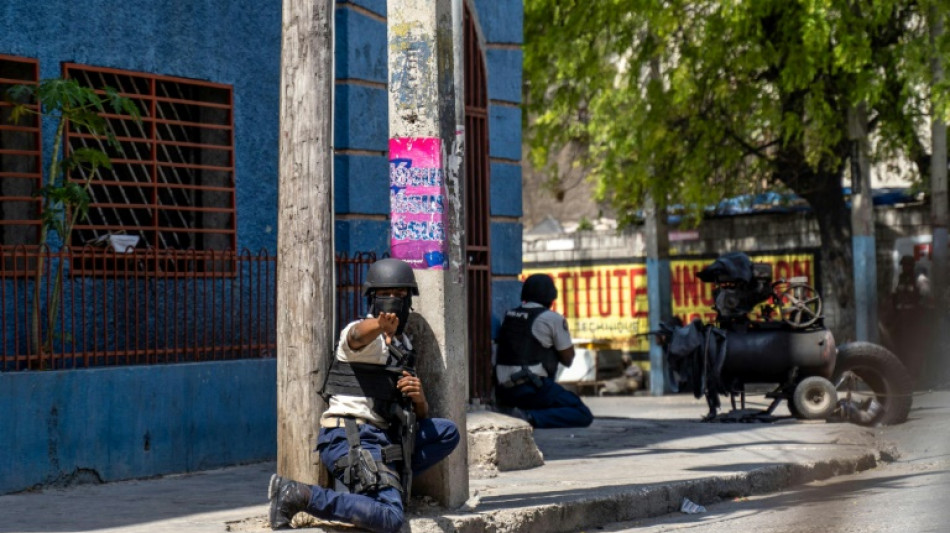
Haunted by previous failures in Haiti and worried about getting stuck in a deadly quagmire, the international community is reluctant to answer a UN call for a special intervention force, experts say.
"There is a strong case for deploying an international force to Haiti, but it could be a very risky mission," said Richard Gowan, an analyst at the International Crisis Group.
"The gangs are well-armed and there is no clear exit strategy if a mission does deploy," he told AFP.
United Nations chief Antonio Guterres, relaying a request from Haitian Prime Minister Ariel Henry, began calling in October 2022 for an international, non-UN deployment to help support police who have been overwhelmed by gangs.
Months later, in mid-July, the UN Security Council adopted a resolution urging the international community "to provide security support to the Haitian National Police," including through "the deployment of a specialized force," but stopped there.
But while countries like Kenya and Jamaica have said they would consider staffing such a mission, no one has stepped up to lead it.
Not the United States, with its checkered history of intervention in the country, and which has firmly said it doesn't want to put Americans in danger. Canada too is out, though it had at one point considered taking the lead, as had Brazil.
"We continue to work with partner nations to identify a lead nation for a police-driven multinational force," State Department spokesman Matt Miller said. "It is urgently needed."
Previous failures by the international community in Haiti hang over calls for an intervention. At the same time, Haiti's gangs -- which control up to 80 percent of Port-au-Prince -- would be formidable opponents.
- An 'illegitimate' Haitian government? -
"They're afraid of the gangs, that they would have to confront the gangs with armed force," said Walter Dorn, a professor of defense studies at the Royal Military College of Canada and the Canadian Forces College.
Another fear: casualties among intervention forces, and collateral damage.
"Urban warfare is very difficult," Dorn added. "And the danger of killing innocent civilians would be great."
"However, I think that it's possible" an international force could prevail against the gangs, Dorn said, estimating it would take at least 7,000 soldiers and as many police officers -- roughly the same amount of people deployed in the UN's last peacekeeping force in Haiti, from 2004 to 2017.
William O'Neil, an independent UN expert on Haiti, estimated 1,000-2,000 people would be needed -- numbers Guterres said "do not reflect any exaggeration."
But huge parts of any mission remain unknown, experts say, such as a precise mandate or what would happen if a proper economic revival and political transition are not carried out in parallel.
In a country where elections haven't been held since 2016, and the last president, Jovenel Moise, was assassinated in 2021, many Haitians don't consider Prime Minister Henry legitimate.
Those in the opposition argue that an intervention would be tantamount to support for "a government that is illegitimate," said Robert Fatton, of the University of Virginia.
- Previous failures -
Previous interventions have left a bitter taste among the Haitian population. During the last UN peacekeeping force's deployment, 10,000 people died from cholera, brought by Nepalese peacekeepers.
While Guterres has called for a non-UN force, the Security Council has asked him to present by mid-August a report on all possible options, including a UN-led mission.
But "there is unlikely to be a return to a traditional form of peacekeeping in Haiti," a UN source told AFP. If it ended up being a UN force, "it would be a police force and it wouldn't look like anything we have on the books today."
"There is still some hope member states will make a decision on a non-UN force, which still remains the preferred option," the source said.
In any case, an intervention would need a green light from the Security Council, where China remains skeptical, insisting instead on stopping the flow of arms trafficked to Haiti from the southern US state of Florida.
"I think the Chinese are quite pleased to see the US grappling with a problem on America's doorstep at the UN," said Gowan of the International Crisis Group.
Though when -- or if -- the time comes to vote on an intervention, he doubts Beijing would actually use its veto.
Q.Bulbul--SF-PST