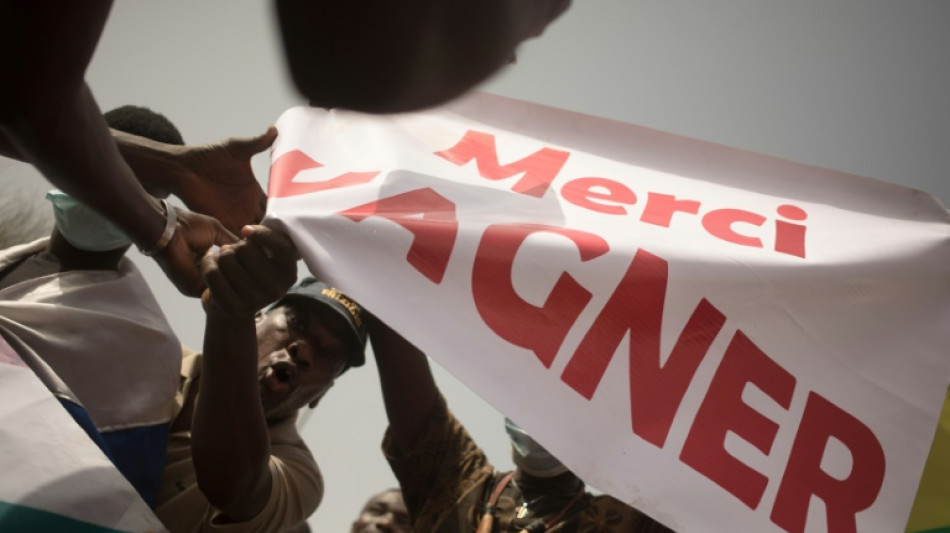
Russian paramilitaries to stay in Africa despite Wagner mutiny / Photo: FLORENT VERGNES - AFP/File

 American Nobel laureate in medicine hopes to illuminate the brain
 Trump approves firing squad for convicted US military base shooter

 Grappling with 'homework scams,' US universities shun AI detectors
 Separatists win Quebec election in test for Canada PM
 Leaders visit Pacific atoll at frontline of climate change
 Yemen's Houthis claim striking Riyadh airport, other Saudi sites
 Best-selling British author Jeffrey Archer dies aged 86
 Military plane crash kills 32 in Nigeria

 Olise powers France to win over Belgium in Nations League
 High-flying Blazy turns to birdlife at Chanel
 Riyadh's allies pledge troops as Yemen, Saudi Arabia attack Houthis
 Clashes erupt outside Kosovo parliament over war crimes court
 Milan's Saelemaekers suffers ankle setback, faces lengthy spell out
 Rubio arrives in Iceland to push for greater US presence in Arctic
 Putin allows Italy's UniCredit to sell part of Russian business
 Djokovic into China Open final as Medvedev out for hitting fan with ball

 ICC unseals arrest warrants for Taliban education ministers
 Modric hopes fans back Croatia against Spain after England shame
 Bolsonaro rides right-wing surge into Brazil's election runoff
 Turkey blocks X account of British reporter
 Ukraine says using AI robot guns to shoot down new Russian drones
 At Oct 7 memorial, Netanyahu says will be no Hamas rule in Gaza
 Ukraine blames Russia for deadly sinking of Turkish ship in Black Sea
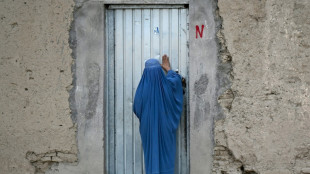 UN rights council slams Taliban's 'oppression' of women
 Norway eyes partial ban of smart glasses
Ever since Wagner founder Yevgeny Prigozhin staged a mutiny in Russia last month, questions have been raised over the future of his group in Africa, the cradle of its wealth and notoriety.
Prigozhin's dramatic rebellion ended in a deal by which he was expected to move to neighbouring Belarus with some of his men.
Details about the accord remain sketchy, but as far as Africa is concerned, Wagner can count on its geopolitical and economic weight to survive in one shape or another.
"Let's continue to train, improve our skills, and then off to the next adventure to Africa," Prigozhin said last week, according to a video, not authenticated by AFP, posted on Telegram by a Wagner-linked account.
As African countries and Russia prepare for a summit in St. Petersburg, here is a snapshot of Wagner's presence on the continent:
- Range of services -
Wagner is openly active in at least four countries in Africa, typically shoring up fragile regimes in exchange for minerals and other natural wealth.
In Mali, Wagner offers a full menu of services. Its paramilitaries protect the current regime, conduct military operations and training and advise on the revision of mining laws and even of the constitution.
In Sudan, Wagner has been accused by observers of being heavily involved in the flourishing and illegal gold trade.
It keeps in close contact with the Rapid Support Forces, a paramilitary unit locked in a bloody power struggle with army chief Abdel Fattah al-Burhan.
In the Central African Republic (CAR), Russian paramilitaries have been present since 2018, supporting President Faustin Archange Touadera in return for concessions to exploit gold, diamonds and other minerals.
In Libya, Wagner is close to Khalifa Haftar, a strongman based in the east of the country. According to Pauline Bax, Africa Program Deputy Director at the International Crisis Group, several hundred Wagner troops are deployed to protect military bases and oil installations there.
- Sanctions -
The group is frequently accused of atrocities and looting of natural resources in Africa, interfering in local politics in numerous conflicts and running anti-Western information campaigns, especially in francophone West Africa.
The United States has imposed sanctions on Prigozhin and labelled his group a transnational criminal organisation.
After an independent UN expert accused the CAR army and its Russian allies of acts of violence, the EU announced new sanctions against several Wagner leaders there.
Last week, Britain imposed sanctions on 13 people or businesses with alleged links to Wagner abuses, including torture and executions, in Mali and the CAR, and accused of threatening the peace in Sudan.
- Deniability -
Created in the early 2010s, Wagner quickly established itself as an African proxy army for Russia, allowing Moscow to officially deny any involvement in its operations.
"Wagner is neither an army unit nor an entirely private entity," said Maxime Audinet, researcher at the French war college's IRSEM institute.
"It serves the official interests of Moscow, but also Prigozhin's personal ambitions. It's a thin line," he told AFP, in remarks that were made before the mutiny.
- Post-mutiny change? -
Wagner's model will need to be reassessed in the light of the mutiny and the settlement, say analysts.
The group is self-financing, at least in terms of paying its, men but still needs logistics support from the Russian defence ministry, said Bax.
This could give Moscow leverage to impose a more loyal figure at Wagner's helm, and perhaps order a name change or even replace the group with a different Russian outfit providing similar services.
Russian Foreign Minister Sergei Lavrov said Wagner's future in Africa was "above all up to the governments of the countries concerned."
But Aditya Pareek at Janes, a privately-owned British open-source intelligence company, said it was unlikely that Russia could ever control Wagner completely.
"Prigozhin's faction is unlikely to prioritise furthering the Kremlin's interests," she said.
- Enduring business model -
Whatever happens to Wagner, its business concept is probably here to stay, said Bax.
"Wagner has introduced a model that seems to work for at least two countries," she said, in reference to Mali and the CAR.
"Even if Wagner ceases to exist, other companies will try to fill the void."
This theory is backed by African governments' decades-long tradition of using mercenaries, often to compensate for their armies' weakness.
The "ambiguous international legalese" defining what is a mercenary "makes Africa an all-too-attractive place to do business with flexible morals," researcher Amanda Brooke Kadlec wrote in New Lines Magazine.
"If the Wagner Group or other Russian competitors are perceived as incompetent or unreliable because of the chaos at home, there are plenty of other options out there."
E.Aziz--SF-PST