Ukraine's war orphans turn to family to survive / Photo: Sergei SUPINSKY - AFP

 American Nobel laureate in medicine hopes to illuminate the brain
 Trump approves firing squad for convicted US military base shooter

 Grappling with 'homework scams,' US universities shun AI detectors
 Separatists win Quebec election in test for Canada PM

 Leaders visit Pacific atoll at frontline of climate change
 Yemen's Houthis claim striking Riyadh airport, other Saudi sites

 Best-selling British author Jeffrey Archer dies aged 86
 Military plane crash kills 32 in Nigeria

 Olise powers France to win over Belgium in Nations League
 High-flying Blazy turns to birdlife at Chanel
 Riyadh's allies pledge troops as Yemen, Saudi Arabia attack Houthis

 Clashes erupt outside Kosovo parliament over war crimes court
 Milan's Saelemaekers suffers ankle setback, faces lengthy spell out
 Rubio arrives in Iceland to push for greater US presence in Arctic
 Putin allows Italy's UniCredit to sell part of Russian business
 Djokovic into China Open final as Medvedev out for hitting fan with ball
 ICC unseals arrest warrants for Taliban education ministers
 Modric hopes fans back Croatia against Spain after England shame

 Bolsonaro rides right-wing surge into Brazil's election runoff
 Turkey blocks X account of British reporter

 Ukraine says using AI robot guns to shoot down new Russian drones
 At Oct 7 memorial, Netanyahu says will be no Hamas rule in Gaza
 Ukraine blames Russia for deadly sinking of Turkish ship in Black Sea
 UN rights council slams Taliban's 'oppression' of women
 Norway eyes partial ban of smart glasses
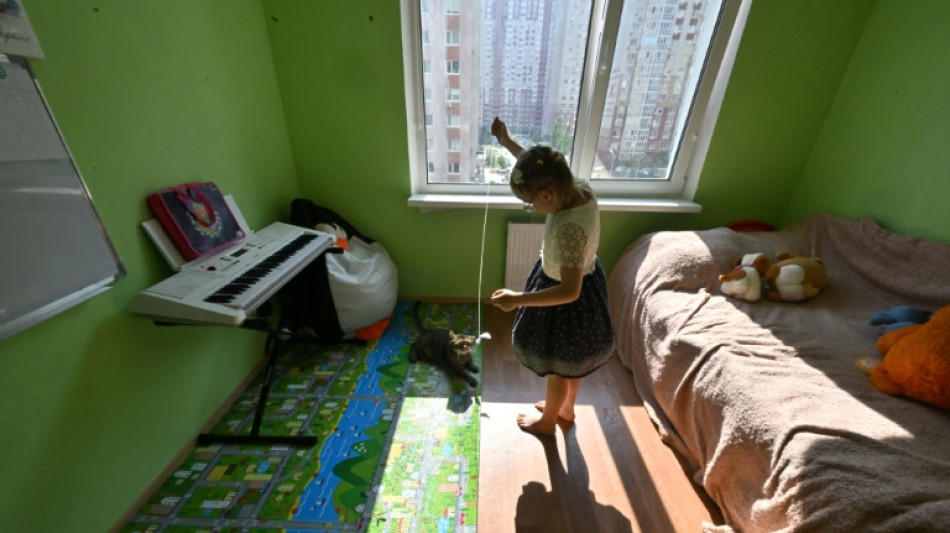
Karina, a seven-year-old war orphan who lives in Kyiv with her aunt, has vivid memories of life before her parents were killed fleeing invading Russian forces.
"I remember mom and dad. Me and dad ate sausages," she says with a giggle. The sausages "only with dad", she stresses, adding: "I helped mum wash the dishes and clean up."
The swelling number of orphans like Karina has added to the pressure on a care system already in need of reform before Russia invaded Ukraine in February last year.
More than 9,000 children -- many of them traumatised by their experiences in the conflict -- have lost their parents due to the war, according to Ukrainian social services.
Karina's mother and father died as the family tried to flee their village in the besieged northern region of Chernigiv in the early stages of the conflict.
An explosion -- potentially caused by a land mine or a shell -- killed her parents and catapulted Karina out of the car they were in.
"She had a concussion because she flew out the window," says Karina's aunt Ruslana Nosenko.
"On her back... the burns were dark, dark blue. They have not healed completely," says Nosenko, 22, who took Karina in after she had been treated in hospital in Chernigiv.
"Physically, I think she was very, very lucky, but psychologically she suffered a lot."
- Family home -
Over 100,000 children lived in Ukraine's institutional orphanages before the war -- the largest number in Europe after Russia.
Now, authorities are looking to place more children in foster homes and with families, providing financial incentives for carers.
But despite moves to make adoption easier, the process still involves too many hurdles for Nosenko.
"You need to have an official income, unlike mine," says Nosenko, who studies in Kyiv and has a child of her own.
"I simply couldn't process the adoption, and at this stage I can't process it either, because I'm a student."
At their Kyiv apartment, Karina practices playing the keyboard for Nosenko, who acts as the girl's guardian in lieu of adoption.
A month after the incident, Karina was reunited with her aunt, who broke the news of her parents' death to the girl.
"She was very nervous. She cried a lot," Nosenko says, recalling how Karina would wake up in the night sobbing.
Nosenko took Karina to a psychologist, who encouraged her to write letters to her parents to work through the trauma.
Protecting children from the "psychological consequences" of the war has become a challenge, according to Ukraine's first lady Olena Zelenska, who has campaigned on the issue.
The horrors of war meant "a large number of our children, like adults, have anxiety disorders", Zelenska said.
- Back to Bucha -
Ukrainian armed forces found the corpse of Nazar Gavrilyuk's father when they retook Bucha from occupying Russian forces, along with the bodies of scores of other civilians.
"It was my brother's friend, he went into the yard and saw three bodies," says the 18-year-old from his home in the town, just outside Kyiv, where Russian forces are accused of war crimes.
Like Karina, Nazar has found a new home with his grandmother after losing his father.
"When I came back here, the whole street was bombed out," recounted Nazar, after sheltering in west Ukraine during Russia's capture of Bucha.
"I walked down the street and there were dead people lying on it, two in a ditch and another dead person further down."
His own father was found on the ground next to Nazar's uncle and another "unknown person" from neighbouring Irpin.
"His teeth were knocked out, maybe they were beaten, we don't know anything," says Nazar's grandmother Olga Gavrilyuk, pulling up a of her son's corpse on her phone.
The Russian soldiers in Bucha quickly lost hope of taking Kyiv in a matter of days and defeating Ukraine, says Nazar.
"And so they went after peaceful people."
A.AlHaj--SF-PST