Biden seeks to strip Russia of favored trade status

 South African rugby player's death due to 'aortic dissection'

 France's Macron lands in Riyadh on surprise 'solidarity' visit
 Around the world, far right blames immigrants for French protests
 South Africa eases fuel pain as growth slows

 Woody Allen shoots new movie in Madrid

 Nvidia's Huang urges Europe to go all in on AI

 Five things to know as French bond yield tops 5%

 'Complete threat' Ngumoha excites Liverpool captain Van Dijk

 'The fishing's terrible': Deforestation devastates C.Africa river

 France's tourism sector worried about impact of riots

 Macron takes aim at Trump for using France riots for election gain
 North Korea says 'new firepower units' in place, loudspeakers to return
 Indonesia leader hits out at market downgrade warning

 Macron slams 'stupid' comments based on AI videos by leaders on France riots

 'Public health crisis': Indonesians seek fire relief from state

 British Museum sells second set of Bayeux exhibition tickets

 Australian lawmaker loses both legs after 'targeted' attack

 UK approves drilling in controversial Jackdaw gas field

 Carrefour shares plunge after profit warning on French protests
 North Korea says 'new firepower units' in place after border threat

 Australia lawmaker loses both legs after 'targeted' attack

 Director Nick Paley channels childhood fears in new thriller 'Phony'

 'Daily struggle': Cubans dig wells in search of water

 Prized wild pepper at risk in Madagascar's shrinking forests
 World falling 'dangerously short' on climate action: UN chief

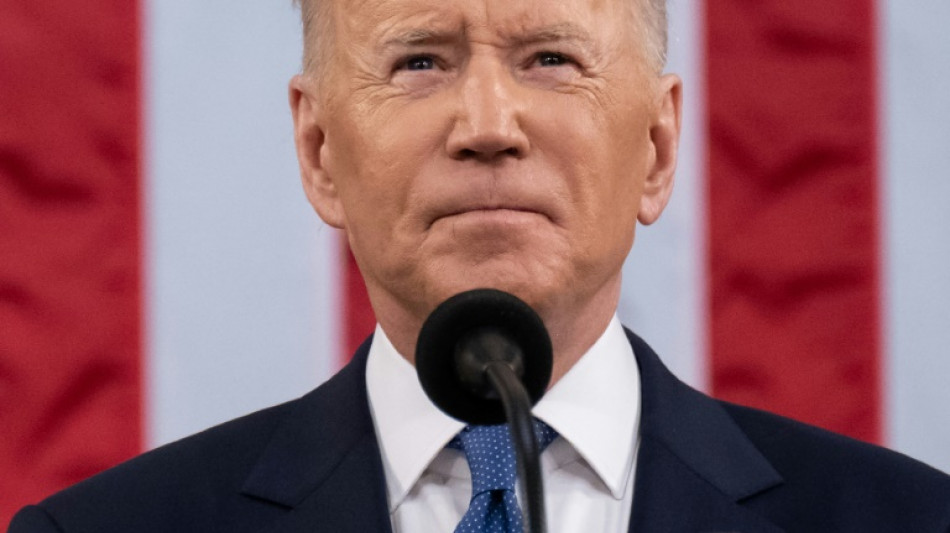
US President Joe Biden intends to strip Russia of its preferential trade status, a move that would enable Washington to inflict steep tariff hikes on Moscow in retaliation for the invasion of Ukraine.
The move is set to be announced Friday, in coordination with the G7 and the European Union, according to a source familiar with the matter, who noted that Congress would have to make the final decision.
That is expected to be a formality, however, as US lawmakers have declared their support for a move to revoke normal trade relations with Russia.
The White House said Biden will "announce actions to continue to hold Russia accountable for its unprovoked and unjustified war on Ukraine."
He is scheduled to speak at 10:15 am (1515 GMT).
The preferential trade status, known in the United States as permanent normal trade relations (PNTR), is a key principle of the World Trade Organization that requires member countries to guarantee equal tariff and regulatory treatment to other members.
Accorded by the United States to most countries in the world, with notable exceptions like Cuba and North Korea, the status also known as most favored nation grants imported goods from a country equal footing with other trading partners.
Stripping Moscow of the designation, granted in December 2012, would allow Biden to impose steep tariffs on Russian goods or restrict imports of some products.
The new trade sanction would cap several rounds of measures intended to sever Russia's economic and financial ties with the rest of the world over its invasion of ex-Soviet Ukraine.
They have included banning Russian oil imports, seizing the assets of billionaires tied to President Vladimir Putin, and freezing the nation's stockpile of cash.
Together, the moves have already pushed Moscow to the brink of a debt default.
- Limited impact? -
But those steps have also caused prices for key commodities, like gasoline and wheat, to soar, harming US consumers already facing the highest inflation in four decades.
And trade experts are dubious about whether new tariffs would be effective.
"US direct trade with Russia is relatively small, so higher tariffs would not do much damage to them but could raise costs for our manufacturers who rely on them for key raw materials," said William Reinsch of the Center for Strategic and International Studies in Washington.
In addition, "The additional damage this does to the trading system, while not immediate, could be significant," he said in an analysis.
The United States imported just under $30 billion in goods from Russia last year, including $17.5 billion in crude oil.
The IMF said Thursday that war and the sanctions will lead to a "sharp contraction" of the Russian economy, and lead to slower global growth.
The IMF this week approved a $1.4 billion in fast-disbursing aid for Ukraine, and the World Bank this week released nearly $500 million of what is expected to be a $3 billion financing package to aid the war-torn country.
US lawmakers meanwhile passed a huge spending bill on Thursday, including almost $14 billion in humanitarian and military aid to war-torn Ukraine, as the invasion by Russia entered its third week.
More than doubling from an initial $6.4 billion last week, the $13.6 billion relief includes aid for refugees, military aid and support for NATO allies in eastern Europe.
S.Barghouti--SF-PST