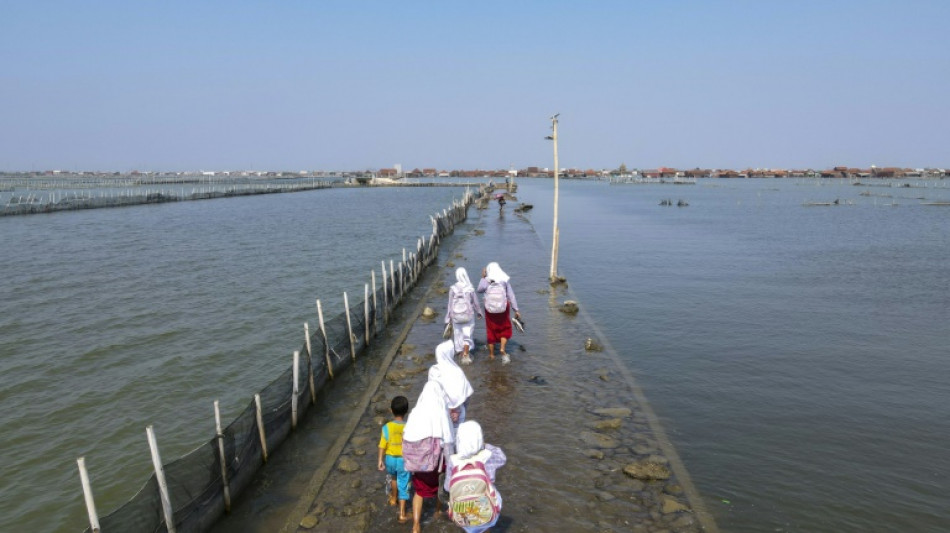
'Slow disaster': Indonesians in sinking village forced to adapt / Photo: BAY ISMOYO - AFP

 American Nobel laureate in medicine hopes to illuminate the brain

 Trump approves firing squad for convicted US military base shooter

 Grappling with 'homework scams,' US universities shun AI detectors

 Separatists win Quebec election in test for Canada PM

 Leaders visit Pacific atoll at frontline of climate change

 Yemen's Houthis claim striking Riyadh airport, other Saudi sites

 Best-selling British author Jeffrey Archer dies aged 86

 Military plane crash kills 32 in Nigeria

 Olise powers France to win over Belgium in Nations League

 High-flying Blazy turns to birdlife at Chanel

 Riyadh's allies pledge troops as Yemen, Saudi Arabia attack Houthis

 Clashes erupt outside Kosovo parliament over war crimes court

 Milan's Saelemaekers suffers ankle setback, faces lengthy spell out

 Rubio arrives in Iceland to push for greater US presence in Arctic

 Putin allows Italy's UniCredit to sell part of Russian business

 Djokovic into China Open final as Medvedev out for hitting fan with ball

 ICC unseals arrest warrants for Taliban education ministers

 Modric hopes fans back Croatia against Spain after England shame

 Bolsonaro rides right-wing surge into Brazil's election runoff

 Turkey blocks X account of British reporter

 Ukraine says using AI robot guns to shoot down new Russian drones

 At Oct 7 memorial, Netanyahu says will be no Hamas rule in Gaza

 Ukraine blames Russia for deadly sinking of Turkish ship in Black Sea

 UN rights council slams Taliban's 'oppression' of women

 Norway eyes partial ban of smart glasses

Indonesian teacher Sulkan leafs through pictures at his small sea-surrounded mosque, remembering a marching band and smiling children who graduated from his kindergarten, standing on a road now submerged by murky, green water.
That is just one of many landmarks in the Javan coastal village of Timbulsloko swallowed by rising tides, which have forced residents to adapt to a new life on the water.
More than 200 people have stayed in one of Indonesia's fastest sinking areas, which has turned from a landscape of lush rice paddies into a network of boardwalks and canoes in an alarming sign of how climate change could upend coastal communities everywhere.
"It's only memories now... there are no such activities any more," said 49-year-old Sulkan, who like many Indonesians goes by one name.
"Why? Because the place is already flooded by the tide."
Timbulsloko residents' lives have been drastically altered by rising sea levels, coastal erosion and excessive groundwater extraction making the land sink.
The coastline has also been left vulnerable to floods after locals cut down mangroves for fishing ponds in the 1990s.
Water has since reached five kilometres (three miles) inland around Timbulsloko and the surrounding Demak region, according to Denny Nugroho Sugianto, professor at Diponegoro University.
He called it a "slow disaster" happening before the world's eyes, with data showing some areas around Timbulsloko sinking up to 20 centimetres annually, double the rate recorded in 2010.
"This is the largest rate of land subsidence" ever recorded in the area, he said.
- 'No future' -
Large parts of megalopolis capital Jakarta are expected to be submerged by 2050 for the same reasons, researchers say, but villagers along the Javan coast are on the front lines of the emergency.
Sulkan was forced to move his kindergarten from an old wooden building next to his house to another structure on higher land to prevent it from being lost.
Residents have elevated the floors of their homes by adding soil and then installing wooden decks to keep themselves dry as the floods become more severe.
This has left them with shrinking space, forcing anyone entering to stoop low to avoid bumping their heads.
Sularso, 54, said he had raised his floor three times since 2018, by a total of 1.5 metres, spending around 22 million rupiah ($1,460).
"For me, there is no future," the fisherman told AFP.
"This village... will be gone in less than five years. We can't build, we can't do anything."
He says his floor can still be submerged in water during high tides, leaving him worried high waves could collapse his home.
Housewife Khoiriyah, 42, said she has had difficulty buying groceries or taking her three children to school because of flooded roads.
"Life is harder now. Whenever the water comes inside my house, I always wish I could move out," she said.
Yet the problem is due to become even worse as climate change grinds on.
The UN's Intergovernmental Panel on Climate Change (IPCC) says an increase of two degrees Celsius from pre-industrial times could raise sea levels by 43 centimetres by the next century.
- Raising the dead -
It is not only the living being protected from the rising seas.
The village's cemetery has been raised to prevent it from sinking, with villagers installing a wood fence, nets and tyres to keep the waters at bay.
Residents have also crowdfunded a boardwalk to connect their houses and give them access to their loved ones' graves.
Timbulsloko's younger generation often spend their time outside their home, escaping the floods that haunt their everyday lives.
"Life is monotonous here. The youths often go out as they hate being in their house," 24-year-old Choirul Tamimi said.
Before the use of boats in the village, Tamimi said, he would walk through the flood on his way to work with a change of clothes.
"When I came back from work, it's annoying because I'm not only tired, but I also got wet," he said.
Sugianto called on the government to expand piped water access to residents to reduce groundwater use, and look to sand filling to replace what has been eroded.
"Without restoring the original coastline, we cannot solve this problem sustainably," the professor said.
Yet those who remain in Timbulsloko refuse to surrender to the elements.
Sulkan insists that he will stay to keep his kindergarten open and teach children like the ones who once stood on the now-engulfed road.
"As long as there are still neighbours, there are still houses, I'm staying here," he said.
B.AbuZeid--SF-PST