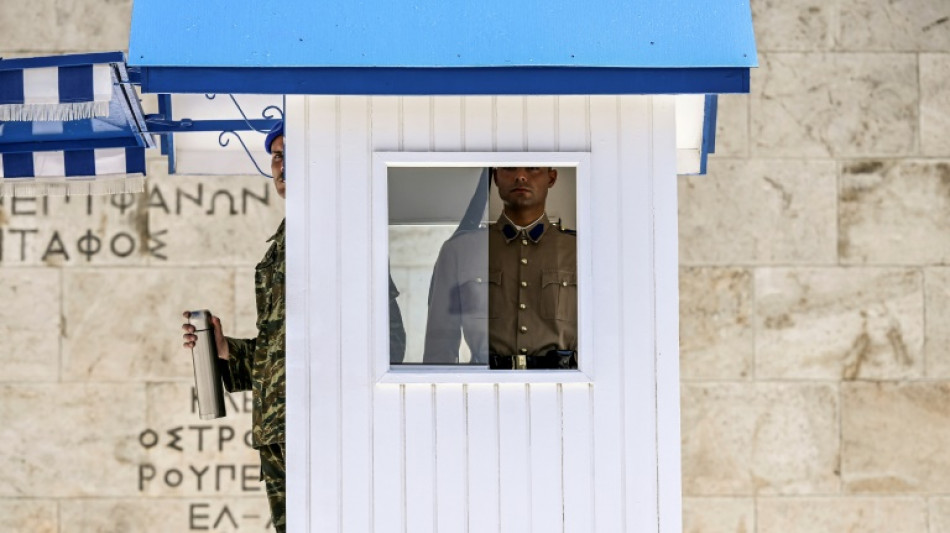
All concrete, no trees: Athens ill-prepared for heatwaves / Photo: Spyros BAKALIS - AFP

 Ready, set, snooze: Sleep-deprived Japanese compete for best-rested

 Falcons thump Saints 45-24 as New Orleans marks Katrina anniversary

 Tuvalu govt adviser says Australia overstepped in pre-COP visit
 Asian stocks mixed despite tech-led Wall St record
 Tens of thousands expected in Paris for high school protests
 AI borrowing binge rattles US markets

 Young Canadians sue government over alleged climate failures

 White Sox down Guardians to take 2-0 series lead
 NHL record-breaker Ovechkin says current season will be his last
 France roar back in Nations League as Italy beat Turkey
 Messi readies for final farewell in Argentina send-off
 Esposito seals Italy win over Turkey in Nations League

 Russia downplays plague reports as Trump offers US help

 Trump says US moved bombers from UK base after 'threats'
 Brazilian stocks surge to record after Bolsonaro election lead
 Leaders to visit Pacific atoll at frontline of climate change

 ICC gives more details about arrest warrants for Taliban ministers
 Nigeria's Tinubu confirms 32 dead after military plane crash
 'Reckless' AI firms can't control models, says whistleblower

 Switching on brain cells: the Nobel-winning science of optogenetics
 Quebec votes as separatist surge poses test for Canada PM
 Euro slides as concerns about French debt mount

 Former Trump press secretary Leavitt joins Fox News

 Djokovic advances to China Open final as Medvedev out for hitting fan with ball

 Disgraced former US House speaker dies at 84

A densely-populated concrete jungle lacking in green space, Athens has become one of Europe's hottest capitals and despite its vulnerability to extreme temperatures, has failed to make environmental innovations, experts warn.
Residents and visitors have sweated through a scorching week in the Greek capital, only finding respite on cafe terraces in the evening.
And the mercury is expected to soar again with highs of 40 degrees Celsius (104 Fahrenheit) forecast for this weekend, prompting authorities to partially close the Acropolis and some major parks.
In 2007, the more than three million residents of the city experienced a record high 44.8C.
"With the concrete and the tarmac, cities become heat islands. In Athens there are very few green spaces to lower temperatures," Kostas Lagouvardos, research director for the Institute for Environmental Research and National Observatory of Athens, told AFP.
"And the forests that surround the city are disappearing due to wildfires."
Despite being flanked by hills and rivers, Athens is overrun by concrete buildings.
From the top of the Acropolis, the view of the city is an endless sprawl of buildings and houses, interrupted by a rare green patch.
Central Athens is the second most densely populated area in Europe after Paris, according to Eurostat.
- Construction everywhere -
"In Greece, construction is going on all the time and everywhere! It's the biggest problem," said urban planner Aris Kalandides.
According to the World Wildlife Fund, there is only 0.96 square meters of green space per resident in Athens, which falls far short of the World Health Organization's recommendation of nine square meters per capita.
With only 11 percent of its surface area covered by trees, Athens is near the bottom of the list compared to other European capitals, according to the European Environment Agency.
"There is hardly any countryside left around Athens, the suburbs are nibbling away and destroying everything. Economic interests are taking priority over the need for green space," said Kalandides.
The lack of a strategy and political will appear to be the main roadblocks to reversing the trend, according to specialists.
In 2021, Athens appointed its first climate tsar responsible for implementing a strategy to adapt infrastructure and behaviour to climate change.
The appointment came with nearly five million euros in funding from the European Investment Bank (EIB).
"The urban fabric of Athens is made up of dense buildings that cover 80 percent of the city's surface area. All this tarmac and cement retains heat during heatwaves," the EIB said in its report.
Projects launched since include three "green corridors" in the city and improved water management on the city's highest peak, Lycabettus.
- Trees sacrificed -
But some current urbanisation projects have rubbed up against environmental goals.
Dozens of trees have been cut to build new metro stations and a huge housing complex is about to be built on the grounds of the former Ellinikon airport.
And a "grand promenade" planned for central Athens, with trees and benches, has been a building site for three years.
"There is a lack of political planning and engagement from the entire population," said Iris Lykourioti, an architecture professor at the University of Thessaly.
"We're in a period when investment policies take precedence over environmental protection," she said.
The legacy of Greece's economic crisis is still being felt, she warned.
"Budget cuts have not only limited public services, but the aid plans (by Greece's creditors) paved the way to the exploitation of (EU recognised) Natura protection areas" across the country, she said.
M.Qasim--SF-PST