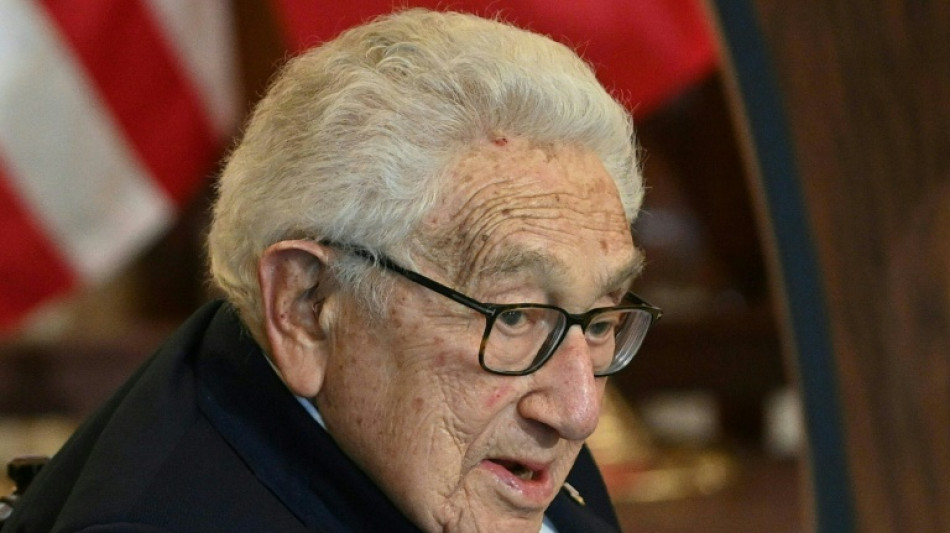
Xi hails 'old friend' Kissinger in Beijing meeting / Photo: ROBERTO SCHMIDT - AFP

 دراسة برازيلية: البعوض الحامل لـ"وولباكيا" يقلل إصابات حمى الضنك بنسبة 69%

 Garmin Patent Reveals Inter-Pixel Solar Tech for AMOLED Watches

 Former Water Board Boss Remanded Over R4.4 Billion Giyani Graft Claims
 Miao and Dong Traditional Knowledge Offers Climate Resilience Lessons at COP31

 Police Departments Deploy AI-Generated 'Grand Theft Auto VI' Recruitment Ads

 كوشنر واستثماره في أسلحة تمول حروب ترمب.. شبهات تضارب مصالح

Chinese leader Xi Jinping hailed former US secretary of state Henry Kissinger as an "old friend" as the two met in Beijing on Thursday.
Kissinger's visit to China this week has seen him call for a rapprochement between Washington and Beijing, which remain at loggerheads over a range of issues, from human rights to trade and national security.
The 100-year-old diplomat was central to the United States establishing ties with communist China in the 1970s and has maintained close contact with the country's leaders over the years.
"Chinese people value friendship, and we will never forget our old friend and your historic contribution to promoting the development of China-US relations and enhancing the friendship between the Chinese and American peoples," President Xi told Kissinger on Thursday, according to state media.
"This not only benefited the two countries, but also changed the world," Xi added.
"The world is currently experiencing changes not seen in a century, and the international order is undergoing enormous change," the Chinese leader said.
"China and the United States are once more at a crossroads, and both sides must once again make a choice."
Kissinger, in response, thanked Xi for hosting him at the Diaoyutai State Guesthouse's building number five -- where he met with then premier Zhou Enlai in 1971.
"The relations between our two countries will be central to the peace in the world and to the progress of our societies," the former diplomat said.
- 'Legendary diplomat' -
Kissinger secretly flew to Beijing in 1971 on a mission to establish relations with communist China.
The trip set the stage for a landmark visit by former US president Richard Nixon, who sought both to shake up the Cold War and enlist help in ending the Vietnam War.
Washington's overtures to an isolated Beijing contributed to China's rise to become a manufacturing powerhouse and the world's second-largest economy.
Since leaving office, Nobel Peace Prize Laureate Kissinger has grown wealthy advising businesses on China -- and has warned against a hawkish turn in US policy.
His trip this week also overlapped with a trip by US climate envoy John Kerry, and follows recent visits by Treasury Secretary Janet Yellen and Secretary of State Antony Blinken.
"Since 1971, Dr Kissinger has visited China more than 100 times," CCTV said on Thursday.
State news agency Xinhua reported him as telling defence minister Li Shangfu on Tuesday that, "in today's world, challenges and opportunities coexist, and both the United States and China should eliminate misunderstandings, coexist peacefully, and avoid confrontation".
Kissinger also met on Wednesday with top diplomat Wang Yi, who praised Kissinger's "historic contributions to the ice-breaking development of China-US relations".
"The US policy toward China needs Kissinger-style diplomatic wisdom and Nixon-style political courage," Wang said.
Kissinger has long been feted by the American elite and was co-awarded the Nobel Peace Prize for negotiating a ceasefire in Vietnam.
But he is seen by many as an unindicted war criminal for his role in, among other events, expanding the Vietnam War to Cambodia and Laos, supporting coups in Chile and Argentina, and turning a blind eye to Pakistan's mass atrocities during Bangladesh's 1971 war of independence.
I.Yassin--SF-PST