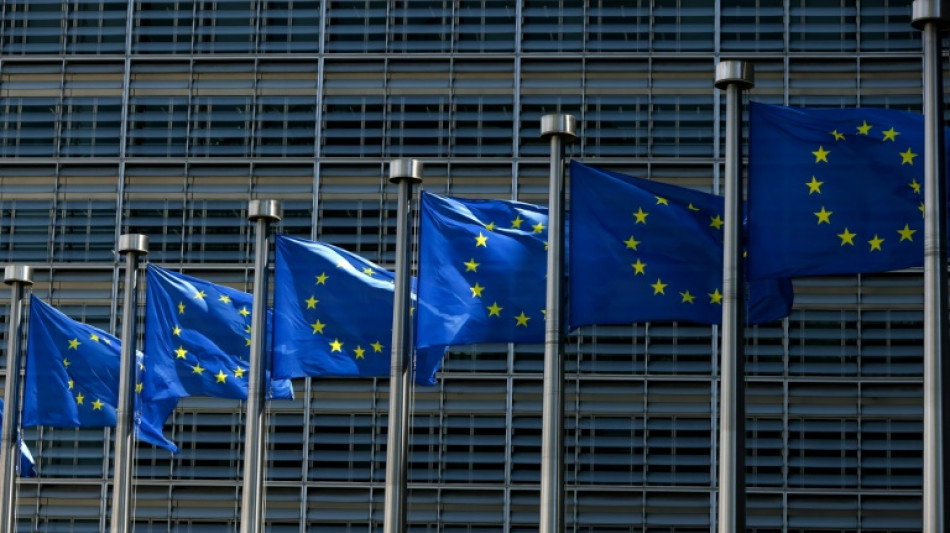
US economist renounces EU job after Macron doubts / Photo: Kenzo TRIBOUILLARD - AFP/File

 دراسة برازيلية: البعوض الحامل لـ"وولباكيا" يقلل إصابات حمى الضنك بنسبة 69%

 Garmin Patent Reveals Inter-Pixel Solar Tech for AMOLED Watches

 Former Water Board Boss Remanded Over R4.4 Billion Giyani Graft Claims

 Miao and Dong Traditional Knowledge Offers Climate Resilience Lessons at COP31

 Police Departments Deploy AI-Generated 'Grand Theft Auto VI' Recruitment Ads

 كوشنر واستثماره في أسلحة تمول حروب ترمب.. شبهات تضارب مصالح

A US economist has decided not to take up a job advising the European Commission, after French president Emmanuel Macron expressed doubts about hiring an American for the role.
Yale University professor and big tech expert Fiona Scott Morton had been hired as chief economist by EU competition commissioner Margrethe Vestager, to advise on anti-trust strategy.
But her appointment was later criticised by French politicians as well as by several EU lawmakers from both the right and the left. On Tuesday, Macron weighed in.
This was followed by the intervention of five of Vestager's colleagues on the commission, who broke ranks to urge EU chief Ursula von der Leyen to reconsider the appointment.
Macron said that the EU executive hiring an American had raised "many questions" -- noting that neither the United States nor China would hire a foreigner to such a job.
He suggested that, whatever Scott Morton's qualifications, having her advise the commission on how to regulate US tech giants was not "coherent" with his vision of EU strategic autonomy.
Grilled by MEPs, Vestager defended the choice, arguing that Europeans were better served by having the most qualified available candidate in the role, regardless of nationality.
She said any conflicts of interest that arose because of Scott Morton's previous consultancy work for US giants Apple, Amazon and Microsoft would be dealt with under existing rules.
But, a day later, Scott Morton had announced her decision to step aside.
In a letter posted on Twitter by Vestager, she said she was pulling out due to "the political controversy that has arisen because of the selection of a non-European to fill this position".
"I have determined that the best course of action is for me to withdraw and not take up the chief economist position," Scott Morton wrote, in the letter addressed to Vestager.
France's junior minister for digital transition, Jean-Noel Barrot, welcomed Scott Morton's "responsible" decision, telling AFP: "Europe's digital sovereignty is an absolute necessity."
- 'Respect for her integrity' -
In a European Commission statement, however, Vestager expressed regret.
"Having also spoken with Professor Scott Morton, I accept her decision, with regret and full respect for her integrity," Vestager wrote.
"I also wish her all the best for the future, and that she will continue to use her extraordinary skill-set and expertise to push for strong competition enforcement and regulation on both sides of the Atlantic."
The controversy had been stirring in Brussels' political circles for more than a week, since the commission first announced that it had hired Scott Morton.
The appointment had been approved by Von der Leyen's college of commissioners, including the five who have now called for the decision to be reviewed.
As well as holding professorships in Yale and Edinburgh, Scott Morton served in a senior role in the US Department of Justice's antitrust division in 2011 and 2012.
More recently, she has carried out consultancy work for several large US tech firms that regularly come under the scrutiny of Vestager's office in Brussels.
This led to allegations from MEPs that she would be unable to fairly advise on these cases, especially at a time when the EU is pushing for tougher tech regulation.
Some critics branded her a "lobbyist" for American interests, despite her academic track record as a champion of tight regulation to protect competition in the sector.
"I have many questions, and it leaves me doubtful," Macron said.
Scott Morton received support, however, from many fellow scholars, including 39 senior European economists, who signed an open letter backing her appointment.
"The European Commission and, more broadly, we as Europeans are very lucky to have drawn someone of her calibre," they wrote.
O.Salim--SF-PST