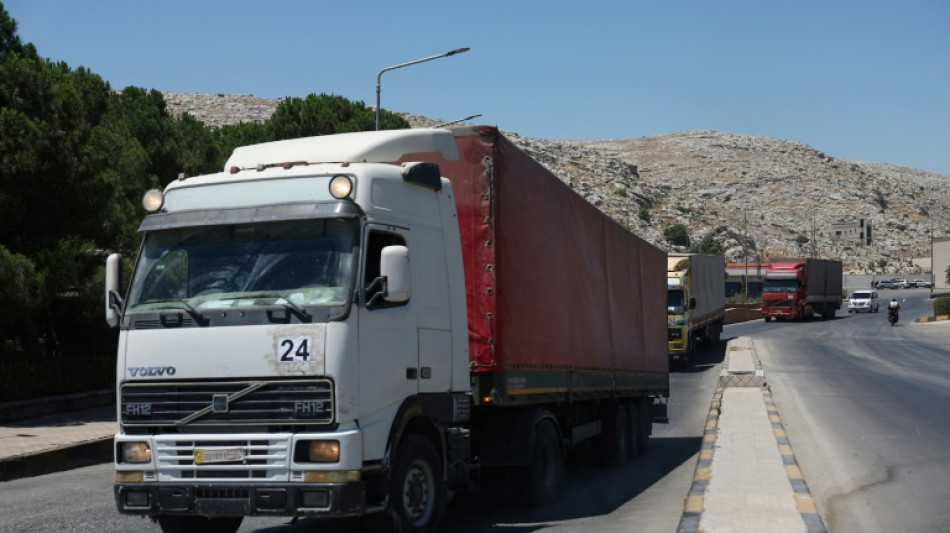
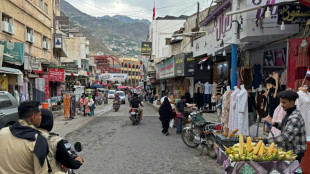
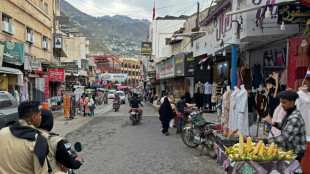
Fears over Syria's proposed control on aid to rebel-held areas / Photo: OMAR HAJ KADOUR - AFP/File

 EU vows AI rules will protect Europeans. Will they?

 Myanmar leader to visit Malaysia after migrant returns begin

 Germany's AfD poised to preside over state assembly for first time
 Australia's opposition vows 'largest cut to immigration' in country's history
 Ready, set, snooze: Sleep-deprived Japanese compete for best-rested

 Falcons thump Saints 45-24 as New Orleans marks Katrina anniversary

 Tuvalu govt adviser says Australia overstepped in pre-COP visit

 Asian stocks mixed despite tech-led Wall St record
 Tens of thousands expected in Paris for high school protests

 AI borrowing binge rattles US markets

 Young Canadians sue government over alleged climate failures

 White Sox down Guardians to take 2-0 series lead

 NHL record-breaker Ovechkin says current season will be his last
 France roar back in Nations League as Italy beat Turkey
 Messi readies for final farewell in Argentina send-off

 Esposito seals Italy win over Turkey in Nations League

 Russia downplays plague reports as Trump offers US help

 Trump says US moved bombers from UK base after 'threats'
 Brazilian stocks surge to record after Bolsonaro election lead
 Leaders to visit Pacific atoll at frontline of climate change

 ICC gives more details about arrest warrants for Taliban ministers
 Nigeria's Tinubu confirms 32 dead after military plane crash

 'Reckless' AI firms can't control models, says whistleblower

 Switching on brain cells: the Nobel-winning science of optogenetics

 Quebec votes as separatist surge poses test for Canada PM

The Syrian government recently announced it would allow aid to cross into rebel-held areas after a United Nations mechanism expired, sparking concerns from humanitarian groups.
They worry over the fate of residents in Syria's last remaining rebel strongholds, in the north and northwest, after the Security Council failed on Wednesday to extend the mechanism.
Under a 2014 deal, aid had largely passed through the Bab al-Hawa crossing with Turkey without the authorisation of Damascus.
But expiry of the UN mechanism, as well as Syria's decision to change course on the delivery of aid to those areas, has sparked fears and questions among the humanitarian community.
- What did Damascus propose? -
Syria said it made a "sovereign decision" to allow aid to flow through the Bab al-Hawa crossing for six months starting last Thursday.
The crossing is the main entry point for aid to rebel-held areas, though it also occasionally trickles in from areas under the control of Damascus.
Following a February 6 earthquake that struck both northwest Syria and southern Turkey, Syrian authorities agreed to temporarily open two other border crossings with Turkey until August.
Russia on Tuesday vetoed a proposal to extend the UN mechanism at Bab al-Hawa for nine months, then failed to muster enough votes for an alternate proposal to extend it for six months.
The UN expressed concerns over two "unacceptable conditions" set by Damascus for allowing aid to flow through the crossing, according to a document reviewed Friday by AFP.
The UN Office for the Coordination of Humanitarian Affairs (OCHA) said it was concerned that Damascus had "stressed that the United Nations should not communicate with entities designated as 'terrorist'".
The second condition it bridled at was that the International Committee of the Red Cross (ICRC) and the Syrian Arab Red Crescent (SARC) should "supervise and facilitate the distribution of humanitarian aid" in northwest Syria.
Roughly half of Idlib province and parts of neighbouring provinces are controlled by Hayat Tahrir al-Sham (HTS), considered a terrorist group by Damascus, as well as by the US and UN.
About three million people, the majority of them displaced, live in areas controlled by HTS, while another 1.1 million are in zones under the control of Turkey-backed groups.
Years of conflict have left much of the rebel-held areas -- which host overcrowded camps for the displaced -- in desperate need of aid as poverty and disease run rife.
- What are the concerns? -
The UN has described Damascus's conditions for reopening the Bab al-Hawa crossing as "unacceptable".
The OCHA document seen by AFP called for the need to "review" and "clarify" parts of Damascus's letter, saying the deliveries "must not infringe on the impartiality... neutrality, and independence of the United Nations' humanitarian operations".
Several international organisations fear that allowing Damascus control over the flow of aid to rebel-held areas could result in limiting access to those most in need.
The International Rescue Committee -- one of the main aid organisations working in Idlib -- said it continues to "emphasise the responsibilities of the Security Council to protect Syrians... and ensure lives are not put at risk".
MedGlobal, which operates clinics and vaccination drives in Idlib, warned that transfer of control of Bab-Al-Hawa "from a neutral party (the UN) to a regime that slaughtered its people and displaced half of its population will lead to more death and suffering among innocent civilians and will trigger another refugee crisis".
About half the residents of rebel-held areas are people displaced by Syria's 12 years of conflict that have killed more than half a million people.
Syrian President Bashar al-Assad has repeatedly said he is determined to regain control over those areas.
Nick Heras, a researcher at the New Lines Institute for Strategy and Policy, told AFP that Damascus "is showing increased confidence in its ability to contain and, over time, shrink the rebel-ruled areas in northwest Syria".
Syria, which in May regained its seat in the Arab League, wishes to "monitor the crossings" to rebel-held areas, Heras said, warning that soon "Assad and his allies will militarily force the issue".
- Are there any alternatives? -
Security Council members and other organisations are betting on a return to negotiations.
The Swiss ambassador to the world body said diplomats would "get back to work immediately to find a solution".
Human Rights Watch's senior researcher on Syria, Hiba Zayadin, urged Security Council members to "return to the negotiating table and reach a consensus that puts Syrians' rights first".
"Allowing Syria to dictate the flow of aid to areas beyond government control puts the lives, rights, and dignity of millions of Syrians at grave risk," she said.
In Idlib, 46-year-old activist Abdel Wahab Elewi expressed his rejection of Damascus's control over the crossing, "even if they cut off aid to us".
"Handing this issue over to Assad spells the beginning of the end and moving towards recognising his regime," he said.
S.AbuJamous--SF-PST