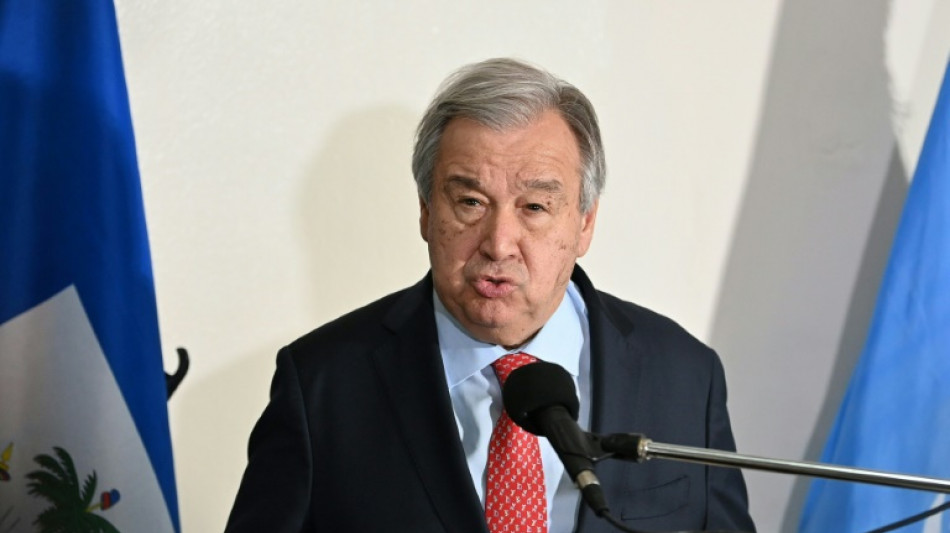
UN chief blasts 'outdated' global financial structure / Photo: Richard PIERRIN - AFP

 The alleged murder by US marine on Okinawa: five things to know

 End of an era as Messi prepares to hang up Argentina boots

 Superstar duo headline strong New Zealand squad for Rugby League World Cup

 South Korea warns of possible AI use in banking hacks

 EU vows AI rules will protect Europeans. Will they?

 Myanmar leader to visit Malaysia after migrant returns begin

 Germany's AfD poised to preside over state assembly for first time

 Australia's opposition vows 'largest cut to immigration' in country's history

 Ready, set, snooze: Sleep-deprived Japanese compete for best-rested

 Falcons thump Saints 45-24 as New Orleans marks Katrina anniversary

 Tuvalu govt adviser says Australia overstepped in pre-COP visit

 Asian stocks mixed despite tech-led Wall St record

 Tens of thousands expected in Paris for high school protests

 AI borrowing binge rattles US markets

 Young Canadians sue government over alleged climate failures

 White Sox down Guardians to take 2-0 series lead

 NHL record-breaker Ovechkin says current season will be his last

 France roar back in Nations League as Italy beat Turkey
 Messi readies for final farewell in Argentina send-off

 Esposito seals Italy win over Turkey in Nations League

 Russia downplays plague reports as Trump offers US help

 Trump says US moved bombers from UK base after 'threats'

 Brazilian stocks surge to record after Bolsonaro election lead

 Leaders to visit Pacific atoll at frontline of climate change

 ICC gives more details about arrest warrants for Taliban ministers

UN chief Antonio Guterres denounced Wednesday a global financial system where nearly half the world's people live in countries whose governments spend more on debt than education or health.
"Half our world is sinking into a development disaster, fuelled by a crushing debt crisis," said the secretary-general, presenting a United Nations report on the state of the world's debt.
"Some 3.3 billion people -- almost half of humanity -- live in countries that spend more on debt interest payments than on education or health," he lamented.
Guterres added that "because most of these unsustainable debts are concentrated in poor countries, they are not judged to pose a systemic risk to the global financial system.
"This is a mirage. 3.3 billion people is more than a systemic risk. It is a systemic failure," he said.
According to the report, titled "A World of Debt", total global public debt reached $92 trillion last year, a five-fold increase on the year 2000.
Developing countries hold nearly 30 percent of this debt, and theirs is also growing faster. Despite a lower level of debt in relation to their GDP, they are paying more interest, in part because of higher interest rates, the report found.
A total of 52 countries, almost 40 percent of the developing world, are in serious debt trouble, Guterres noted.
"It is one result of the inequality built into our outdated global financial system, which reflects the colonial power dynamics of the era when it was created," he said.
Rebeca Grynspan, who heads the United Nations Conference on Trade and Development, pointed out that the "composition" of developing countries' debt had changed.
In 2010, private creditors accounted for 47 percent of the external debt of developing countries, but by 2021 that had grown to 62 percent.
"So while these private sources can provide essential liquidity to the countries, usually there are less favorable terms for that debt and that makes the restructuring more complex and also the debt more expensive," she said.
Y.AlMasri--SF-PST