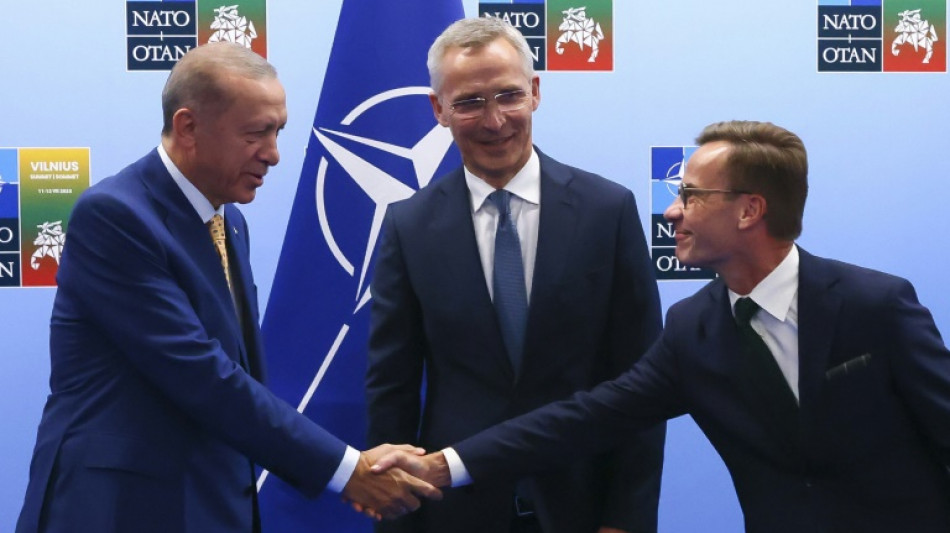
Sweden deal crowns Erdogan's post-election shift West / Photo: YVES HERMAN - POOL/AFP

 Kenya reports first-ever Ebola death
 Tennis world No.1 Sinner's season over due to knee injury
 Yemen's Houthis claim attack on Riyadh airport, deny losing territory

 7-Eleven exits India amid mounting competition
 The alleged murder by US marine on Okinawa: five things to know

 End of an era as Messi prepares to hang up Argentina boots

 Superstar duo headline strong New Zealand squad for Rugby League World Cup
 South Korea warns of possible AI use in banking hacks
 EU vows AI rules will protect Europeans. Will they?
 Myanmar leader to visit Malaysia after migrant returns begin

 Germany's AfD poised to preside over state assembly for first time
 Australia's opposition vows 'largest cut to immigration' in country's history

 Ready, set, snooze: Sleep-deprived Japanese compete for best-rested

 Falcons thump Saints 45-24 as New Orleans marks Katrina anniversary

 Tuvalu govt adviser says Australia overstepped in pre-COP visit
 Asian stocks mixed despite tech-led Wall St record
 Tens of thousands expected in Paris for high school protests
 AI borrowing binge rattles US markets

 Young Canadians sue government over alleged climate failures
 White Sox down Guardians to take 2-0 series lead
 NHL record-breaker Ovechkin says current season will be his last

 France roar back in Nations League as Italy beat Turkey
 Messi readies for final farewell in Argentina send-off
 Esposito seals Italy win over Turkey in Nations League

 Russia downplays plague reports as Trump offers US help

Turkish President Recep Tayyip Erdogan has performed one of his trademark policy U-turns on Sweden's accession to NATO that culminates a gradual pro-Western tilt of course since his May re-election.
Erdogan's ended more than a year of wrangling and struck a deal Monday that will allow the Nordic nation to become the 32nd member of the US-led defence bloc.
It followed a dramatic day during which Erdogan upped the stakes by suddenly demanding a clear path for Turkey's long-stalled accession to the European Union in return.
The new ask secured him a private meeting with EU chief Charles Michel and a pledge from Sweden and NATO to "support efforts to reinvigorate Turkey's EU accession process".
The agreement allows NATO to stand more united at a two-day summit that started Tuesday in Vilnius with the aim of showing Western resolve in the face of Russia's war on Ukraine.
But it also highlights a strategic shift in thinking that appears to have occurred in Ankara since Erdogan nearly lost his two-decade grip on power in May elections.
The vote coincided with a dire economic crisis that Erdogan tried to buffer through deals with rich Gulf countries and -- to the West's growing alarm -- Russian President Vladimir Putin.
Erdogan's refusal to budge on Sweden added to the growing perception that NATO member Turkey was turning into a Kremlin tool for sowing divisions in the West.
That image began to change after Erdogan turned to Wall Street-trained economists who want to improve relations with Western investors post-election.
He then hosted Ukrainian President Volodymyr Zelensky for more than two hours of talks Friday that created huge unease in Moscow.
The deal on Sweden followed a call with US President Joe Biden during which Erdogan raised both EU accession and Turkey's desire to acquire a large batch of F-16 fighter jets.
"Ankara wants to improve its relations with Europe and the West," European Council of Foreign Relations analyst Asli Aydintasbas remarked.
"The recent policy balance had shifted too much towards Russia."
- 'Transactional style' -
Erdogan has long tried to leverage Turkey's strategic location between Europe and Asia to play off Russian and Western interests for maximum gain.
Few expect his westward turn to represent a fundamental or long-term shift.
"We tend to think of Erdogan as unpredictable. But that's not entirely true," said veteran Turkish analyst Salim Cevik.
"Once you understand his transactional style, he is quite predictable."
Many note that Erdogan's change in tactics followed a June mutiny by Wagner mercenaries group leader Yevgeny Prigozhin that created mayhem in Moscow and suddenly left Putin looking weak.
Erdogan ended his meeting with Zelensky by declaring support for Ukraine's NATO ambitions and approving a deal under which Kyiv could get more Turkish combat drones.
But Russia's most vocal anger came in response to five Ukrainian commanders that Zelensky brought back with him to Kyiv from Turkey.
The Avov regiment fighters became national heroes in Ukraine because of their last-stand defence of Mariupol -- now seized by Russia -- in the first months of war.
They were supposed to stay in Turkey until the war was over under a deal arranged with Erdogan's help in September 2022.
Kremlin spokesman Dmitry Peskov said Monday that Russia "expects to receive explanations from the Turkish side about what happened".
"We will take this into account in our future agreements," Peskov added.
- 'Damaged goods' -
Long-time Russia and Turkey watcher Timothy Ash partially links Erdogan's shift to the Wagener revolt.
"The Azov and drone deals over the weekend around the Zelensky visit showed that Turkey thinks, post the Prigozhin mutiny, that Ukraine will win and Putin is damaged goods and likely on his way out," Ash said.
But Turkey's membership of the European Union still looks like a distant prospect and Erdogan's balancing acts will likely continue for the final five years of his rule.
Erdogan has scheduled a fund-raising trip to Saudi Arabia and two other petro-dollar rich Gulf nations days after the NATO summit.
And European powers such as France have longstanding reservations about accepting Muslim-majority Turkey into the bloc.
The European Parliament voted to suspend negotiations with Ankara in 2019 because of what it viewed as Erdogan's backsliding on democratic values and human rights.
Turkey has been a formal candidate country since 2005.
"Turkey needs Western investments, but I don't think they will come simply because the president has changed his rhetoric," Turkey's TEPAV policy institute analyst Nilgun Arisan Eralp said.
"They would like to see an economy based on the rules of law."
N.Shalabi--SF-PST