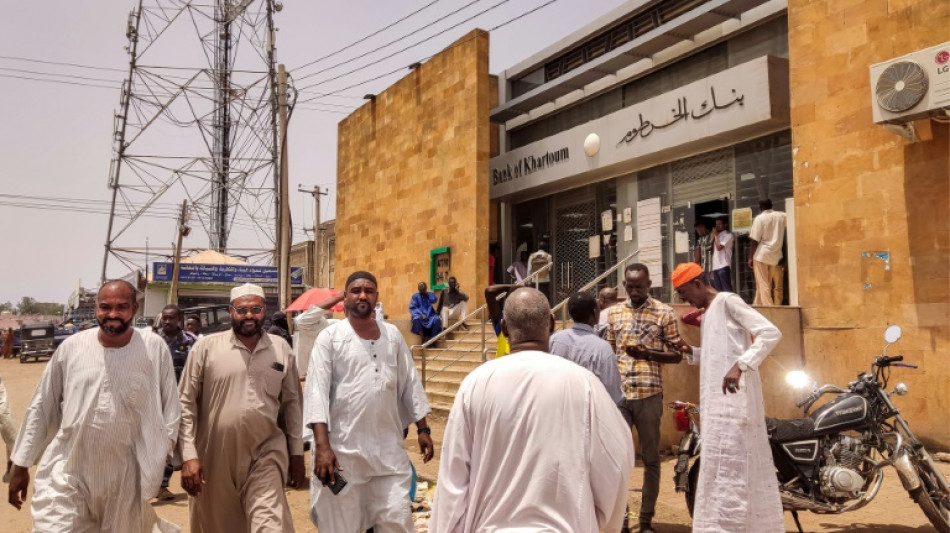
Sudan civil servants go hungry as war claims livelihoods / Photo: - - AFP

 Kenya reports first-ever Ebola death

 Tennis world No.1 Sinner's season over due to knee injury
 Yemen's Houthis claim attack on Riyadh airport, deny losing territory

 7-Eleven exits India amid mounting competition
 The alleged murder by US marine on Okinawa: five things to know

 End of an era as Messi prepares to hang up Argentina boots

 Superstar duo headline strong New Zealand squad for Rugby League World Cup

 South Korea warns of possible AI use in banking hacks

 EU vows AI rules will protect Europeans. Will they?

 Myanmar leader to visit Malaysia after migrant returns begin

 Germany's AfD poised to preside over state assembly for first time
 Australia's opposition vows 'largest cut to immigration' in country's history
 Ready, set, snooze: Sleep-deprived Japanese compete for best-rested

 Falcons thump Saints 45-24 as New Orleans marks Katrina anniversary

 Tuvalu govt adviser says Australia overstepped in pre-COP visit

 Asian stocks mixed despite tech-led Wall St record

 Tens of thousands expected in Paris for high school protests

 AI borrowing binge rattles US markets

 Young Canadians sue government over alleged climate failures

 White Sox down Guardians to take 2-0 series lead

 NHL record-breaker Ovechkin says current season will be his last
 France roar back in Nations League as Italy beat Turkey
 Messi readies for final farewell in Argentina send-off
 Esposito seals Italy win over Turkey in Nations League

 Russia downplays plague reports as Trump offers US help

Sudanese public school teacher Imad Mohammed had worked for 32 years when war broke out almost three months ago, tearing his country apart and his finances to shreds.
"We only eat one meal a day now," he told AFP about his family of five.
"And we don't know how long this will go on," said the teacher from Al-Jazirah state, which has been spared the brutal fighting but has still suffered dire shortages.
Like other civil servants, Mohammed has gone without a salary since the Sudanese army and the paramilitary Rapid Support Forces took up arms against each other.
When the first blasts shook Khartoum on April 15, banks there shuttered their doors, and branches nationwide have since struggled to provide services because they are cut off from headquarters in the capital.
Since then, the only government salaries that have been paid are the army's.
Deprived of their pay and annual holiday bonuses for the Muslim festivals of Eid al-Fitr in April and Eid al-Adha in June, around one million desperate public sector workers have been forced to survive on their savings or on social aid networks.
"What teachers and their families are going through, in both the public and private sectors, is catastrophic," said Ammar Youssef, head of the Sudanese Teachers Committee.
The livelihood losses and descent into poverty have compounded the horrors of the war, which has already killed around 3,000 people and displaced three million.
More than 1.5 million people have fled from Khartoum alone, using whatever money they had when the fighting started, to escape the air strikes, artillery fire and street fighting that have turned the capital into a war zone.
- Collective action -
But some who were unlucky enough to have had little or no savings they could access, have been left stranded, unable to pay for expensive transport as fuel prices have surged 20-fold.
"Not only are they struggling to feed their families even once a day, but they also can't afford to take their families to safety, away from the combat zones," Youssef told AFP.
"State education alone employs over 300,000 people, who were already underpaid before the war," he said, adding that the education ministry has been unreachable since the war began.
"Those who aren't killed by a bullet will die of hunger."
With food prices soaring, basic supplies running low and salaries halted, over half of the country's 48 million people are in need of aid, according to the United Nations.
It ranks Sudan as one of the highest alert areas for food insecurity and warns of the need for "urgent" action from the international community.
Since the war began, a handful of government officials have held news conferences seeking to assure the public that the economy is not at risk, among them the finance minister Gibril Ibrahim, an ex-rebel commander.
The central bank announced in early July that branches in most of Sudan's states were back in service, raising the hopes of some.
But, according to economist Mohamed al-Nayer, "the situation over the next few months is only going to get worse".
Even before the war, Sudan's economy was hit by triple-digit inflation.
Those struggling to make ends meet while protecting their family from the horrors of war are fed up.
"We don't understand why the government won't pay us what we're owed," civil servant Al-Sammani Mohammed told AFP.
Multiple unions, unable to receive a response from Khartoum, have banded together and warned they may take industrial action, which could further heighten tensions in Sudan.
A coalition of representatives for doctors, engineers, teachers, university professors and journalists have announced they would take "escalating measures if salaries are not paid".
C.Hamad--SF-PST