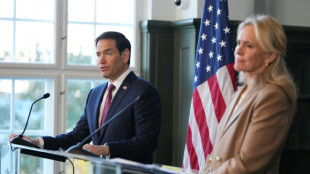
US podcast misinformation goes largely unchecked
/ Photo: CHIP SOMODEVILLA - GETTY/Getty / AFP/File

 Stocks climb as oil prices retreat

 Vstock Transfer Names Securities Industry Veteran Erica Goodstein General Counsel and Chief Compliance Officer

 Four Indonesian seamen return home after Somali pirate ordeal

 Crisis-striken Haiti postpones elections

 Germany arrests ex-spy chief on suspicion of giving secrets to foreign powers

 Djokovic wins China Open after de Minaur retires

 IMF warns cost-of-living shocks cause 'lasting deterioration' in affordability

 Alcaraz wins Japan Open for first title since injury return

 'We're working to keep football clean', Turkish minister says

 FIFA chief Infantino hit by Norwegian double complaint
 Exiled Catalan separatist leader Puigdemont cleared to return to Spain

 Stock markets climb as oil prices retreat

 'No future': Thousands mass in France for high school protests
 Nobel physics prize honours work on 'ghostly messengers' from outer space

 Bulgaria searches for missing crew after drones hit two more ships in Black Sea

 Le Pen vows drastic cost savings to prevent French 'default'

 'Eats through a straw': French teens wounded in high school protests

 Thousands mass in France for high school protests

 Moscow denies sanitary measures over plague reports

 Samoa look to recreate 2022 final run at Rugby League World Cup

 Asian stocks mostly up after tech-led Wall St record

 German factory orders plunge as recovery still fragile
 Coco Gauff calls out online racism following China open video review

 KVB Accelerates Middle East Footprint with Strategic MENA Regional Expansion

 Purple reign: Philippines seeks to keep grip on ube throne
Misinformation about everything from election fraud to Covid-19 vaccines is reaching millions of Americans through a popular but opaque medium: podcasts.
Many podcasts -- on-demand audio programs which users can listen to on smartphones -- bluntly promote false and unproven claims.
The Brookings Institution found "War Room" from former Donald Trump aide Steve Bannon has aired the most false statements, amassing more than 135 million downloads while promoting allegations of vote rigging in the 2020 US election.
Commentator Joe Rogan, whose podcast is the most popular on Spotify, has also used his platform to push unproven Covid-19 treatments.
Analysts say people seek out the shows that reaffirm their own beliefs. But the intimate, conversational format also helps enable the spread of rampant misinformation.
"There's something inherent to the relationship between a host and the audience that lends this level of credibility, this level of trust," Valerie Wirtschafter, a senior data analyst who led the Brookings research, told AFP.
"And the challenge, of course, is that anybody can be a podcaster, anybody can get a microphone and start talking about whatever they want."
Wirtschafter's team analyzed 36,000 episodes and found 70 percent of the most popular US podcasts had shared at least one claim debunked by fact-checkers. Many cast doubt on the 2020 election or the coronavirus pandemic.
Unlike social media platforms, podcasts offer little or no opportunity for listeners to comment or push back on misinformation. This "makes it easier for false, misleading, or unsubstantiated content to spread with little oversight," Brookings researchers said in their February report.
Rogan took down an episode in January after he discussed a fake tweet about Covid-19 vaccines that was falsely attributed to a Florida doctor.
But such a move is rare -- and Wirtschafter said moderation is "really complicated" for technology companies.
-- High listener trust --
A Pew Research Center study published in April found about half of Americans listen to podcasts -- and 87 percent say they expect the information to be accurate, representing a higher level of trust than other media.
"The relationship with the host is different," said Sylvia Chan-Olmsted, director of media consumer research at the University of Florida.
"It's like having a one-on-one conversation; you feel this person is talking to you," she told AFP. "People trust it more, and that's why it's more impactful."
Another podcast cited by Brookings is one of Apple's top news commentary programs from conservative activist Charlie Kirk, who has falsely claimed athletes are dying from Covid-19 vaccines and that election officials in Arizona manipulated 2020 results.
Rogan, Bannon and Kirk did not respond to requests for comment. Bannon told The New York Times he considered his inclusion in the report a "badge of honor" and that what others label misinformation, he calls "truth."
– 'Human intelligence' required –
Responding to podcast misinformation is challenging because it is a decentralized, primarily audio-based ecosystem on multiple platforms with different moderation rules.
Spotify, for example, has a policy banning "dangerous" content but also seeks to "respect creator expression." The company stood by Rogan in 2022 when he was accused of spreading coronavirus misinformation.
NewsGuard, a firm that rates the credibility of websites, announced in May it would begin evaluating the trustworthiness of popular podcasts.
NewsGuard said it will release the ratings for some 200 podcasts in 2024, giving more transparency to listeners and enabling advertisers to avoid podcasts featuring misinformation or content at odds with their brand.
Editorial Director Eric Effron said rating podcasts is "more challenging" than other content because of the audio format, which requires time to listen and to examine transcripts.
"This takes a tremendous investment because we use human intelligence," Effron said.
Responsibility for countering podcast misinformation is murky, with some pointing to the hosting platforms or recommendation algorithms from tech giants like Apple, Google and Facebook.
Wirtschafter, the Brookings analyst, said governments, podcast hosts and listeners can all work to improve information quality.
"Taking things down is maybe not the best solution," she said. "But adding more context, providing a richer environment so that people actually can explore evidence or have conversations I think would be extremely useful."
W.AbuLaban--SF-PST