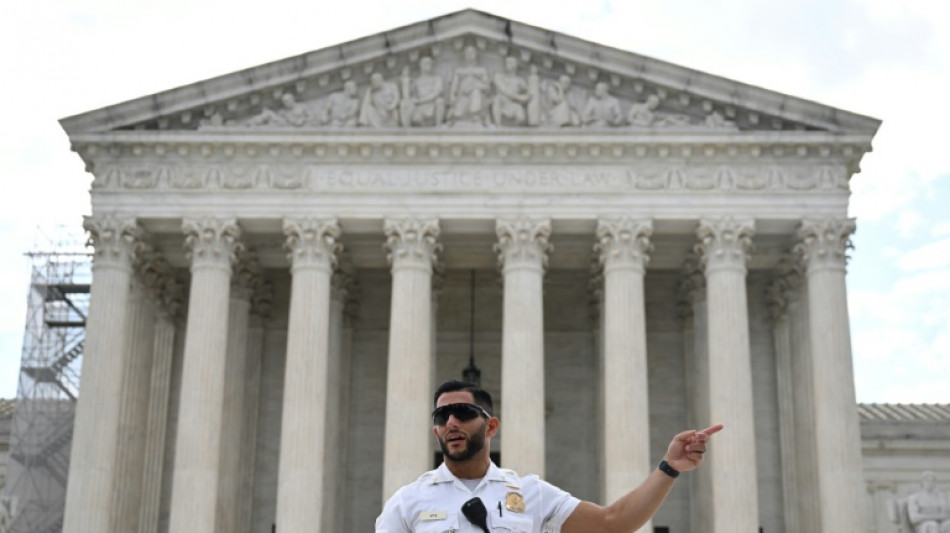
Supreme Court backs free speech rules in online stalking case / Photo: Jim WATSON - AFP

 Ronaldo opens door for Portugal return, apologises for walkout

 'Nobody seems to care': Russian city shrugs off plague reports

 Hundreds arrested in French school protests as Macron summons ministers

 WADA seeks tough anti-doping stance from Kenya

 German ex-spy chief arrested for suspected espionage, treason

 Furyk vows US will 'do more' to end Ryder Cup losing streak

 Iyer hits ton as India hammer West Indies in T20 opener

 Mandhana named India women's team captain after Kaur quits

 'The sound keeps coming back': children maimed in Ethiopia's Tigray clashes

 Paris Women's Fashion Week: the key trends

 i-payout Introduces a New Approach to Payments, Closing the Beneficiary Information Gap

 New Generation of Crypto Miners Released by ASICID

 New investor forecasts LIV Golf teams could be worth $100 mn each
 Shakira, Pique return to court over children visit arrangements

 Nobel physics prize hails 'ghostly messengers' from space

 France's Mistral unveils latest model in sovereign AI push

 Stocks climb as oil prices retreat
 Vstock Transfer Names Securities Industry Veteran Erica Goodstein General Counsel and Chief Compliance Officer

 Four Indonesian seamen return home after Somali pirate ordeal

 Crisis-striken Haiti postpones elections

 Germany arrests ex-spy chief on suspicion of giving secrets to foreign powers

 Djokovic wins China Open after de Minaur retires

 IMF warns cost-of-living shocks cause 'lasting deterioration' in affordability
 Alcaraz wins Japan Open for first title since injury return

 'We're working to keep football clean', Turkish minister says

The US Supreme Court sided with free speech advocates Tuesday in ruling that a man's online harassment of a country singer could only be deemed illegally threatening if he knew it could be understood as such.
The high court overruled the Colorado conviction of Billy Counterman for making what the western US state deemed threats among the thousands of unwelcome Facebook messages he sent to country singer Coles Whalen from 2014 to 2016.
True threats are not protected by the US Constitution's guarantee of free speech rights.
The Colorado court found based on state laws that Counterman's messages to Whalen -- such as writing "die, don't need you" and "staying in cyber life is going to kill you" -- could be objectively considered threats.
Counterman's attorney turned to the Supreme Court arguing that the only way of determining whether a message is a threat should be subjective: what was the sender's intent?
The case drew the interest of free speech advocates who worried that upholding Counterman's conviction would chill free speech protections by permitting the prosecution of anyone whose speech is perceived as threatening by another person, without proof of intent.
But Colorado had argued that requiring a subjective determination of the sender's intent would enable abuse of free speech rights, and specifically immunize stalkers "who are untethered from reality."
"Ninety percent of actual or attempted domestic violence murder cases begin with stalking," Colorado Attorney General Phil Weiser had told the court.
But in their 7-2 opinion, the justices rejected Colorado's arguments.
They said it needed to prove Counterman had at least some awareness that his messages could be perceived as threats.
Writing for the majority, Justice Elena Kagan did not completely bow to Counterman's argument that Colorado needed to prove he made a conscious threat against Whalen.
Instead, she said, the state only needed to prove that Counterman was being reckless.
"The state must show that the defendant consciously disregarded a substantial risk that his communications would be viewed as threatening violence," she wrote.
Based on legal precedents, according to Kagan, "we hold that a recklessness standard is enough" to convict.
The recklessness standard offers enough "breathing space" for protected speech without sacrificing the ability to enforce laws against true threats, she wrote.
In dissent, Justice Amy Coney Barret, backed by Clarence Thomas, said objective standards of what is threatening are supported by established law and enforced in many states.
She said the majority decision would make it harder to prosecute real threats, and that "recklessness" was a flimsy standard.
"The reality is that recklessness is not grounded in law, but in a Goldilocks judgement: Recklessness is not too much, not too little, but instead 'just right.'"
In response, Kagan wrote: "In law, as in life, there are worse things than being 'just right.'"
E.Aziz--SF-PST