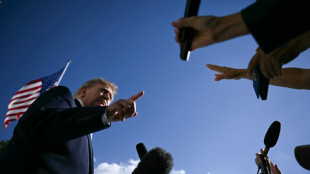
US and China eye stability but base hollow for next crisis / Photo: GREG BAKER - AFP

 Hotel Blacklist Launches New Accommodation Industry Risk Assessment Tool

 Bangladesh nuclear plant draws hope -- and worry

 US beat Canada 1-0 to wrap up four-win international break

 Turkey, Australia's joint COP31 leadership raises doubts
 For Turkish NGOs, COP31 offers rare space for action

 Sleep, appetite, gene-editing experts contend for Nobel chemistry prize
 Nobel Peace Prize haunted by the 'spectre' of Trump

 Africa launches own credit agency in bid for cheaper borrowing

 US, China, EU: three paths to regulating AI
 Australia's High Court rules against coal mine in landmark climate case
 Australia touts new funds for Pacific infrastructure at Fiji 'pre-COP'

 Eva Marie Saint, Oscar winner of Hollywood classics, dies at 102

 Australia probes app used in cheap smart glasses over privacy fears
 England needed to 'move on' from World Cup pain, says Tuchel

 O'Neill to stay at Celtic after period of "reflection"

 Kane marks 125th England cap with Wembley Nations League double
 Quebec's incoming separatist leader wants to block Crown from swearing-in

 Emmys gala will now stream its premier television awards
 Paramount completes Warner Bros takeover, creating Skydance
 Trump blames France unrest on Islam, migration
 Apple's Cook praises EU over efforts to protect children online

 Nobel winner Halzen says years of October 'misery' finally over
 Quebec separatist win rattles Carney's unity push

 'Itching' for change: Shiffrin cuts back slaloms this season

 'Gen Z has risen up': Tens of thousands mass for tense France school protests
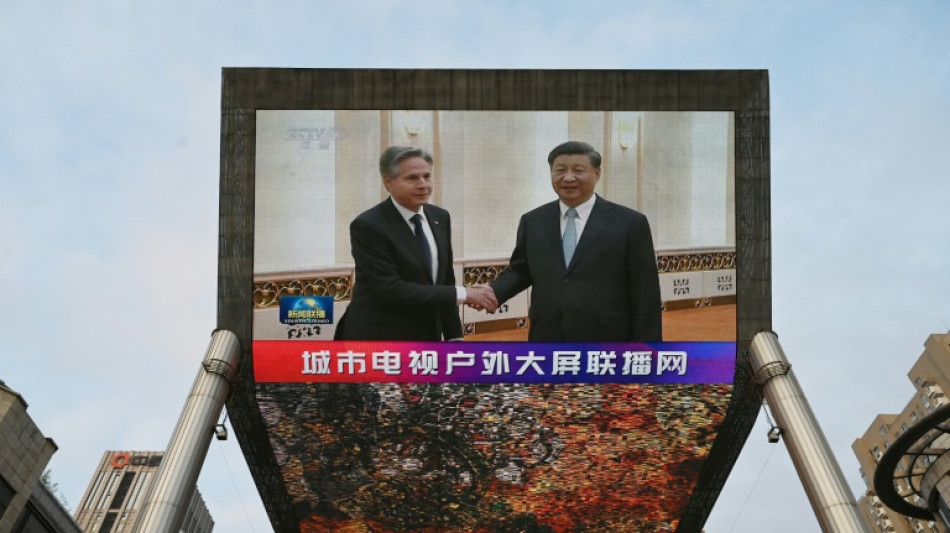
The United States and China looked to set up a safety net for their intensifying rivalry during a visit to Beijing by Secretary of State Antony Blinken, but the trip achieved only general promises and no breakthroughs on hoped-for military talks and flashpoint issues.
Both President Xi Jinping, who met Blinken on Monday at the end of his 11 hours of talks in Beijing, and President Joe Biden saluted the long-awaited trip as a sign of progress following months of soaring tensions.
"It was clear coming in that the relationship was at a point of instability, and both sides recognised the need to work to stabilise it," Blinken told reporters in Beijing.
US officials have repeatedly spoken of expanding communication to establish "guardrails" in the relationship to prevent misunderstandings from descending into conflict.
But Blinken acknowledged that the United States did not achieve one of its wishes most crucial to avoiding miscalculations -- a resumption of dialogue between the two militaries.
And the two powers remained far apart on Taiwan, the self-ruling democracy that Beijing has not ruled out seizing by force.
Blinken insisted the United States wanted to preserve the status quo and "responsible management of the Taiwan question" as he raised concerns about "provocative" moves by Beijing.
China's top diplomat, Wang Yi, told Blinken that on Taiwan there was "no room to compromise or concede" by Beijing, which has carried out military drills twice since August including after a defiant visit to Taipei by Nancy Pelosi, then speaker of the House of Representatives.
Bonnie Glaser, a China expert at the German Marshall Fund of the United States, said Beijing was increasingly on guard as Taiwan approaches elections next year and that Blinken's remarks sounded like "boilerplate placeholders".
"The two sides have basically agreed to explore the possibility of stabilising the bilateral relationship. There is no certainty they will achieve that goal," she said.
- Can gap be narrowed? -
Glaser noted that while the United States speaks of managing the growing rivalry, Xi again spoke of avoiding competition between major powers.
"I think accepting competition is necessary in order to stabilise the relationship. So I see this gap between the two sides that has yet to be narrowed, and I don't know if it will be," she said.
Yun Sun, director of the China programme at the Stimson Center, said the United States shared blame for the failure to restart dialogue in the military realm, an area where a crisis is most likely to erupt.
The Biden administration -- which the rival Republican Party is eager to portray as weak on Beijing -- has refused Chinese requests to lift sanctions on its new defence minister, General Li Shangfu, which were imposed under a US law that targets arms purchases from Russia.
The administration says that sanctions should not prevent Li from meeting his counterpart Lloyd Austin.
"The State Department will say there is no legal problem for him to meet Secretary Austin. Sure, there's no problem for the Americans, but there is for the Chinese," Yun said.
"It takes two to dance. At least to me, it's not an unreasonable request," she said of removing sanctions.
- Expectations for summit -
Shi Yinhong, a professor of international relations at Renmin University of China, said Blinken's visit was in line with expectations and that the two sides both stressed the positive.
He said the atmosphere appeared on track for Xi to pay a visit to the United States in November, when Biden will welcome leaders to San Francisco for the Asia-Pacific Economic Cooperation forum.
The talk of greater communication and narrow cooperation "of course are positive, though difficult to be concretely implemented", Shi said.
Xi and Biden, who know each other well from their times as vice presidents, met for the first time as leaders in November in Bali, where both sides similarly said they wanted to keep tensions in check.
The Bali good vibes abruptly ended within months when the United States said it detected and later shot down a Chinese spy balloon over US soil, leading Blinken to put off an earlier plan to visit.
Xi in a speech soon afterward took rare direct aim at the United States, which he accused of pursuing "containment, encirclement and suppression" of China.
China has been particularly incensed by Biden's ban on semiconductor exports. Blinken said in Beijing that the United States was not trying to "economically contain" China but rather did not want US technology to go against its own interests.
Yun, the Washington-based analyst, noted that the United States has kept issuing sanctions on Chinese companies and that House Speaker Kevin McCarthy, Pelosi's Republican successor, has voiced hope of paying his own visit to Taiwan.
"I don't expect this temporary restarting of engagement to survive that kind of trauma," she said.
"After Blinken's visit, the relationship is still extremely vulnerable."
O.Mousa--SF-PST