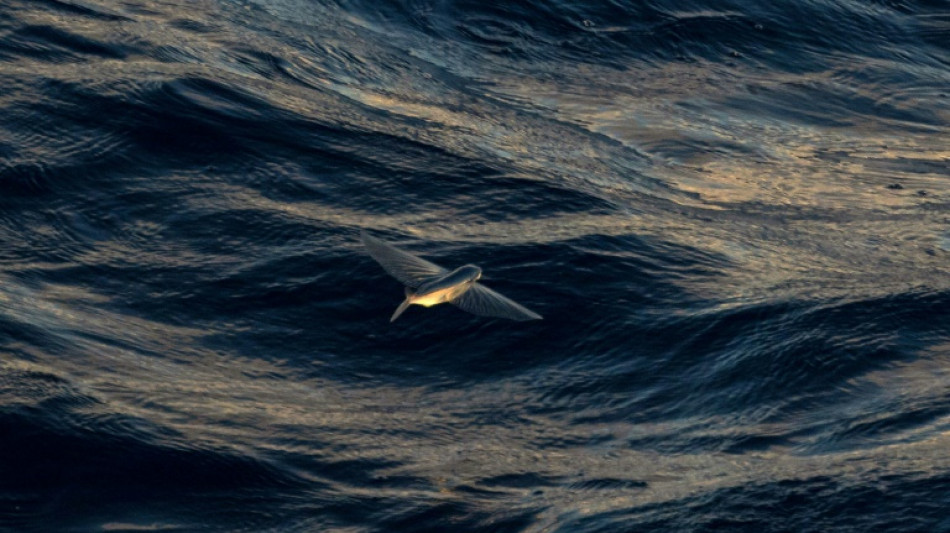
What does the UN high seas treaty mean for protecting the ocean? / Photo: PATRICK HERTZOG - AFP

 Hotel Blacklist Launches New Accommodation Industry Risk Assessment Tool

 Bangladesh nuclear plant draws hope -- and worry

 US beat Canada 1-0 to wrap up four-win international break
 Turkey, Australia's joint COP31 leadership raises doubts

 For Turkish NGOs, COP31 offers rare space for action

 Sleep, appetite, gene-editing experts contend for Nobel chemistry prize

 Nobel Peace Prize haunted by the 'spectre' of Trump

 Africa launches own credit agency in bid for cheaper borrowing

 US, China, EU: three paths to regulating AI

 Australia's High Court rules against coal mine in landmark climate case
 Australia touts new funds for Pacific infrastructure at Fiji 'pre-COP'
 Eva Marie Saint, Oscar winner of Hollywood classics, dies at 102

 Australia probes app used in cheap smart glasses over privacy fears

 England needed to 'move on' from World Cup pain, says Tuchel

 O'Neill to stay at Celtic after period of "reflection"

 Kane marks 125th England cap with Wembley Nations League double

 Quebec's incoming separatist leader wants to block Crown from swearing-in

 Emmys gala will now stream its premier television awards

 Paramount completes Warner Bros takeover, creating Skydance

 Trump blames France unrest on Islam, migration

 Apple's Cook praises EU over efforts to protect children online

 Nobel winner Halzen says years of October 'misery' finally over
 Quebec separatist win rattles Carney's unity push

 'Itching' for change: Shiffrin cuts back slaloms this season

 'Gen Z has risen up': Tens of thousands mass for tense France school protests

The world's first international treaty to protect the high seas, adopted by the United Nations on Monday, contains landmark tools for the conservation and management of international waters.
International waters -- outside the jurisdiction of any single state -- cover more than 60 percent of the world's oceans.
Ocean ecosystems create half the oxygen humans breathe and limit global warming by absorbing much of the carbon dioxide emitted by human activities.
The UN treaty, which will open for signatures on September 20, will go into force 120 days after 60 countries have ratified it.
Here are the key points of the text approved in March.
- Ocean under threat -
The treaty begins by recognizing "the need to address, in a coherent and cooperative manner, biodiversity loss and degradation of ecosystems of the ocean."
These impacts include the warming of ocean waters along with their loss of oxygen, acidification, mounting plastics and other pollutants, as well as overfishing.
The text specifies that it will apply to waters beyond countries' exclusive economic zones, which extend to a maximum of 200 nautical miles from the coasts.
It also covers what is known as "the Area", shorthand for seabed and subsoil beyond the limits of national jurisdiction. The Area comprises just over half of the planet's seabed.
The Conference of the Parties (COP) will have to navigate the authority of other regional and global organizations.
Chief among these are regional fisheries bodies and the International Seabed Authority, which oversees permits for deep-sea mining exploration in some areas and may soon make the controversial move of allowing companies to mine beyond current test runs.
- Marine protected areas -
Currently, almost all protected marine areas (MPAs) are within national territorial waters.
The treaty, however, allows for these reserves to be created in the open ocean.
Most decisions would be taken by a consensus of the COP, but an MPA can be voted into existence with a three-quarters majority, to prevent deadlock caused by a single country.
One crucial shortcoming: the text does not say how these conservation measures will be monitored and enforced over remote swathes of the ocean -- a task that will fall to the COP.
Some experts say satellites could be used to spot infractions.
Individual countries are already responsible for certain activities on the high seas that they have jurisdiction over, such as those of ships flying their flags.
- Sharing the bounty? -
On the high seas, countries and entities under their jurisdiction will be allowed to collect animal, plant, or microbial matter whose genetic material might prove useful, even commercially.
Scientists, for example, have discovered molecules with the potential to treat cancer or other diseases in microbes scooped up in sediment, or produced by sponges or marine mollusks.
Benefits-sharing of those resources has been a key point of contention between wealthy and poorer nations.
The treaty establishes frameworks for the transfer of marine research technologies to developing countries and a strengthening of their research capacities, as well as open access to data.
But it's left to the COP to decide exactly how any monetary benefits will eventually be shared, with options including a system based on specific commercialized products, or more generalized payment systems.
- Environmental impact studies -
The treaty requires signatories to assess the environmental impacts of planned activities under their control on the high seas before they are authorized in instances when such activities may have more than a minor or transitory effect.
It also calls for countries to assess the potential impact on international waters of activities within national jurisdictions that may cause "substantial pollution" or harm the high sea marine environment.
Ultimately, states are responsible for giving the green light to any potentially harmful activity -- a role NGOs hoped would go to the COP, to make controversial approvals more difficult.
The treaty also requires states to publish updates on an activity's environmental impacts. Approvals can be called into question if unanticipated impacts arise.
Though they are not specifically listed in the treaty, activities that could come under regulation include transport and fishing, as well as more controversial subjects such as deep-sea mining or even geo-engineering initiatives to mitigate global warming.
A.AbuSaada--SF-PST