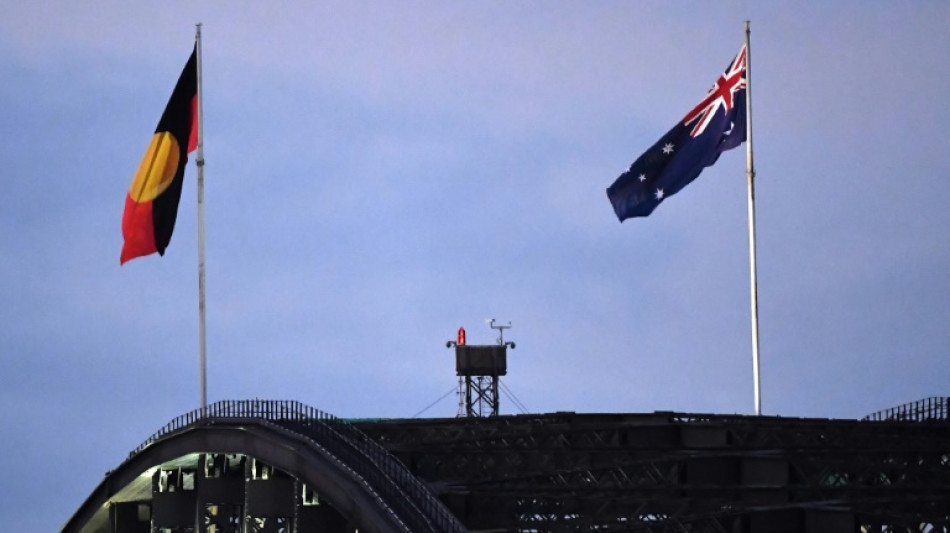
Australia set for landmark Indigenous rights referendum / Photo: Saeed KHAN - AFP/File

 Lloyd’s Register Approves First Universal Classification Rules for Nuclear-Powered Maritime Units

 Luxembourg Hosts European Coalition Meeting on Crisis Resilience

 Grammy Winner Silvana Estrada Named Creative Chair for Latin Music at LA Phil

 Lotto Results for Saturday, November 21, 2026

 Meta Offices Vandalized in India Amid Protests Over Account Removals

 اندلاع حريق في ناقلة نفط بمضيق هرمز بعد استهدافها بمقذوف

 England vs New Zealand Nations Championship 2026: Viewing Guide and Kick-off Time
Australia's parliament on Monday paved the way for a historic referendum on Aboriginal rights, with voters set to decide if the Indigenous population gets a dedicated "voice" in national policymaking.
The Senate passed referendum legislation 52-19, allowing Prime Minister Anthony Albanese to set a date for a vote, which is now expected by year's end.
The referendum will be a pivotal moment in national politics -- helping define what it means to be Australian and redefining the often-troubled relationship between Indigenous minorities and the white majority.
If passed, Indigenous Australians -- whose ancestors have lived on the continent for at least 60,000 years -- would be recognised in the constitution for the first time.
Aboriginal and Torres Strait Islanders would also gain a constitutionally enshrined right to be consulted by the government on laws that impact their communities.
"This is about who we are as a nation," said Albanese, welcoming the passage in parliament and wasting no time in making the case for a "Yes" vote.
"Today, our Parliament has said 'yes' to holding a referendum," the centre-left leader said.
"Now, the Australian people will have a chance to say 'yes' to reconciliation and 'yes' to constitutional recognition of First Nations people."
The "Yes" campaign hopes the creation of a consultative body would empower Indigenous populations that are plagued by poorer health, lower levels of education, and higher rates of imprisonment.
Current polls show a majority backing for the so-called "Voice to Parliament", but with support slipping as the debate becomes increasingly acrimonious.
Opposition leader Peter Dutton -- whose conservative coalition is split on his referendum stance -- has claimed a "Yes" vote would split the country along racial lines.
"It will have an Orwellian effect where all Australians are equal, but some Australians are more equal than others," he said earlier this year.
That sentiment was denounced Monday as "racist dog-whistling" by Green party leader Adam Bandt.
But the Voice to Parliament is not universally popular among Aboriginal Australians, with some questioning whether it is a bureaucratic fix that will have little real impact.
Independent senator Lidia Thorpe, a prominent Indigenous activist, said it was a "powerless advisory body".
"That's what this is about -- it's appeasing the white guilt in this country," she said before the bill was passed on Monday.
Indigenous rights advocate Pat Anderson urged "maturity" in the debate.
"The Australian people will decide what sort of a country we are, what do we stand for," she said. "What are our values? Who are we? That is what we will vote on soon."
Z.Ramadan--SF-PST