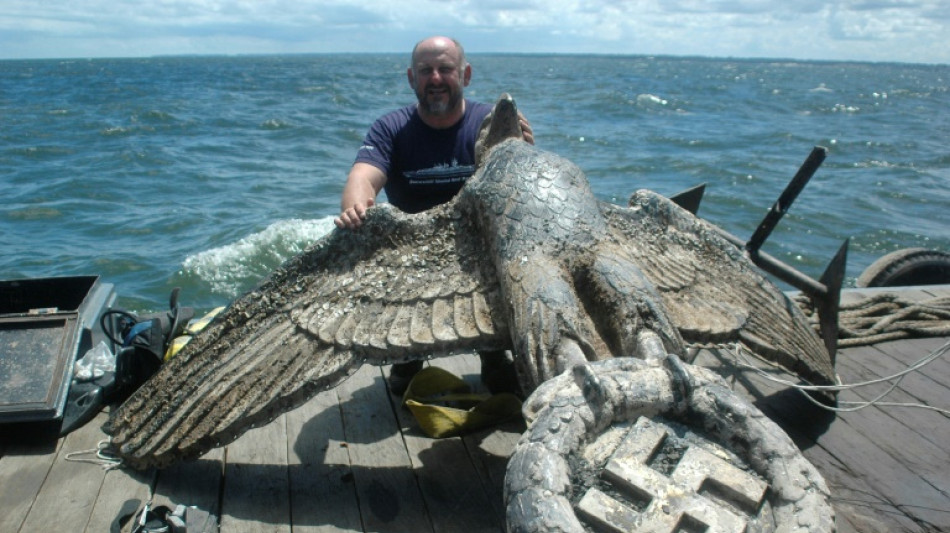
Uruguay abandons plan to melt, recast Nazi bronze / Photo: HO - ALFREDO ETCHEGARAY/AFP

 Lloyd’s Register Approves First Universal Classification Rules for Nuclear-Powered Maritime Units

 Luxembourg Hosts European Coalition Meeting on Crisis Resilience

 Grammy Winner Silvana Estrada Named Creative Chair for Latin Music at LA Phil

 Lotto Results for Saturday, November 21, 2026

 Meta Offices Vandalized in India Amid Protests Over Account Removals

 اندلاع حريق في ناقلة نفط بمضيق هرمز بعد استهدافها بمقذوف

 England vs New Zealand Nations Championship 2026: Viewing Guide and Kick-off Time
Uruguayan authorities are reversing plans to melt down a bronze eagle found on a sunken Nazi ship and recast it as a dove of peace, the president said Sunday.
The imposing bronze eagle, weighing 350 kilos (771 pounds) and clutching a swastika between its claws, was recovered from a World War II-era German destroyer off Uruguay's coast 17 years ago.
On Friday, President Luis Lacalle Pou had told reporters that this "symbol of violence and war" would be turned into a "symbol of peace and union."
But the plan drew concern from both cultural and political spheres.
By Sunday, the president had reversed himself, saying: "There is an overwhelming majority that does not share this decision" to melt and recast the eagle.
"And if one wants to generate peace, the first thing one has to do is to generate union," he added. "Clearly this has not generated it"
The bronze eagle had adorned the stern of the Admiral Graf Spee, a battleship involved in one of the first naval skirmishes of World War II.
The Graf Spee's captain, Hans Langsdorff, scuttled the battleship -- one of the Third Reich's largest -- on December 17, 1939, following the Battle of the River Plate, off the Uruguayan coast.
The sculpture was found in 2006 after a 10-year hunt, but what to do with it has long been a source of controversy.
The German government complained when, after its discovery, it was briefly displayed in Montevideo, with Berlin discouraging the exhibition of Nazi paraphernalia.
In 2010, the German foreign minister said his desire was "to prevent the remains of the symbols of the Nazi regime from becoming commercialized," and discouraged selling it to private collectors, fearing the eagle could fall into the hands of Nazi sympathizers.
V.AbuAwwad--SF-PST