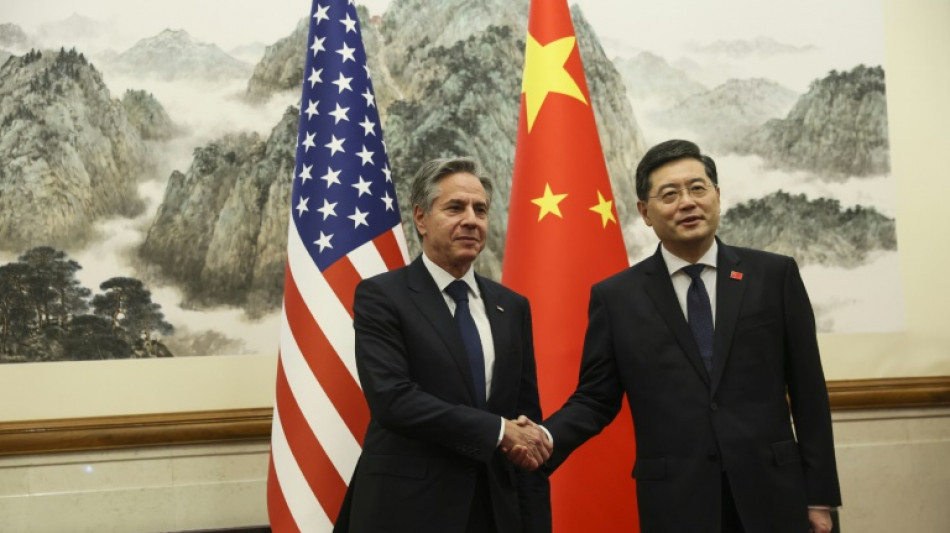
Blinken opens rare Beijing visit in bid to lower temperature / Photo: LEAH MILLIS - POOL/AFP

 Myanmar leader lands in Malaysia for migrant return talks

 Indian central bank hikes rates for first time since 2023

 US military on Okinawa face curfew, alcohol ban after murder case

 Fierce lobbying in EU over 'forever chemicals'

 Dodgers beat Braves and Padres avoid sweep in MLB playoffs
 Mourning, war and elections as Israel marks October 7

 Messi says Argentina retirement is 'saddest day of my career'
 Oil rises and stocks fall as Hormuz worries flare

 Pacific presses world for help 'surviving' climate change at pre-COP summit
 Verstappen revival to be put to the test in steamy Singapore
 US woman who survived botched execution is conscious, speaking: lawyers

 Climate champion Australia digging more coal
 Emotion, tears as Messi retires from Argentina national team

 Dodgers push Braves to the brink of MLB playoff exit
 Crisis-stricken Haiti postpones elections
 N. Korea's Kim pledges 'invariable support' in Putin birthday letter

 OGRD Alliance Advances PLPC Multi-Asset Platform Following APHELAR Milestone, Expanding Licensing and Strategic Capital Frameworks

 Emotion, tears as Messi prepares for Argentina farewell

 Kane eyes Ronaldo record after matching England cap mark

 Spain fight back to beat Croatia, Kane adds to record for England
 Merino double helps Spain beat Croatia, reach Nations League quarters

 US stocks hit fresh records as oil stabilizes on rising supplies

 As Messi bows out, Argentines say 'thank you'

 Ronaldo opens door for Portugal return, apologises for walkout

 'Nobody seems to care': Russian city shrugs off plague reports
Secretary of State Antony Blinken began talks in China on Sunday on the highest-level trip by a US official in nearly five years as the two powers looked to notch down the temperature in an escalating rivalry.
Both sides have voiced guarded hope of improving communication and preventing conflict, with the world's two largest economies at odds on an array of issues from trade to technology and regional security.
Blinken and his aides opened the two-day visit by meeting Foreign Minister Qin Gang at an ornately decorated state villa in Beijing's ancient Diaoyutai gardens, where the Chinese hosts will later throw a banquet dinner.
Qin and Blinken walked along a red carpet and shook hands next to a pair of national flags standing in front of a painting of craggy mountains and wispy clouds.
Blinken earlier said he would seek to avoid "miscalculations" and to "responsibly manage" relations with the country identified by US policymakers across party lines as the greatest challenge to Washington's global primacy.
He was originally scheduled to visit in February but abruptly scrapped his plans as the United States protested -- and later shot down -- what it said was a Chinese spy balloon flying over its soil.
US President Joe Biden played down the balloon episode as Blinken was heading to China, saying: "I don't think the leadership knew where it was and knew what was in it and knew what was going on."
"I think it was more embarrassing than it was intentional," Biden told reporters Saturday.
Biden said he hoped to again meet President Xi Jinping after their lengthy and strikingly cordial meeting in November on the sidelines of a Group of 20 summit in Bali, where they agreed on Blinken's visit.
"I'm hoping that, over the next several months, I'll be meeting with Xi again and talking about legitimate differences we have but also how there's areas we can get along," Biden said.
The two leaders are likely to attend the next G20 summit, in September in New Delhi, and Xi is invited to travel to San Francisco in November when the United States hosts the Asia-Pacific Economic Cooperation forum.
- Array of disputes -
The United States and China are at odds over a slew of issues including trade, technology and Taiwan.
Beijing has not ruled out seizing Taiwan by force and has conducted military drills twice since August near the self-governing democracy, in response to the actions of top US lawmakers.
Ahead of Blinken's visit, Chinese foreign ministry spokesman Wang Wenbin said the United States needed to "respect China's core concerns" and "give up the illusion of dealing with China 'from a position of strength'".
Beijing has been especially irritated by Biden's restrictions on the export of high-end semiconductors to China, with the United States both fearing their military application and eager to prevent the communist state from dominating next-generation technologies.
In a rising domestic priority for the United States, an aide said Blinken is expected to press China to curb precursor chemicals sent to Latin America to produce fentanyl, the powerful painkiller behind an addiction pandemic that kills tens of thousands of Americans a year.
Washington has also lashed China over human rights, with Blinken's visit the first by a cabinet member since the United States formally accused Beijing of genocide against the mostly Muslim Uyghur minority.
- Keeping allies close -
As part of the Biden administration's focus on keeping allies close, Blinken spoke by telephone with his counterparts from both Japan and South Korea during his 20-hour trans-Pacific journey.
Biden's national security advisor, Jake Sullivan, travelled to Tokyo for separate three-way meetings involving Japan and both South Korea and the Philippines.
In recent months the United States has reached deals on troop deployments in southern Japan and the northern Philippines, both strategically close to Taiwan.
Blinken before departure also met in Washington with his counterpart from ally Singapore, who voiced hope that the United States would stay as a power but also find ways to coexist with a rising China.
Blinken's "trip is essential, but not sufficient", Foreign Minister Vivian Balakrishnan said.
"There are fundamental differences in outlook, in values. And it takes time for mutual respect and strategic trust to be built in."
Blinken is the first top US diplomat to visit Beijing since a stop in 2018 by his predecessor Mike Pompeo, who later championed no-holds-barred confrontation with China in the final years of Donald Trump's presidency.
The Biden administration has gone further than Trump in some areas, notably semiconductors, but has remained open to cooperation in limited areas such as climate.
Experts say China sees more predictability with Biden than with Trump, who is running for president again next year.
Danny Russel, the top diplomat on East Asia during Barack Obama's second term, doubted Blinken's brief trip would resolve fundamental differences.
"But his visit may well restart badly needed face-to-face dialogue and send a signal that both countries are moving from angry rhetoric at the press podium to sober discussions behind closed doors."
Z.Ramadan--SF-PST