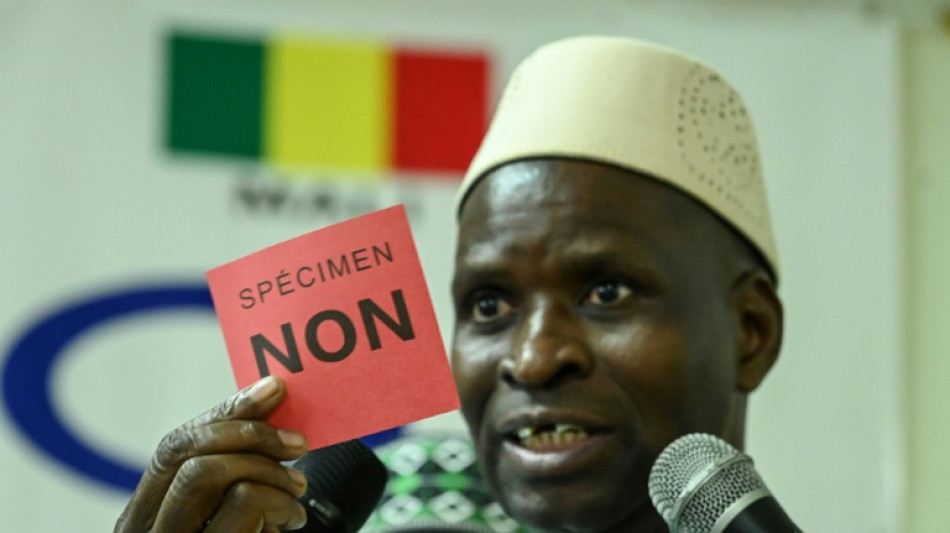
Mali junta holds vote on new constitution / Photo: Sia KAMBOU - AFP

 Myanmar leader lands in Malaysia for migrant return talks
 Indian central bank hikes rates for first time since 2023
 US military on Okinawa face curfew, alcohol ban after murder case

 Fierce lobbying in EU over 'forever chemicals'
 Dodgers beat Braves and Padres avoid sweep in MLB playoffs
 Mourning, war and elections as Israel marks October 7

 Messi says Argentina retirement is 'saddest day of my career'
 Oil rises and stocks fall as Hormuz worries flare

 Pacific presses world for help 'surviving' climate change at pre-COP summit
 Verstappen revival to be put to the test in steamy Singapore
 US woman who survived botched execution is conscious, speaking: lawyers

 Climate champion Australia digging more coal
 Emotion, tears as Messi retires from Argentina national team
 Dodgers push Braves to the brink of MLB playoff exit
 Crisis-stricken Haiti postpones elections
 N. Korea's Kim pledges 'invariable support' in Putin birthday letter

 OGRD Alliance Advances PLPC Multi-Asset Platform Following APHELAR Milestone, Expanding Licensing and Strategic Capital Frameworks

 Emotion, tears as Messi prepares for Argentina farewell

 Kane eyes Ronaldo record after matching England cap mark

 Spain fight back to beat Croatia, Kane adds to record for England

 Merino double helps Spain beat Croatia, reach Nations League quarters

 US stocks hit fresh records as oil stabilizes on rising supplies

 As Messi bows out, Argentines say 'thank you'

 Ronaldo opens door for Portugal return, apologises for walkout

 'Nobody seems to care': Russian city shrugs off plague reports

Malians go to the polls on Sunday to pass judgment on the governing junta's constitution, which has fuelled speculation that the country's strongman ruler will seek election.
The west African nation has been under military rule since an August 2020 coup, which came after a decade of instability marked by jihadist insurgencies and political and economic crisis.
Some 8.4 million citizens are eligible to vote "yes" or "no" on the draft constitution in the first electoral test for leader Colonel Assimi Goita, 40, who has vowed to lead the country back to civilian rule in 2024 elections.
Voting begins at 0800 GMT and results are expected within 72 hours.
But election turnout is typically low in the country of 21 million, where many have grown weary of chronic instability, while others face the direct danger of jihadist attacks in central and northern regions.
Security is an ever-present concern -- there is always the risk of an attack. For this reason the vote will not be held in some parts of the country, including in Kidal, the ex-rebels' stronghold in the north.
The junta will be judged on turnout as a measure of its ability to restore stability, as well as an indicator of people's enthusiasm for the junta's agenda.
- Chronic instability -
The junta has advertised the new constitution as the answer to Mali's inability to tackle its multiple crises.
Mali's recent woes began in 2012, when separatist insurgents in the north -- long seen as marginalised by the southern government -- aligned with Al-Qaeda-linked Islamists to seize vast swathes of territory.
Former colonial power France stepped in and helped push back the Islamists, but attacks have continued, and Bamako has since broken its alliance with Paris in favour of Russia and its Wagner mercenaries.
Disputed parliamentary elections in March 2020, and mass protests against a government unable to reign in the insurgency, corruption and economic crisis, ended in a coup.
Goita initially appointed an interim president, but kicked him out in a second coup in 2021 and stepped into the top job himself.
Now doubts are swirling over his commitment to step down next year.
Mali's ruling junta called on Friday for the immediate departure of the country's UN peacekeeping mission, a central and controversial actor in a security crisis that has claimed the lives of nearly 200 peacekeepers in the last decade.
The African nation's military rulers had increasingly imposed operational restrictions on the peacekeepers, ultimately accusing the mission on Friday of not only being a "failure", but even becoming "part of the problem".
- A stronger presidency -
The new constitution will strengthen the role of the president, who will have the right to hire and fire the prime minister and cabinet members.
The government will answer to the president, and not parliament as the current 1992 document states.
It will also give amnesty to those behind prior coups, reform the regulation of public finances, and force MPs and senators to declare their wealth in a bid to clamp down on corruption.
"Those who contest these provisions think that Goita will be a candidate in the elections" in 2024, said Bamako University sociologist Brema Ely Dicko.
A politician, speaking on condition of anonymity, said some in the military were hoping a new constitution would "reset the clock" -- erasing a previous commitment that Goita would not take part in the election.
- 'Very popular' -
Goita, a former special forces commander who saw action during the 2012 rebellion, stays out of the limelight, and is known to be publicity shy.
"Opinion in Bamako is favourable to the president," said Dicko.
"Through his political and verbal silence he has become a sort of icon, and is very popular," said political scientist Abdoul Sogodogo.
Observers say a vote for "yes" is almost certain.
"Malians say that presidents from democratic regimes did not necessarily shine. Corruption has reached a certain level. People want to see something else," Dicko explained.
However, the reform has drawn vocal opposition, from former rebels and imams as well as political opponents.
Influential religious organisations oppose the continuation of secularism enshrined in the current constitution.
In the north, former rebels who, unlike the jihadists, signed a major peace deal with the state, also reject it.
"Mali needs a system built around institutions and not a system built around a man," said Makan Mary, a member of the Yelema party.
One researcher, who like many others spoke on condition of anonymity, argued the old constitution was satisfactory.
"The problem with the 1992 constitution is that it was never really applied... it cannot be the cause of the crisis," the researcher said.
Turnout is widely expected to be low.
"Generally, Malians do not vote. Since 1992, turnout has rarely exceeded 30 percent," said Sogodogo, the political scientist.
M.AlAhmad--SF-PST