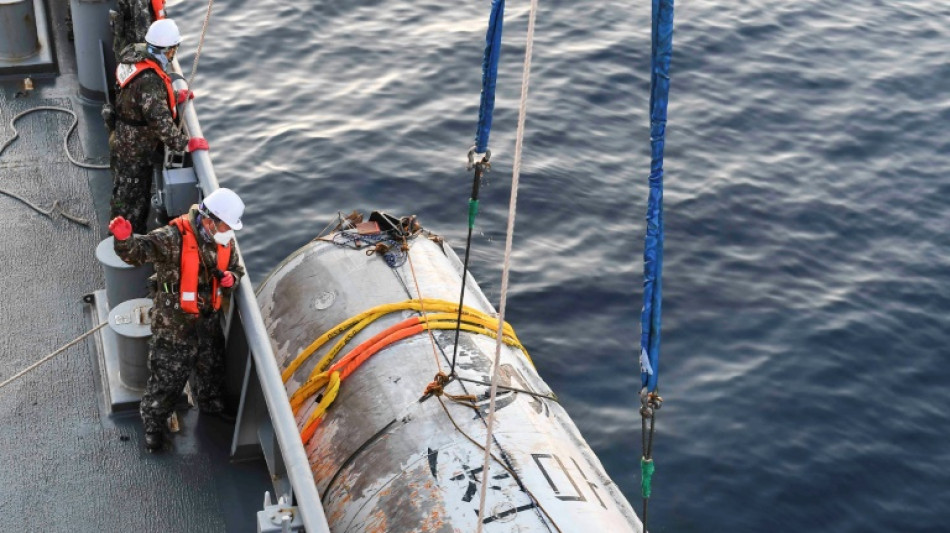
Seoul military salvages North Korea's space rocket wreckage / Photo: Handout - South Korean Defence Ministry/AFP

 Lloyd’s Register Approves First Universal Classification Rules for Nuclear-Powered Maritime Units

 Luxembourg Hosts European Coalition Meeting on Crisis Resilience

 Grammy Winner Silvana Estrada Named Creative Chair for Latin Music at LA Phil

 Lotto Results for Saturday, November 21, 2026

 Meta Offices Vandalized in India Amid Protests Over Account Removals

 اندلاع حريق في ناقلة نفط بمضيق هرمز بعد استهدافها بمقذوف

 England vs New Zealand Nations Championship 2026: Viewing Guide and Kick-off Time
South Korea's military said Friday it had successfully retrieved a large chunk of a crashed North Korean space rocket from the sea bed after 15 days of complex salvage operations.
North Korea attempted to put its first military spy satellite into orbit on May 31, but the projectile and its payload crashed into the sea shortly after launch due to what Pyongyang said was a rocket failure.
After deploying a fleet of naval rescue ships and minesweepers plus dozens of deep-sea divers, Seoul's military said it had managed to salvage what appeared to be the main body of the rocket late Thursday from the Yellow Sea.
"The salvaged object is scheduled to be analysed in detail by specialised institutions such as the national agency for defense development," the Joint Chiefs of Staff said in a statement.
The wreckage was pulled from the sea bed at a depth of about 75 metres (250 feet) in waters about 200 kilometres (125 miles) southwest of Eocheong Island, it added.
Images released by Seoul's defence ministry showed a long, white barrel-like metal structure with the word "Chonma" written on it -- possibly a shorter form of the rocket's official name, Chollima-1.
The rocket was named after a mythical winged horse that often features in Pyongyang's propaganda.
The May 31 launch was slammed by the United States, South Korea and Japan, saying it violated UN resolutions barring the nuclear-armed country from any tests using ballistic missile technology.
Analysts have said there is significant technological overlap between the development of intercontinental ballistic missiles and space launch capabilities.
Seoul has been working for the last two weeks to recover the wreckage of the space rocket, as the debris could help scientists gain insight into Pyongyang's ballistic missile and satellite surveillance programmes.
North Korea vowed after the May 31 failure that it would successfully launch its spy satellite soon.
Pyongyang has previously claimed its military spy satellite is necessary to counterbalance the growing US military presence in the region.
North Korea fired two short-range ballistic missiles Thursday, shortly after it warned of an "inevitable" response to ongoing US-South Korea joint military drills.
Relations between the two Koreas are at one of their lowest points in years, with diplomacy stalled and North Korea's leader Kim Jong Un declaring his country an "irreversible" nuclear power, as well as calling for ramped-up weapons production, including of tactical nukes.
T.Samara--SF-PST