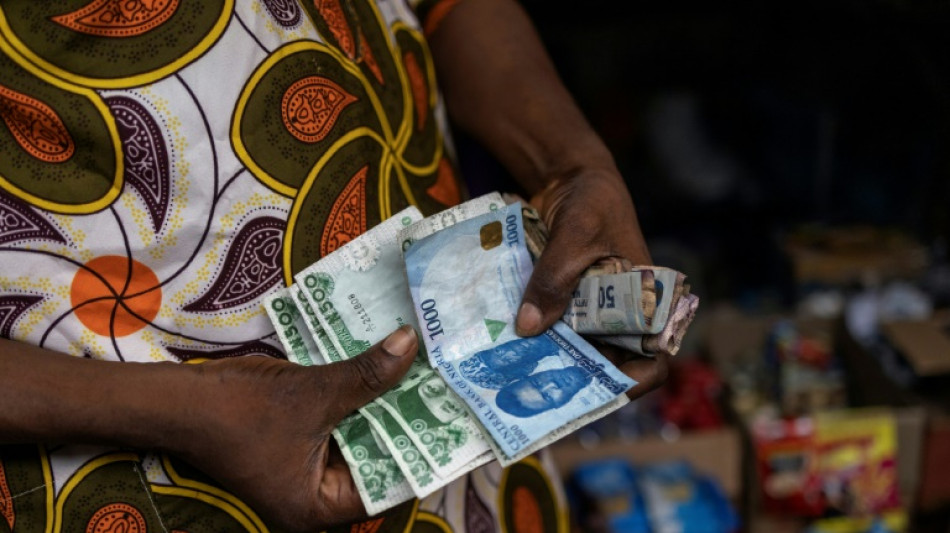
Nigeria unifies currency exchange rates, floats naira / Photo: Michele Spatari - AFP

 Lloyd’s Register Approves First Universal Classification Rules for Nuclear-Powered Maritime Units
 Luxembourg Hosts European Coalition Meeting on Crisis Resilience

 Grammy Winner Silvana Estrada Named Creative Chair for Latin Music at LA Phil

 Lotto Results for Saturday, November 21, 2026

 Meta Offices Vandalized in India Amid Protests Over Account Removals

 اندلاع حريق في ناقلة نفط بمضيق هرمز بعد استهدافها بمقذوف

 England vs New Zealand Nations Championship 2026: Viewing Guide and Kick-off Time
Nigeria's central bank has abolished the country's multiple exchange rate system and effectively floated the naira currency, the bank said, as new President Bola Ahmed Tinubu revamps the country's monetary policies.
Economists, the World Bank and IMF had long urged Nigeria to abandon the complex exchange mechanism and capital controls put into place under former President Muhammadu Buhari as a way to encourage investment in Africa's largest economy and top oil producer.
In a statement late Wednesday, the Central Bank of Nigeria said it had ended the "segmentation" of forex markets, with transactions to be carried out only through one so-called "Investors and Exporters" category.
The naira will also be traded at a "willing buyer, willing seller" market rate instead of regulated rates against the US dollar and other currencies, the statement said.
"All segments are now collapsed into the Investors and Exporters window," it said in a statement posted on its website.
The naira currency had officially traded at around 460 to the dollar last week, but by the end of official trade on Wednesday it had closed at around 660 to the dollar, according to local traders and analysts.
"It is effectively both a devaluation as well as a deregulation," said Tunde Ajileye, an analyst at Nigeria's SBM Intelligence.
"A lot of the market distortions that were there because the central bank and the Nigerian government were trying to control the FX price, will go. So its positive."
The controls had created a back up in demand for foreign currency and a thriving black market or parallel trade where the naira was selling at around 750 to the greenback.
Foreign airlines operating in Nigeria, for example, had often complained of their inability to expatriate millions of dollars of their earnings because of the controls.
The forex shakeup is just one of a raft of decisions taken by former Lagos State governor Tinubu since he came to presidency two weeks ago promising reforms to revitalise the economy of Africa's most populous nation.
On his May 29 inauguration, Tinubu ended the country's long-standing subsidy on petrol prices to keep them artificially low but which cost of billions of dollars for the cash-strapped government.
Fuel prices almost tripled across Nigeria after Tinubu announced that subsidies were "gone", but most analysts say the measure was needed to end to help the government cut spending.
A week ago, Tinubu's government also suspended the country's central bank chief who was later detained by domestic security services as part of an investigation into his time in office.
Tinubu on Wednesday also suspended the country's anti-corruption chief as part of an investigation into allegations of abuse of office, the government said, and he was later questioned by domestic security services.
V.AbuAwwad--SF-PST