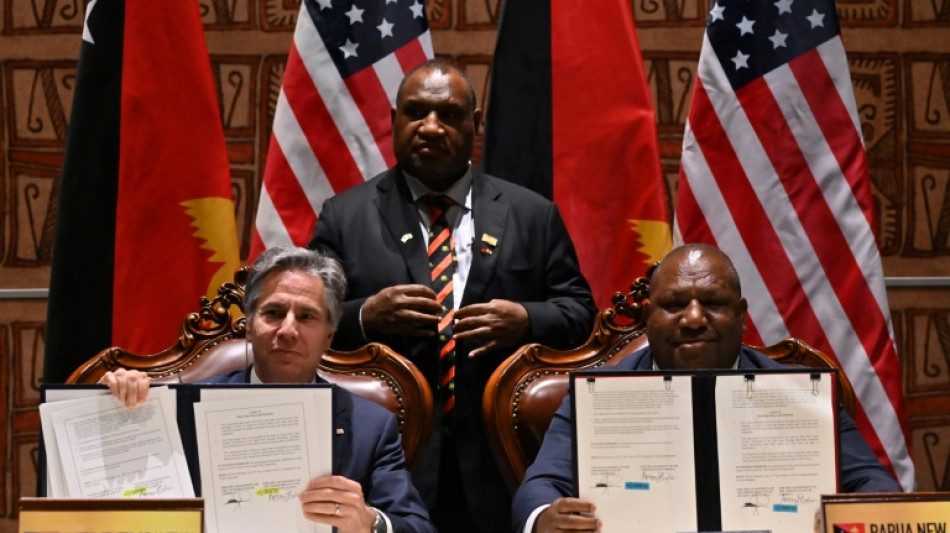
US military wins 'unimpeded' access to Papua New Guinea bases / Photo: ADEK BERRY - AFP

 Indonesian court hears 'negligence' complaint against state over fires, haze
 Rubio in Greece to urge against Western civilisation 'decline'
 Micron workers at Taiwan plant vote in favour of strike

 In 'The Social Reckoning,' Jeremy Allen White takes on Facebook's 'frightening' ambition
 Chip industry activists call for South Korea to recognise cancer cases
 Famine-scarred southern Madagascar braces for El Nino
 How the EU regulates lobbyists
 I.Coast refuge offers lifelong care for youngsters scorned as 'sorcerers'

 Indian central bank hikes rates for first time in more than 3 years

 Hotel Blacklist Launches New Accommodation Industry Risk Assessment Tool

 Bangladesh nuclear plant draws hope -- and worry
 US beat Canada 1-0 to wrap up four-win international break
 Turkey, Australia's joint COP31 leadership raises doubts

 For Turkish NGOs, COP31 offers rare space for action

 Sleep, appetite, gene-editing experts contend for Nobel chemistry prize
 Nobel Peace Prize haunted by the 'spectre' of Trump

 Africa launches own credit agency in bid for cheaper borrowing

 US, China, EU: three paths to regulating AI
 Australia's High Court rules against coal mine in landmark climate case
 Australia touts new funds for Pacific infrastructure at Fiji 'pre-COP'

 Eva Marie Saint, Oscar winner of Hollywood classics, dies at 102

 Australia probes app used in cheap smart glasses over privacy fears

 England needed to 'move on' from World Cup pain, says Tuchel

 O'Neill to stay at Celtic after period of "reflection"

 Kane marks 125th England cap with Wembley Nations League double
The US military can develop and operate out of bases in Papua New Guinea, according to a landmark security pact underpinning Washington's efforts to outflank China in the Pacific.
The full text of the deal was tabled in Papua New Guinea's parliament on Wednesday evening and obtained by AFP, shedding light on details that have been closely guarded since the pact was inked in May.
With Papua New Guinea's agreement, the United States will be able to station troops and vessels at six key ports and airports, including Lombrum Naval Base on Manus Island and facilities in the capital Port Moresby.
Washington would have "unimpeded access" to the sites to "pre-position equipment, supplies and materiel", and have "exclusive use" of some zones, where development and "construction activities" could be carried out.
The agreement opens the door to Washington establishing a new military footprint at a strategically prized deep-water port, at a time of growing rivalry with Beijing.
Perched at the southwest edge of the Pacific Ocean, Lombrum has in the past been used as a garrison for British, German, Japanese, Australian and US troops.
During World War II it was one of the largest US bases in the Pacific, with 200 ships at anchor, including six battleships and 20 aircraft carriers that were used to retake the Philippines from Japan.
China had sought its own foothold at Lombrum in recent years, before being pipped at the post by Australia and the United States, who in 2018 agreed to jointly develop the facility with Papua New Guinea.
Access for US troops to Lombrum could be used to reinforce US facilities on Guam to the north, which could be key in the event of a conflict over Taiwan.
- New Great Game -
Prime Minister James Marape has been forced to defend the deal against a wave of protests and criticism, with some opponents questioning whether Papua New Guinea was signing away its sovereignty.
"We have allowed our military to be eroded in the last 48 years," he told parliament on Wednesday evening.
"Sovereignty is defined by the robustness and strength of your military."
Rich in natural resources and close to key shipping routes, Papua New Guinea increasingly finds itself at the centre of a diplomatic tug-of-war between Washington and Beijing.
Former prime minister Peter O'Neill said the agreement painted a target on Papua New Guinea's back.
"America is doing it for the protection of their own national interest, we all understand the geopolitics happening within our region," he said.
US President Joe Biden had been due to visit Papua New Guinea to sign the deal, a trip that was derailed by a budget tussle in the US Congress.
Washington is trying to woo Pacific nations with an array of diplomatic and financial incentives in return for strategic support, after similar moves by Beijing.
Chinese firms have snapped up mines and ports across the Pacific, and last year inked a secretive security pact with the nearby Solomon Islands that could allow China to deploy troops to the country.
The United States fears that a Chinese military foothold in the South Pacific could outflank its facilities on Guam, and make the defence of Taiwan more complicated in the event of an invasion by mainland China.
N.Shalabi--SF-PST