'Voiceless', destitute: Lebanon's Syrian refugees lose hope for return / Photo: ANWAR AMRO - AFP

 Myanmar leader lands in Malaysia for migrant return talks
 Indian central bank hikes rates for first time since 2023
 US military on Okinawa face curfew, alcohol ban after murder case

 Fierce lobbying in EU over 'forever chemicals'
 Dodgers beat Braves and Padres avoid sweep in MLB playoffs

 Mourning, war and elections as Israel marks October 7

 Messi says Argentina retirement is 'saddest day of my career'
 Oil rises and stocks fall as Hormuz worries flare

 Pacific presses world for help 'surviving' climate change at pre-COP summit

 Verstappen revival to be put to the test in steamy Singapore
 US woman who survived botched execution is conscious, speaking: lawyers

 Climate champion Australia digging more coal

 Emotion, tears as Messi retires from Argentina national team
 Dodgers push Braves to the brink of MLB playoff exit
 Crisis-stricken Haiti postpones elections
 N. Korea's Kim pledges 'invariable support' in Putin birthday letter

 OGRD Alliance Advances PLPC Multi-Asset Platform Following APHELAR Milestone, Expanding Licensing and Strategic Capital Frameworks

 Emotion, tears as Messi prepares for Argentina farewell

 Kane eyes Ronaldo record after matching England cap mark

 Spain fight back to beat Croatia, Kane adds to record for England

 Merino double helps Spain beat Croatia, reach Nations League quarters

 US stocks hit fresh records as oil stabilizes on rising supplies

 As Messi bows out, Argentines say 'thank you'

 Ronaldo opens door for Portugal return, apologises for walkout

 'Nobody seems to care': Russian city shrugs off plague reports

Syrian refugees languishing in camps in eastern Lebanon's Bekaa Valley for years say their hopes for the future are evaporating as their host country loses patience and international support dwindles.
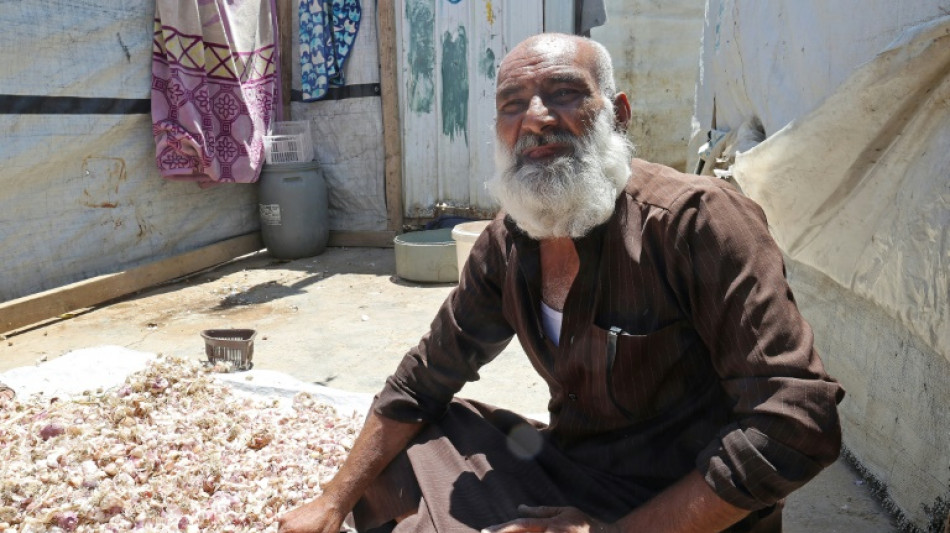
Ibrahim al-Korbaw is only 48, but the hardships of war and poverty have aged the white-bearded man beyond his years.
In front of his tent in Saadnayel, he and his children are hard at work under the midday sun, separating and peeling fragrant cloves of garlic.
Korbaw fled Syria's Raqa almost a decade ago after the Islamic State group took over, turning the city into its de facto Syria capital.
He and five of six children -- all under 12 -- now earn just around $20 a week between them peeling garlic, a meagre supplement to United Nations aid that he said barely covers the necessities.
Aid groups have warned that crucial support for Syrians at home and abroad has dwindled, as the international community meets in Brussels this week for a pledging conference.
One of the boys recently begged Korbaw to stop working because his hands were bruised, "but I told him 'keep going... we must put bread on the table'", Korbaw told AFP.
Lebanese authorities say the country hosts around two million Syrians, while more than 800,000 are registered with the UN -- the highest number of refugees per capita in the world.
- 'No home' -
But amid a crushing economic crisis that has pushed most of Lebanon into poverty, anti-Syrian sentiment has soared, the government has called for refugees to leave and security forces have deported dozens to Syria this year alone.
Korbaw says he cannot go back to his destroyed house in Raqa, and that he fears arrest and deportation -- especially after Lebanese authorities began a crackdown on Syrians in April.
"I would rather die in front of my children" in Lebanon, he said, crouched over the garlic, beads of sweat trickling down his face.
"At least they would know for sure that I'm dead," he added, alluding to the tens of thousands whose fates are unknown in Syria.
Other refugees living in agricultural lands in eastern Lebanon told AFP that no matter how dire their situation, they could not return to Syria because their homes were gone, they feared forced conscription and regime reprisals, or had no means to support their family there.
Korbaw's sister Souad, 34, said she lost all hope of living a normal life after fleeing the horrors of IS jihadists only to lose her 12-year-old son in Lebanon while he was at work.
He died in a tractor accident harvesting potatoes this year, after he and his five siblings were forced to drop out of school to help put food on the table.
"I feel like all the doors are shut for us... like I will never again live a decent life," she said from her shelter.
"I feel like I will live out the rest of my life in this tent, voiceless."
- 'Watching my children die' -
When her husband managed to return to Syria to bury their son, he found the family house looted and destroyed by shelling.
"In Syria, we have no home, no security, no livelihood," she said.
Since 2011, more than 500,000 people have been killed in Syria after the government's brutal crackdown on peaceful protesters plunged the country into a complex war that drew in foreign powers and jihadists.
Madaniya al-Khalaf, 35, told AFP she can no longer afford diapers for her six-month-old baby, and uses a plastic bag and cloth instead after losing meagre UN aid due to budget cuts.
The mother of four said she has had to beg for money from camp dwellers and have her young children rummage through garbage for plastic and metal to sell to make ends meet.
In a nearby camp, Ghofran al-Jassem, 30, originally from northwest Syria's Idlib region, said her four children had "no future" in Lebanon and were not attending school because the family could not afford the bus fares.
Her two boys were born with a heart condition, but she said they had to skip medical tests and borrow money for treatments after she was "cut off from UN aid since November" due to funding shortages. Her husband is only employed in low-paid seasonal work.
Her eldest son, who is seven, could die unless he undergoes a costly heart transplant, she said.
"I'm watching my children die right in front of me," Jassem told AFP, breaking into tears.
"If I stay, I may lose them," she said. "But if I return to Syria I will lose both my children and my husband -- because there is no health care... and my husband will be forcibly conscripted."
Without hope either way, "I may as well stay."
I.Yassin--SF-PST