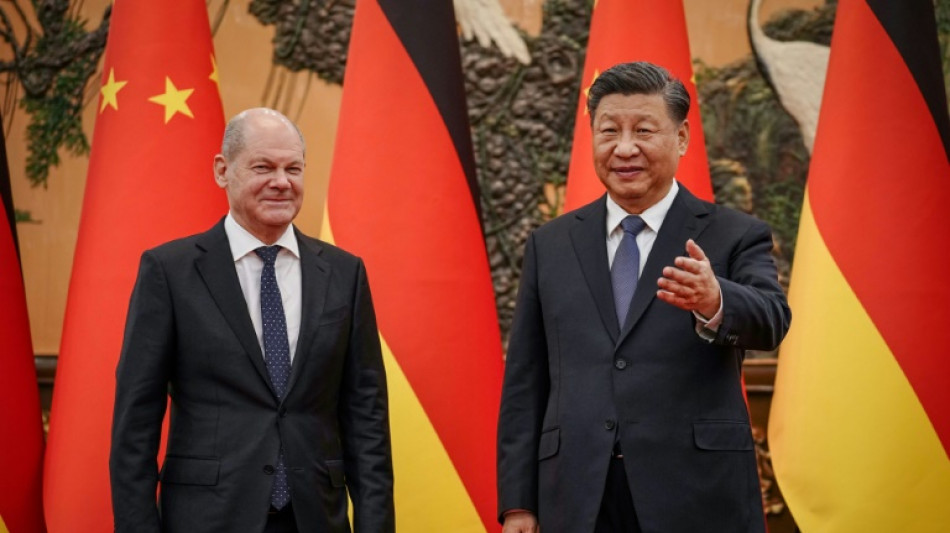
Germany takes aim at China in first national security blueprint / Photo: Kay Nietfeld - POOL/AFP

 Indonesian court hears 'negligence' complaint against state over fires, haze

 Rubio in Greece to urge against Western civilisation 'decline'
 Micron workers at Taiwan plant vote in favour of strike

 In 'The Social Reckoning,' Jeremy Allen White takes on Facebook's 'frightening' ambition
 Chip industry activists call for South Korea to recognise cancer cases
 Famine-scarred southern Madagascar braces for El Nino
 How the EU regulates lobbyists
 I.Coast refuge offers lifelong care for youngsters scorned as 'sorcerers'

 Indian central bank hikes rates for first time in more than 3 years

 Hotel Blacklist Launches New Accommodation Industry Risk Assessment Tool

 Bangladesh nuclear plant draws hope -- and worry
 US beat Canada 1-0 to wrap up four-win international break

 Turkey, Australia's joint COP31 leadership raises doubts

 For Turkish NGOs, COP31 offers rare space for action

 Sleep, appetite, gene-editing experts contend for Nobel chemistry prize
 Nobel Peace Prize haunted by the 'spectre' of Trump

 Africa launches own credit agency in bid for cheaper borrowing

 US, China, EU: three paths to regulating AI

 Australia's High Court rules against coal mine in landmark climate case
 Australia touts new funds for Pacific infrastructure at Fiji 'pre-COP'

 Eva Marie Saint, Oscar winner of Hollywood classics, dies at 102

 Australia probes app used in cheap smart glasses over privacy fears
 England needed to 'move on' from World Cup pain, says Tuchel

 O'Neill to stay at Celtic after period of "reflection"

 Kane marks 125th England cap with Wembley Nations League double

Germany on Wednesday called China a "partner, competitor and systemic rival" in its first national security strategy, accusing Beijing of repeatedly acting against the European giant's interests in a bid to reshape the global order.
The document prepared by Chancellor Olaf Scholz's coalition slammed China for putting regional stability and international security "under increasing pressure" and for disregarding human rights.
"China is trying in various ways to remould the existing rules-based international order, is asserting a regionally dominant position with ever more vigour, acting time and again counter to our interests and values," the strategy paper said.
At the same time, it acknowledged that the Asian giant "remains a partner without whom many global challenges and crises cannot be resolved".
"That is why we must grasp the options and opportunities for cooperation in these fields in particular," the paper said.
Publication of the much-awaited strategy blueprint came just days before Chinese Prime Minister Li Qiang was due to visit Berlin.
Asked what message the document sent to Beijing, Scholz told a press conference "the point is that China will continue to grow economically and that China's integration into world trade and world economic relations should not be impaired.
"But at the same time the security issues that arise for us must be taken into account," he said, adding that Germany "doesn't want decoupling, we want de-risking".
- 'Most significant threat' -
Drawn up under the lead of the foreign ministry, the strategy document covers defence pledges such as the NATO two-percent spending vow, supply chain security and cyberattacks.
It cites Russia as "for now the most significant threat to peace and security in the Euro-Atlantic area", blasting Moscow's invasion of its neighbour Ukraine.
Russia's war has deeply shaken Germany, forcing it to rip up long-held pacifist policies to instead drastically re-arm its army.
The conflict has also prompted Berlin to accelerate plans to reduce its reliance on China, after the coronavirus pandemic acted as a wake-up call on the risks of depending on the Asian giant for health essentials like surgical gowns, masks or medication.
Over the last months, Germany has been busy diversifying its imports or bringing production of key components such as semiconductor chips to its soil.
But Germany's export giants have expressed concerns over the shift away from China, fearful of alienating the huge market.
In a clear warning to German companies, Foreign Minister Annalena Baerbock underlined that Berlin would not be able to bail out huge industrial groups with deep ties with China should a crisis erupt with Beijing.
She added that in discussions with German companies she and Scholz had underscored that lessons had to be drawn from Russia's war on Ukraine.
At the same time, she underlined the importance of boosting cooperation with Beijing in areas on which both sides can agree.
One key area would be on the climate, where the Asian giant's cooperation would be crucial if the world is to succeed in limiting warming to 1.5 Celsius.
"We obviously see the world in a completely different way. But in recognising that the climate crisis is the greatest security threat... we have overlap with China," Baerbock said.
"You can't say that you want to save the world's climate but don't want to talk to China."
Analysts however said the strategy did not contain any answers on how Germany would deal with the most pressing threats.
"The paper contains many clever ideas for dealing with a multi-polar world and considers important aspects of a comprehensive security understanding that goes beyond a military core," noted Tagesspiegel daily.
"But it does not draw up any course of action for the most urgent threats in the current world situation," it said, noting that already in 2024, "the most important pillar of security could crack" if Donald Trump were re-elected as US president.
M.AlAhmad--SF-PST