France says uncovers major disinformation campaign by Russia / Photo: OLIVIER CHASSIGNOLE - AFP

 Indonesian court hears 'negligence' complaint against state over fires, haze

 Rubio in Greece to urge against Western civilisation 'decline'
 Micron workers at Taiwan plant vote in favour of strike
 In 'The Social Reckoning,' Jeremy Allen White takes on Facebook's 'frightening' ambition
 Chip industry activists call for South Korea to recognise cancer cases
 Famine-scarred southern Madagascar braces for El Nino
 How the EU regulates lobbyists
 I.Coast refuge offers lifelong care for youngsters scorned as 'sorcerers'

 Indian central bank hikes rates for first time in more than 3 years
 Hotel Blacklist Launches New Accommodation Industry Risk Assessment Tool
 Bangladesh nuclear plant draws hope -- and worry
 US beat Canada 1-0 to wrap up four-win international break
 Turkey, Australia's joint COP31 leadership raises doubts
 For Turkish NGOs, COP31 offers rare space for action
 Sleep, appetite, gene-editing experts contend for Nobel chemistry prize
 Nobel Peace Prize haunted by the 'spectre' of Trump

 Africa launches own credit agency in bid for cheaper borrowing

 US, China, EU: three paths to regulating AI
 Australia's High Court rules against coal mine in landmark climate case
 Australia touts new funds for Pacific infrastructure at Fiji 'pre-COP'

 Eva Marie Saint, Oscar winner of Hollywood classics, dies at 102

 Australia probes app used in cheap smart glasses over privacy fears
 England needed to 'move on' from World Cup pain, says Tuchel

 O'Neill to stay at Celtic after period of "reflection"

 Kane marks 125th England cap with Wembley Nations League double
France on Tuesday said it had uncovered a major Russian disinformation campaign which involved posting false news items disguised as articles by prominent media, in a "hybrid" war waged by Moscow for its invasion of Ukraine.
Western states have been acutely concerned about an intensification of Russian-led disinformation campaigns, as Moscow seeks to influence public opinion across the world over the war in Ukraine.
"France condemns these actions unworthy of a permanent member of the United Nations Security Council," Foreign Minister Catherine Colonna said.
"The French authorities are working closely with their partners to defeat the hybrid warfare led by Russia," she added.
France has for several years sounded the alarm over alleged Russian disinformation campaigns in areas of Francophone Africa, particularly those where the Russian mercenary group Wagner has been active.
The campaign was carried out by "Russian actors" with "state entities or entities affiliated to the Russian state" then working to amplify its impact, according to Colonna.
"This campaign is based in particular on the creation of fake web pages impersonating national media and government sites as well as the creation of false accounts on social networks," she said.
- 'Won't deter France' -
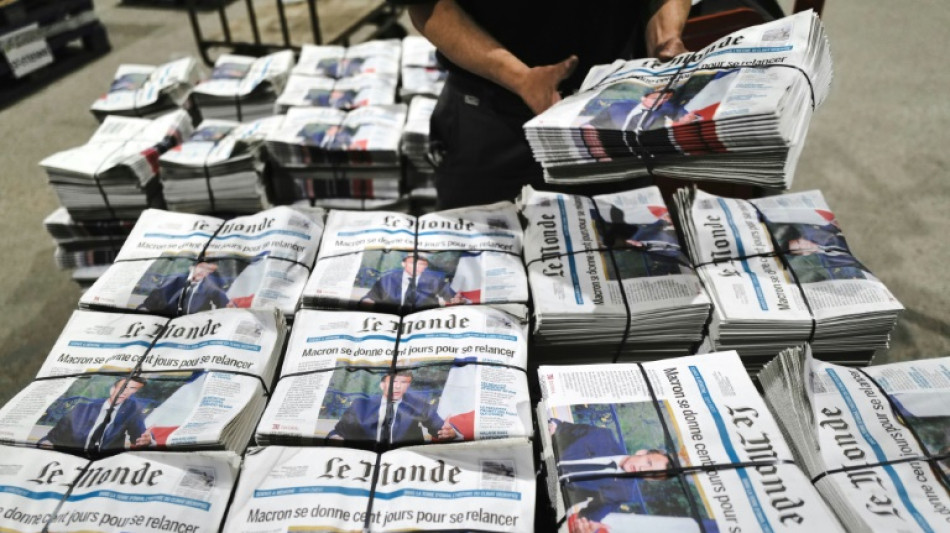
At least four French daily newspapers -- Le Parisien, Le Figaro, Le Monde and 20 Minutes -- were victims of the operation.
Other major media were also targeted, particularly German ones including Frankfurter Allgemeine Zeitung, Der Spiegel and Bild.
In its article on the campaign, Le Monde confirmed it had been one of the media organisations targeted and published one example of the false news articles.
"French minister supports murders of Russian troops in Ukraine," said the false headline, with the masthead and layout identical to that of Le Monde's actual website.
Le Monde's director Jerome Fenoglio denounced the "unfair and unacceptable methods" seeking to spread "elements of communication from the Kremlin".
The "intolerable" campaign was "aimed at misleading the general public about the reality of the war in Ukraine and the role of the Kremlin in this invasion", he wrote.
The French foreign ministry itself foiled an attempt to create a fake reproduction of its own website, Colonna said.
She added Russian embassies and cultural centres had "actively" participated in amplifying the campaign.
"The campaign is a new illustration of the hybrid strategy that Russia is implementing to undermine the conditions for peaceful democratic debate and therefore undermine our democratic institutions.
"No attempt at manipulation will deter France from supporting Ukraine in the face of the Russian war of aggression," she added.
- 'Putin waiting' -
The campaign involved techniques including producing fake articles on a page identical in all respects to those of the legitimate sites of media organisations, but with different domain names -- for example .ltd instead of .fr.
This means that users can be unknowingly led to the false news site by wrongly inputting the domain name. The technique is known as typosquatting.
The operation uncovered by the government is "the second phase" of a campaign that had already come to light in 2022 "but with more sophisticated modes of action intended to circumvent countermeasures and be less visible", a security source who asked not to be named told AFP.
This so-called "Doppelgaenger" operation had been documented in 2022 by the organisation EU DisinfoLab and Meta, the parent company of Facebook.
"Meta hoped that its report would put an end to the operation. This was not the case," said the security source.
"We found dozens of domain names bought by the Russians for typosquatting," said the source. "We do not know their final objective," they added, while warning the campaign is "very well coordinated and structured".
As well as typosquatting, the campaign saw other influence operations, such as the production of cartoons lampooning Ukrainian President Volodymyr Zelensky or pro-Russian narratives on specific websites.
Officials warn Moscow is betting on the disinformation campaign to undermine Western public support for Ukraine.
Russian President Vladimir Putin "is waiting for Western societies to get tired", said a senior European official who asked not to be named, warning there could be tensions in Western societies in winter if Russia drives up the price of fuel.
A.AlHaj--SF-PST