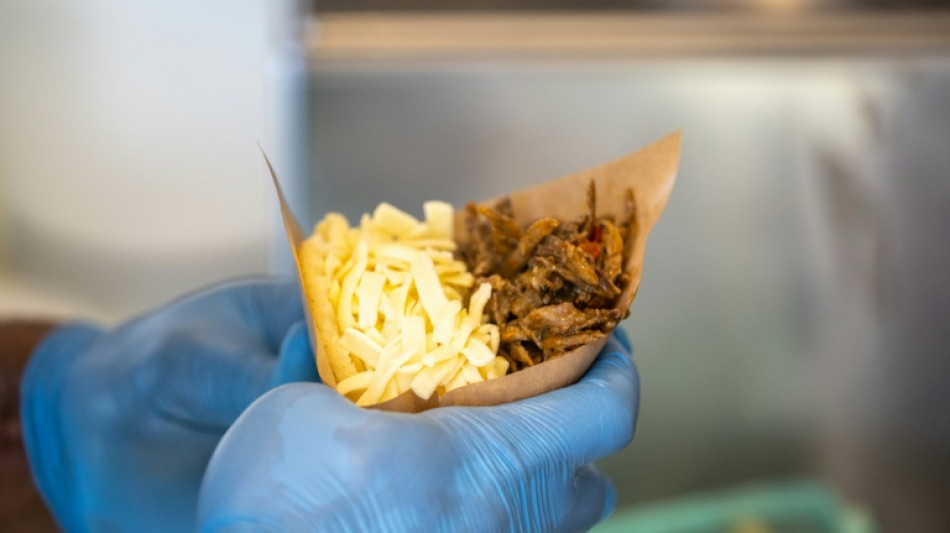
Venezuela's 'daily bread,' humble arepa conquers the world / Photo: Philip FONG - AFP

 Indonesian court hears 'negligence' complaint against state over fires, haze
 Rubio in Greece to urge against Western civilisation 'decline'

 Micron workers at Taiwan plant vote in favour of strike

 In 'The Social Reckoning,' Jeremy Allen White takes on Facebook's 'frightening' ambition

 Chip industry activists call for South Korea to recognise cancer cases

 Famine-scarred southern Madagascar braces for El Nino

 How the EU regulates lobbyists

 I.Coast refuge offers lifelong care for youngsters scorned as 'sorcerers'

 Indian central bank hikes rates for first time in more than 3 years

 Hotel Blacklist Launches New Accommodation Industry Risk Assessment Tool

 Bangladesh nuclear plant draws hope -- and worry

 US beat Canada 1-0 to wrap up four-win international break

 Turkey, Australia's joint COP31 leadership raises doubts

 For Turkish NGOs, COP31 offers rare space for action

 Sleep, appetite, gene-editing experts contend for Nobel chemistry prize
 Nobel Peace Prize haunted by the 'spectre' of Trump

 Africa launches own credit agency in bid for cheaper borrowing

 US, China, EU: three paths to regulating AI

 Australia's High Court rules against coal mine in landmark climate case

 Australia touts new funds for Pacific infrastructure at Fiji 'pre-COP'

 Eva Marie Saint, Oscar winner of Hollywood classics, dies at 102

 Australia probes app used in cheap smart glasses over privacy fears

 England needed to 'move on' from World Cup pain, says Tuchel

 O'Neill to stay at Celtic after period of "reflection"

 Kane marks 125th England cap with Wembley Nations League double

From the streets of Caracas to trendy eateries in New York, Paris and Tokyo, the arepa, a humble cornmeal flatbread, is riding a wave of Venezuelan emigration and feeding a craving for exotic and gluten-free food.
Prepared in just minutes by forming a ball from pre-cooked cornflour and water, it's flattened and then grilled. The arepa can be whatever you want: filled with anything from cheese and meat to beans or seafood, even greens.
A favorite in Venezuela is the "reina pepiada" -- a mix of chicken, mayonnaise and avocado.
The 'viuda' or widow, comes without a filling -- the ideal accompaniment for a soup but also the only option for many among Venezuela's poor.
The arepa "is the daily bread of the Venezuelan. He eats it every day, every night," said Patrick Ribas, who translated into French the book "Arepologo" dedicated to the maize delicacy.
"You can put anything you want in it. It’s a dish. You can also eat it on its own when you don’t have much money. This is unfortunately the case for many Venezuelans," he told AFP.
According to "Arepologo" author Ricardo Estrada Cuevas, the arepa "is a food that has no social class."
"It is eaten by everyone, from the simplest and most humble people to (someone who is) a manager," he told AFP.
"It is a food that everyone eats, in the same way, with the same fillings, with the same characteristics. Where there is a Venezuelan, there are arepas."
- 'Exotic' and gluten-free -
Amid a political and economic crisis that has seen their country's GDP shrink by 80 percent between 2013 and 2022, more than seven million Venezuelans -- almost a quarter of the population -- have emigrated in recent years.
And they've taken their cuisine with them.
Marlyn Quiroga, 47, was a lawyer in Venezuela but left five years ago for New York.
She did odd jobs until 2021, when she started an arepa catering business. This despite saying she "did not know how to cook an egg" before then.
"I went door-to-door in Queens: to beauty salons, offices, clinics. I gave away free samples" to promote the business, Quiroga told AFP.
Success came quickly, said the boss of "Arepa LaNewyorkquina," explaining that more and more people in the City That Never Sleeps now prefer gluten-free arepas to bread.
And on the other side of the Atlantic, "It's a change from the ubiquitous hamburger," said Jean-Francois Lamaison, a 63-year-old digital designer and diner at the Venezuelan restaurant "Ajidulce" in Paris.
Ajidulce boss Luis Fernando Machado, a former petroleum engineer who moved to the French capital in 2011, told AFP he started with a food truck but now employs 10 people.
His restaurant has an open kitchen so customers can see their meals being prepared.
"Parisians love to discover exotic food," he said. "It is a bit like taking a trip to the Caribbean."
It also helps to be listed on a register of gluten-free restaurants in the City of Light. "There are a lot of tourists who come" for that reason, said Machado.
- 'Spread our culture' -
In Tokyo, Venezuelan expat Raul Marquez, 42, and his Japanese wife Miho advertise "gluten-free, healthy street food" at their food truck selling arepas.
"Venezuela has been through a difficult time, you know, for the last few years.... that leads people to emigrate, and you know, to spread our culture in all ways, and food is part of it," Marquez, who himself left about a decade ago, told AFP.
After all these years, for Marquez, an arepa still represents "my mom... eating in the morning before going to school."
"That's what I (bring) when I'm selling arepas -- that passion, that love that comes from home."
Back in Caracas, Lisbeth Marquez has been selling arepas on the street for 15 years, from 4 pm to 2 am every day.
Her personal favorite? The "pabellon," which comes with melted butter, black beans, an egg and grated cheese.
She sells about 1,200 arepas a day, but "I never tire of eating them. The best arepa is the one made at home."
burs-pgf/lab/sf/fio/mlr/nro
G.AbuGhazaleh--SF-PST