Nuclear arms spending, arsenals swell as global tensions grow: studies / Photo: GREG BAKER - AFP/File

 Indonesian court hears 'negligence' complaint against state over fires, haze
 Rubio in Greece to urge against Western civilisation 'decline'
 Micron workers at Taiwan plant vote in favour of strike
 In 'The Social Reckoning,' Jeremy Allen White takes on Facebook's 'frightening' ambition
 Chip industry activists call for South Korea to recognise cancer cases
 Famine-scarred southern Madagascar braces for El Nino
 How the EU regulates lobbyists
 I.Coast refuge offers lifelong care for youngsters scorned as 'sorcerers'

 Indian central bank hikes rates for first time in more than 3 years
 Hotel Blacklist Launches New Accommodation Industry Risk Assessment Tool
 Bangladesh nuclear plant draws hope -- and worry
 US beat Canada 1-0 to wrap up four-win international break
 Turkey, Australia's joint COP31 leadership raises doubts
 For Turkish NGOs, COP31 offers rare space for action

 Sleep, appetite, gene-editing experts contend for Nobel chemistry prize
 Nobel Peace Prize haunted by the 'spectre' of Trump

 Africa launches own credit agency in bid for cheaper borrowing

 US, China, EU: three paths to regulating AI
 Australia's High Court rules against coal mine in landmark climate case
 Australia touts new funds for Pacific infrastructure at Fiji 'pre-COP'

 Eva Marie Saint, Oscar winner of Hollywood classics, dies at 102

 Australia probes app used in cheap smart glasses over privacy fears
 England needed to 'move on' from World Cup pain, says Tuchel
 O'Neill to stay at Celtic after period of "reflection"

 Kane marks 125th England cap with Wembley Nations League double
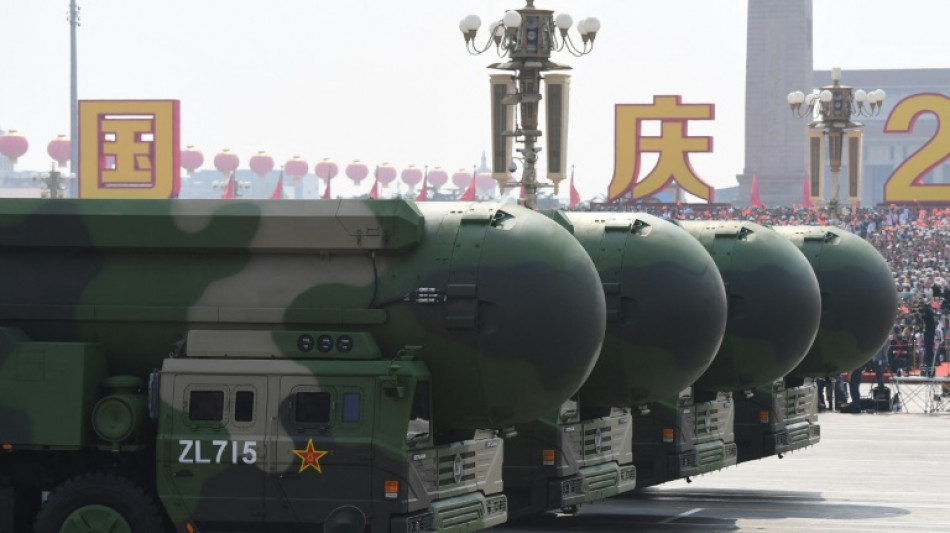
The world's nuclear powers, and China in particular, increased investment in their arsenals for a third consecutive year in 2022 amid swelling geopolitical tensions, two reports showed Monday.
The world's nine nuclear-armed states jointly spent $82.9 billion on their arsenals last year, with the United States accounting for more than half of that, according to a new report from the International Campaign to Abolish Nuclear Weapons (ICAN).
The Stockholm International Peace Research Institute (SIPRI) meanwhile released a report showing that the total number of nuclear warheads held by Britain, China, France, India, Israel, North Korea, Pakistan, Russia and the United States was down to 12,512 at the outset of this year, from 12,710 at the start of 2022.
While some of that included older warheads scheduled to be dismantled, SIPRI said that 9,576 were in "military stockpiles for potential use" -- 86 more than a year earlier.
"We are approaching, or maybe have already reached, the end of a long period of the number of nuclear weapons worldwide declining," SIPRI director Dan Smith told AFP.
- 'Beginning to tick up' -
Pointing to the stockpile of usable nuclear warheads, Smith said that "those numbers are beginning to tick up", while adding that they remain far below the more than 70,000 seen during the 1980s.
The bulk of the increase was in China, which increased its stockpile from 350 to 410 warheads.
India, Pakistan and North Korea also upped their stockpiles and Russia's grew to a smaller extent, from 4,477 to 4,489, while the remaining nuclear powers maintained the size of their arsenals.
Russia and the United States together have almost 90 percent of all nuclear weapons.
"The big picture is we've had over 30 years of the number of nuclear warheads coming down, and we see that process coming to an end now," Smith said.
- $157,664 every minute -
The higher spending reported by ICAN appeared to back that up.
ICAN, which was awarded the 2017 Nobel Peace Prize, found that spending on nuclear weapons had risen three percent from 2021, marking the third consecutive annual increase.
The $82.9 billion spent amounted to $157,664 for every minute of 2022, it said in its report entitled "Wasted: 2022 Global Nuclear Weapons Spending".
Washington spent $43.7 billion, which was slightly less than a year earlier but was still far ahead of all other countries, the report showed.
China was next in line with $11.7 billion spent, followed by Russia at $9.6 billion -- both marking an increase of around six percent from 2021.
India meanwhile showed the most drastic spending jump, dishing out $2.7 billion -- 21.8 percent more than a year earlier -- while Britain raised its spending level by 11 percent to $6.8 billion.
The report also highlighted how arms companies involved in the production of nuclear weapons received new contracts worth just under $16 billion last year, and in turn spent $113 million lobbying governments in the United States and France alone.
Globally, nuclear-armed countries have contracts with companies to produce nuclear weapons worth at least $278.6 billion, continuing in some cases through to 2040, it said.
- Diplomatic setbacks -
Researchers at SIPRI also noted that diplomatic efforts on nuclear arms control and disarmament had suffered setbacks following Russia's invasion of Ukraine in February last year.
Russia has for instance suspended participation in New START, a Cold War-era treaty that limits warheads and allows verification by both sides.
At the same time, Smith said the increase in stockpiles could not be explained by the war in Ukraine, as it takes a longer time to develop new warheads and the bulk of the increase was among countries not directly affected.
China has also invested heavily in all parts of its military as its economy and influence have grown.
"What we're seeing is China stepping up as a world power," Smith said.
E.AbuRizq--SF-PST