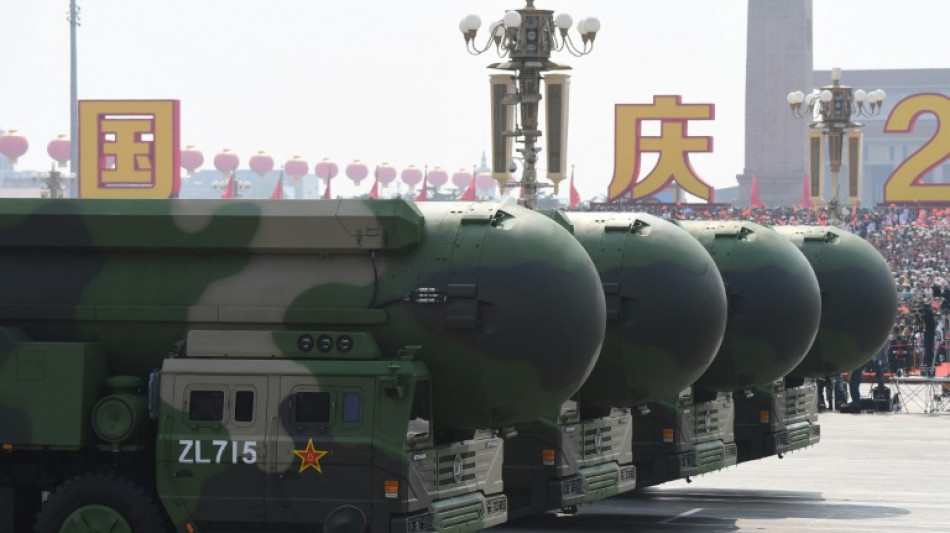
China expands nuclear arsenal as global tensions grow: study / Photo: GREG BAKER - AFP/File

 Gauff says online abuse was 'draining' after China Open exit

 As sector struggles, Porsche puts luxury ahead of volume
 'It's personal': Fiji minister pushes better climate finance at pre-COP
 Russia glosses over dark Soviet past in reinvented museum

 UK tax body opened probe into Man City in 2018: FT
 Yemen's Houthis claim new attacks on Saudi airports as conflict deepens
 Germany factory production at highest level for 18 months
 Thailand floods death toll rises to 60 since mid-September

 US pushes Russia for information on plague reports

 Myanmar leader lands in Malaysia for migrant return talks
 Indian central bank hikes rates for first time since 2023
 US military on Okinawa face curfew, alcohol ban after murder case
 Fierce lobbying in EU over 'forever chemicals'

 Dodgers beat Braves and Padres avoid sweep in MLB playoffs
 Mourning, war and elections as Israel marks October 7

 Messi says Argentina retirement is 'saddest day of my career'
 Oil rises and stocks fall as Hormuz worries flare

 Pacific presses world for help 'surviving' climate change at pre-COP summit
 Verstappen revival to be put to the test in steamy Singapore
 US woman who survived botched execution is conscious, speaking: lawyers

 Climate champion Australia digging more coal
 Emotion, tears as Messi retires from Argentina national team

 Dodgers push Braves to the brink of MLB playoff exit

 Crisis-stricken Haiti postpones elections
 N. Korea's Kim pledges 'invariable support' in Putin birthday letter

The nuclear arsenals of several countries, especially China, grew last year and other atomic powers continued to modernise theirs as geopolitical tensions rise, researchers said Monday.
"We are approaching, or maybe have already reached, the end of a long period of the number of nuclear weapons worldwide declining," Dan Smith, director of the Stockholm International Peace Research Institute (SIPRI), told AFP.
The total amount of nuclear warheads among the nine nuclear powers -- Britain, China, France, India, Israel, North Korea, Pakistan, Russia and the United States -- was down to 12,512 at the outset of 2023, from 12,710 at the start of 2022, according to SIPRI.
Of those, 9,576 were in "military stockpiles for potential use", 86 more than a year earlier.
SIPRI distinguishes between countries' stockpiles available for use and their total inventory -- which includes older ones scheduled to be dismantled.
"The stockpile is the usable nuclear warheads, and those numbers are beginning to tick up," Smith said, while noting that numbers are still far from the over 70,000 seen during the 1980s.
The bulk of the increase was from China, which increased its stockpile from 350 to 410 warheads.
India, Pakistan and North Korea also upped their stockpiles and Russia's grew to a smaller extent, from 4,477 to 4,489, while the remaining nuclear powers maintained the size of their arsenal.
Russia and the United States together still have almost 90 percent of all nuclear weapons.
"The big picture is we've had over 30 years of the number of nuclear warheads coming down, and we see that process coming to an end now," Smith said.
- China 'stepping up' -
Researchers at SIPRI also noted that diplomatic efforts on nuclear arms control and disarmament had suffered setbacks following Russia's invasion of Ukraine.
For instance, the United States suspended its "bilateral strategic stability dialogue" with Russia in the wake of the invasion.
In February, Moscow announced it was it was suspending participation in the 2010 Treaty on Measures for the Further Reduction and Limitation of Strategic Offensive Arms (New START).
SIPRI noted in a statement that it "was the last remaining nuclear arms control treaty limiting Russian and US strategic nuclear forces".
At the same time, Smith said the increase in stockpiles could not be explained by the war in Ukraine as it takes a longer time to develop new warheads and that the bulk of the increase was among countries not directly affected.
China has also invested heavily in all parts of its military as its economy and influence have grown.
"What we're seeing is China stepping up as a world power, that is the reality of our time," Smith said.
G.AbuOdeh--SF-PST