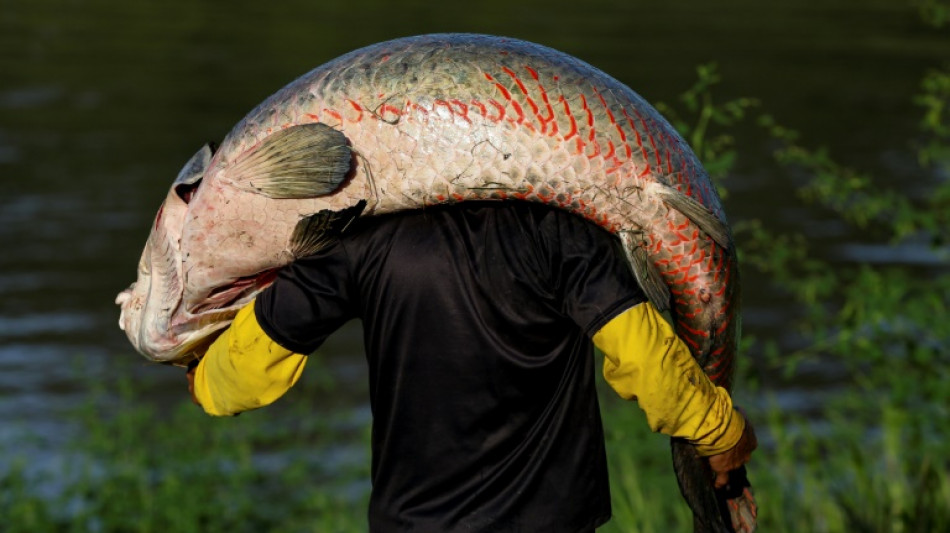
Pirarucu: Amazon's giant air-breathing fish in poachers' sights / Photo: MICHAEL DANTAS - AFP

 Gauff says online abuse was 'draining' after China Open exit

 As sector struggles, Porsche puts luxury ahead of volume

 'It's personal': Fiji minister pushes better climate finance at pre-COP

 Russia glosses over dark Soviet past in reinvented museum

 UK tax body opened probe into Man City in 2018: FT

 Yemen's Houthis claim new attacks on Saudi airports as conflict deepens

 Germany factory production at highest level for 18 months

 Thailand floods death toll rises to 60 since mid-September

 US pushes Russia for information on plague reports

 Myanmar leader lands in Malaysia for migrant return talks

 Indian central bank hikes rates for first time since 2023
 US military on Okinawa face curfew, alcohol ban after murder case

 Fierce lobbying in EU over 'forever chemicals'

 Dodgers beat Braves and Padres avoid sweep in MLB playoffs

 Mourning, war and elections as Israel marks October 7

 Messi says Argentina retirement is 'saddest day of my career'

 Oil rises and stocks fall as Hormuz worries flare

 Pacific presses world for help 'surviving' climate change at pre-COP summit

 Verstappen revival to be put to the test in steamy Singapore
 US woman who survived botched execution is conscious, speaking: lawyers

 Climate champion Australia digging more coal

 Emotion, tears as Messi retires from Argentina national team
 Dodgers push Braves to the brink of MLB playoff exit

 Crisis-stricken Haiti postpones elections

 N. Korea's Kim pledges 'invariable support' in Putin birthday letter
A fish larger than a man, tasty as well as beautiful, the freshwater pirarucu is a favorite with poachers in a lawless part of the Amazon jungle where Brazil, Peru and Colombia meet.
Prized for its skin as much as its flesh, the pirarucu has long been a staple for Indigenous people who hunt the air-breathing fish in lakes in the Javari Valley.
But it has also become a much sought-after protein on the menus of gastronomic and fusion restaurants in Rio, Bogota and Lima -- its rising popularity pushing up prices and raising the stakes for Amazon dwellers.
The growing appetite for pirarucu is blamed for the deaths last year of Indigenous rights defender Bruno Pereira and British journalist Dom Phillips at the hands of fish poachers who hacked up the pair's bodies and hid the remains in the jungle.
In Brazil's Amazonas province, pirarucu harvesting is strictly regulated.
In the Javari Valley which holds the country's second-largest protected Indigenous reserve -- home to seven tribes including the Kanamari -- only residents may hunt it.
Yet, "they are stealing from us!" said Joao Filho Kanamari, an Amazon resident who takes his last name from his tribe which comes into regular conflict with intruders in pursuit of the prized fish.
- 'Cow of the Amazon' -
For the Kanamari, the story of the pirarucu is that of "a tree leaf that fell into the water and became a giant fish," tribal chief Mauro da Silva Kanamari told AFP.
"Arapaima gigas" by its scientific name, the pirarucu is one of the largest freshwater fish on the planet.
It is a weird-looking creature with a pink, tapered tail, awkwardly-flattened head and globular eyes reminiscent of a prehistoric monster.
An omnivore, the pirarucu can grow up to three meters (9.8 feet) long and weigh over 200 kilograms (440 pounds.)
Caught with nets and harpoons, the giant fish is relatively easy to spot and kill as it needs to surface to breathe about every 20 minutes.
Known lovingly to locals as "the cow of the Amazon," presumably for its ability to feed many at a time, the pirarucu is also versatile: its skin is used for exotic leather products -- shoes, bags or wallets.
Pirarucu scales, reputedly resistant to piranha teeth, are sold to tourists as key chains.
Subject to overfishing in the Brazilian Amazon, the pirarucu all but disappeared in the 1990s until the government introduced fishing restrictions.
- 'Fished like crazy' -
In 2017, a project was started in the Javari Valley with the help of an Indigenous NGO called CTI to ensure the community will be able to continue harvesting pirarucu for a long time to come. Sustainably.
The project is managed by the Kanamari themselves, who have voluntarily limited their own catches of pirarucu and agreed not to sell any for five years.
"The idea is that the natives can feed themselves, provide for their needs, all while protecting their territory," said CTI spokesman Thiago Arruda.
The project also involves patrols to spot and report poachers -- a risky endeavor that can bring the tribespeople in contact with illegal fishermen, often armed.
"The project is very important for us," said Bushe Matis, coordinator of the Union of Indigenous Peoples of the Javari Valley (Univaja.)
"Before people fished like crazy. From now on we will take care of the lakes and fishing areas, so that we will always have fish in the future."
A stocktake will occur within weeks, and if fish numbers have recovered sufficiently, the Kanamari will be able to start selling again.
But there are obstacles ahead: the community still has to set up a cold chain to get the fish safely to clients from all the way inside the bowels of the jungle, and decide how to split the proceeds.
Some fear the opening to sales could expose the Indigenous jungle dwellers to a whole new kind of risk.
According to one project promoter, who asked not to be named, there is a danger of local politicians or businessmen "not necessarily well-intentioned and probably involved in illegal fishing networks" working their way into the system.
I.Yassin--SF-PST