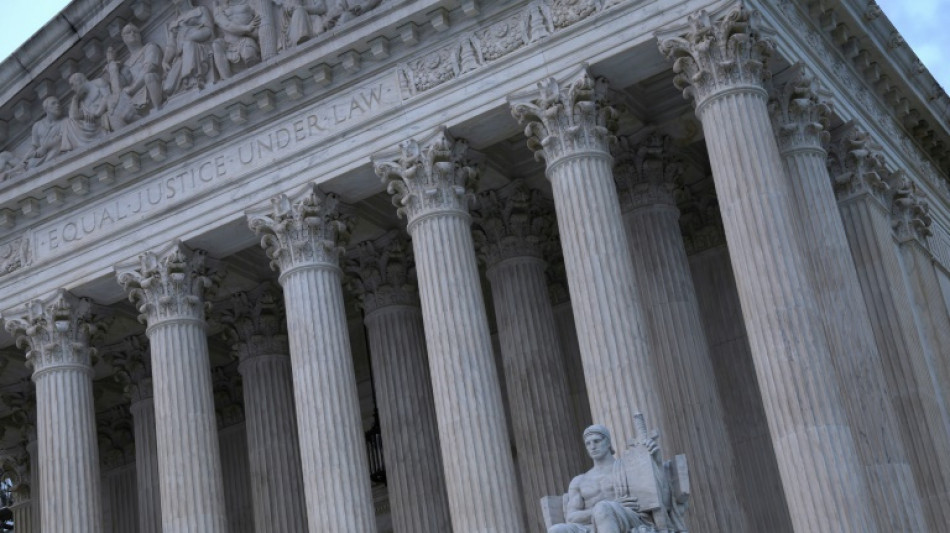
Alabama electoral map discriminated against Black voters: court / Photo: ALEX WONG - GETTY IMAGES/AFP

 Gauff says online abuse was 'draining' after China Open exit

 As sector struggles, Porsche puts luxury ahead of volume

 'It's personal': Fiji minister pushes better climate finance at pre-COP

 Russia glosses over dark Soviet past in reinvented museum

 UK tax body opened probe into Man City in 2018: FT

 Yemen's Houthis claim new attacks on Saudi airports as conflict deepens
 Germany factory production at highest level for 18 months

 Thailand floods death toll rises to 60 since mid-September

 US pushes Russia for information on plague reports

 Myanmar leader lands in Malaysia for migrant return talks

 Indian central bank hikes rates for first time since 2023

 US military on Okinawa face curfew, alcohol ban after murder case

 Fierce lobbying in EU over 'forever chemicals'

 Dodgers beat Braves and Padres avoid sweep in MLB playoffs

 Mourning, war and elections as Israel marks October 7

 Messi says Argentina retirement is 'saddest day of my career'

 Oil rises and stocks fall as Hormuz worries flare

 Pacific presses world for help 'surviving' climate change at pre-COP summit

 Verstappen revival to be put to the test in steamy Singapore

 US woman who survived botched execution is conscious, speaking: lawyers

 Climate champion Australia digging more coal
 Emotion, tears as Messi retires from Argentina national team

 Dodgers push Braves to the brink of MLB playoff exit
 Crisis-stricken Haiti postpones elections

 N. Korea's Kim pledges 'invariable support' in Putin birthday letter

The US Supreme Court ruled on Thursday that a congressional electoral map drawn in the southern state of Alabama discriminated against Black voters.
The 5-4 decision by the conservative-majority court is a surprise victory for the Voting Rights Act, which was passed by Congress during the civil rights movement in 1965 to prevent racial discrimination against minorities in elections.
The Alabama case concerns a map that was redrawn in 2021 by Alabama's Republican majority legislature to allocate seats in the US House of Representatives.
Under the map, Black voters -- who represent around a quarter of registered voters statewide -- are in a majority in only one of Alabama's seven US House districts.
African Americans in Alabama tend to vote Democratic while white voters in the state mostly support Republicans.
Citizens and rights groups took the Alabama redistricting map to court, accusing legislators of violating the Voting Rights Act which prohibits diluting the Black vote.
Chief Justice John Roberts and another conservative, Brett Kavanaugh, sided with the three liberal justices in upholding a lower court ruling ordering Alabama to redraw the congressional map to include a second district with a large African American population.
Republican officials in Alabama had appealed the lower court ruling to the Supreme Court, where conservatives hold a 6-3 majority, and the nation's highest court heard the case in October.
President Joe Biden welcomed the decision, saying it "confirms the basic principle that voting practices should not discriminate on account of race."
"The right to vote and have that vote counted is sacred and fundamental -- it is the right from which all of our other rights spring," Biden said in a statement.
Attorney General Merrick Garland said the ruling "preserves the principle that in the United States, all eligible voters must be able to exercise their constitutional right to vote free from discrimination based on their race."
- 'Crucial win' -
Deuel Ross, senior counsel at the Legal Defense Fund, also praised the decision, calling it a "crucial win against the continued onslaught of attacks on voting rights."
"Alabama attempted to rewrite federal law by saying race had no place in redistricting," said Ross, who argued the case before the court.
"But because of the state's sordid and well-documented history of racial discrimination, race must be used to remedy that past and ensure communities of color are not boxed out of the electoral process," he said.
Davin Rosborough, senior staff attorney with the American Civil Liberties Union's Voting Rights Project, called the ruling a "huge victory for Black Alabamians."
"The Supreme Court rejected the Orwellian idea that it's inappropriate to consider race in determining whether racial discrimination led to the creation of illegal maps," Rosborough said.
The Alabama case is one of several the court heard this term revolving around race.
The justices are set to rule shortly in a case involving the use of race in deciding who gets to attend Harvard University and the University of North Carolina.
Harvard and UNC, like many other US institutions of higher education, use race as a factor in trying to ensure a diverse student body and to make up for a legacy of discrimination against African Americans and Hispanics.
Q.Jaber--SF-PST