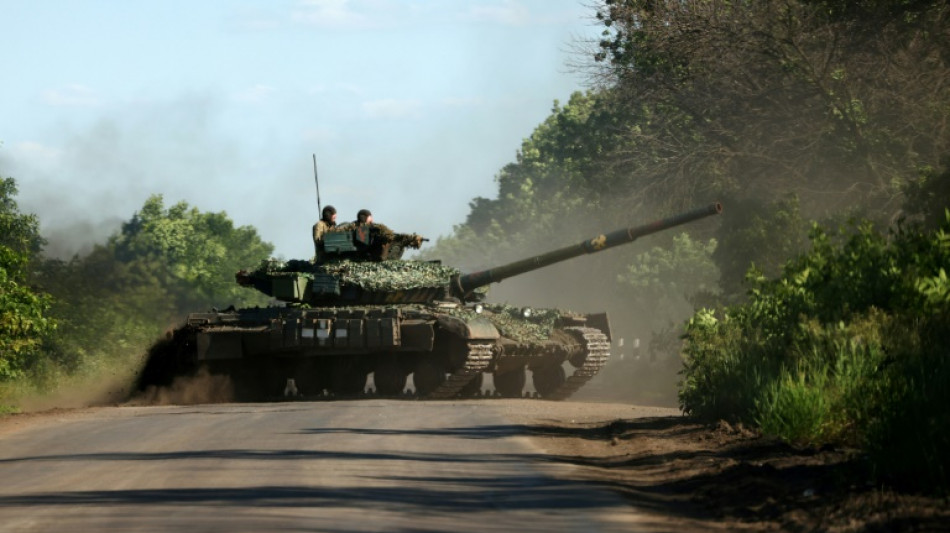
Foreign aid sets up Ukraine to strike tough Russian defenses / Photo: Anatolii STEPANOV - AFP/File

 Gauff says online abuse was 'draining' after China Open exit

 As sector struggles, Porsche puts luxury ahead of volume
 'It's personal': Fiji minister pushes better climate finance at pre-COP

 Russia glosses over dark Soviet past in reinvented museum

 UK tax body opened probe into Man City in 2018: FT

 Yemen's Houthis claim new attacks on Saudi airports as conflict deepens
 Germany factory production at highest level for 18 months

 Thailand floods death toll rises to 60 since mid-September

 US pushes Russia for information on plague reports

 Myanmar leader lands in Malaysia for migrant return talks

 Indian central bank hikes rates for first time since 2023

 US military on Okinawa face curfew, alcohol ban after murder case

 Fierce lobbying in EU over 'forever chemicals'

 Dodgers beat Braves and Padres avoid sweep in MLB playoffs

 Mourning, war and elections as Israel marks October 7

 Messi says Argentina retirement is 'saddest day of my career'
 Oil rises and stocks fall as Hormuz worries flare

 Pacific presses world for help 'surviving' climate change at pre-COP summit

 Verstappen revival to be put to the test in steamy Singapore
 US woman who survived botched execution is conscious, speaking: lawyers

 Climate champion Australia digging more coal

 Emotion, tears as Messi retires from Argentina national team

 Dodgers push Braves to the brink of MLB playoff exit

 Crisis-stricken Haiti postpones elections
 N. Korea's Kim pledges 'invariable support' in Putin birthday letter

Ukraine has to breach multiple lines of heavily fortified defenses in its counteroffensive against invading Russian forces, and equipment and training provided by the United States and others will play a central role.
Kyiv's infantry, armored vehicles, artillery and engineers must operate in close coordination while under Russian fire to push through the trenches, anti-tank obstacles and other defenses -- efforts that require a high level of skill and leave little room for error.
Ukraine's international supporters have worked for months to prepare them for the task, training tens of thousands of the country's troops and supplying them with the materiel they will need to succeed.
"What we've done is not only provide higher-end platforms like the Bradley fighting vehicles -- infantry fighting vehicles -- and Strykers and some other things, we've trained them on a number of things in terms of maneuver," US Defense Secretary Lloyd Austin told journalists during a recent trip to Asia.
"One of those things is breaching, you know, in anticipation of... having to encounter complex obstacles" constructed by the Russians, Austin said, expressing confidence that Ukrainian forces know how to achieve that.
Kyiv's backers have trained some 54,000 Ukrainian troops in total, including more than 6,000 who make up some 12 battalions that have been instructed by the United States in combined arms operations.
- Find the weak points -
"Attacking well-prepared defenses is very difficult. It requires a high level of skill to get all the different arms working together," said Mark Cancian, a senior advisor at the Center for Strategic and International Studies, describing the myriad elements required for a successful assault.
First, artillery bombardment -- lasting from hours to days -- will be employed to disrupt Russian defenses, and then suppressive fire will be needed to keep Moscow's troops from responding effectively.
Engineers will clear minefields and cross barriers so other forces can advance, and infantry will search for weak points while working with armored forces.
"The intention will be to break through the defenses so that the armored units can get past... and maneuver freely," said Cancian.
Austin said Russian defenses extend for hundreds of miles (kilometers) -- something that provides potential weak spots for Ukraine to exploit.
"If you're defending along a front that long, then you cannot be strong everywhere," he said.
In addition to training, equipment supplied by Kyiv's supporters "is absolutely critical," Cancian said.
- 'Bloody and difficult' -
"The armored capability -- tanks, and armored fighting vehicles -- will provide firepower to get through the Russian defenses and then the mobility to exploit any breakthrough," while other equipment such as mine-clearing gear and explosives are also needed, he said.
Ukrainian forces have launched a series of attacks in recent days, leading to fevered speculation about whether the long-awaited counteroffensive has begun.
Charles Kupchan, a senior fellow at the Council on Foreign Relations, said it appears that "shaping operations" -- moves laying the groundwork for a large-scale assault -- have been underway for several weeks.
"Ukraine has been trying to hit Russian depots and supply lines in occupied areas, including Crimea, and in areas of southern Russia close to the border," he said, while noting that widespread flooding caused by the recent destruction of the country's Kakhovka dam could delay the counteroffensive.
"The Russians have built a formidable array of defenses in the south, including anti-tank ditches, followed by concrete barricades known as 'dragon's teeth,' and then trenches," Kupchan said.
"Ukraine will need to muster a sustained and potent offensive to break through this layered 'defense in depth.'"
Kyiv's forces have the equipment and training they need, but Russia has greater numbers, according to Kupchan.
"The coming battles are likely to be bloody and difficult, and may end in a stalemate," he said, predicting that "neither side is likely to muster the capabilities needed to attain a decisive victory on the battlefield."
N.Awad--SF-PST