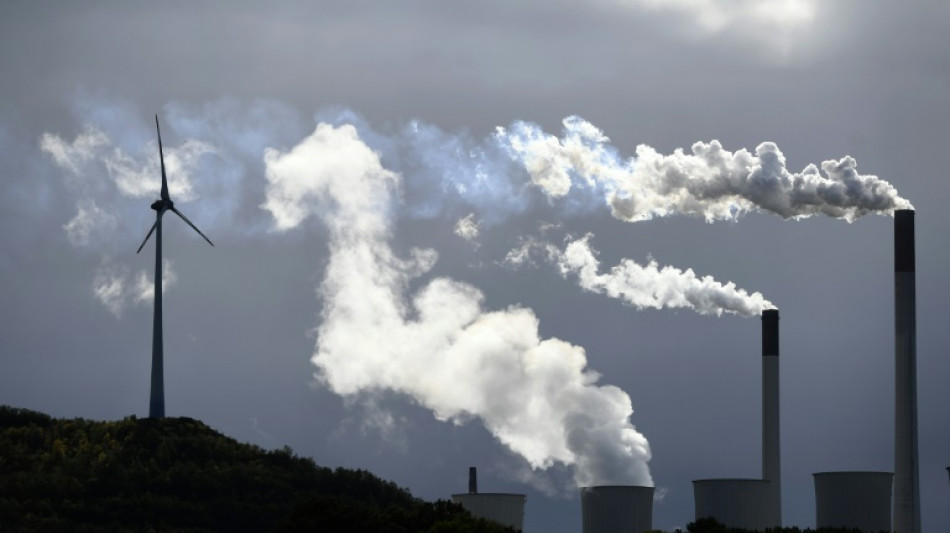
Climate: Battle lines harden over how to slash CO2 / Photo: INA FASSBENDER - AFP/File

 West must embrace 'national power' or face decline: Rubio

 Shell refining margins reach record highs as wars hit supply

 Former Spain, Barca winger Pedro retires from football

 Arteta signs new Arsenal deal until 2030

 Stocks decline as oil climbs on Mideast flareup

 Gauff says online abuse was 'draining' after China Open exit

 As sector struggles, Porsche puts luxury ahead of volume

 'It's personal': Fiji minister pushes better climate finance at pre-COP

 Russia glosses over dark Soviet past in reinvented museum

 UK tax body opened probe into Man City in 2018: FT

 Yemen's Houthis claim new attacks on Saudi airports as conflict deepens

 Germany factory production at highest level for 18 months

 Thailand floods death toll rises to 60 since mid-September

 US pushes Russia for information on plague reports

 Myanmar leader lands in Malaysia for migrant return talks

 Indian central bank hikes rates for first time since 2023

 US military on Okinawa face curfew, alcohol ban after murder case

 Fierce lobbying in EU over 'forever chemicals'

 Dodgers beat Braves and Padres avoid sweep in MLB playoffs

 Mourning, war and elections as Israel marks October 7

 Messi says Argentina retirement is 'saddest day of my career'
 Oil rises and stocks fall as Hormuz worries flare

 Pacific presses world for help 'surviving' climate change at pre-COP summit

 Verstappen revival to be put to the test in steamy Singapore
 US woman who survived botched execution is conscious, speaking: lawyers

Banish fossil fuels, capture their emissions, pull CO2 from thin air -- diplomats in Bonn for UN-led climate talks agree there's too much planet-warming carbon dioxide in the atmosphere, but remain at loggerheads on the best way to reduce it.
At stake is nothing less than a liveable world: even if humanity caps global warming at 1.5 degrees Celsius -- a huge 'if' -- hundreds of millions will still confront devastating heat, drought, flooding and sea level rise, recent studies have shown.
There are three ways to deal with the problem, intervening at different points in the CO2 "value chain" from source to tailpipe: stop burning fossil fuels, by far the main driver of warming; if you do burn them, stop carbon pollution from seeping into the air; and remove CO2 from the atmosphere once it's there.
"All technologies, all levers available need to be used," Simon Stiell, the head of UN Climate, told AFP as the talks in Bonn opened.
"But the science is very, very clear: the fastest and most effective way of getting us to where we need to is the phasing down and phasing out of all fossil fuels."
Politically, an informal "high ambition" coalition including the European Union (especially Germany) and scores of climate vulnerable developing countries are pushing -- to cite the Association of Small Island States (AOSIS) -- to "radically reduce fossil fuels now" through policy, regulatory and economic levers.
But major oil and gas exporters, the United States and some emerging economies are keen to shift the focus further downstream, saying the world can reduce carbon emissions without ditching the fossil fuels that generate them.
- Persistent failure -
Their standard bearer is Sultan al-Jaber, head of the Abu Dhabi National Oil Company and -- controversially -- president of the COP28 climate summit to be hosted at year's end by the United Arab Emirates.
The persistent failure over decades to cut carbon emissions -- currently 53 billion tonnes of CO2 or its equivalent per year -- has forced once marginal technologies toward centre stage.
These fall roughly into two categories that are often confused and conflated.
"Carbon capture" refers to syphoning off concentrated CO2 from the exhaust, or flue gas, of coal- and gas-fired power generation, as well as heavy industrial processes.
Once isolated, the CO2 can be used to make products ("carbon capture and utilisation" or CCU), or socked away underground in depleted oil and gas reservoirs ("carbon capture and storage" or CCS).
A crucial point: Even when CCS stores all the CO2 captured, it does not decrease the amount in the atmosphere. But only prevent more from entering.
- Potential advantages -
Carbon dioxide removal (CDR) techniques, however, do result in a net reduction in atmospheric CO2 and could, if scaled up, help lower Earth's surface temperature when we overshoots the Paris Agreement's 1.5C threshold, as seems likely.
Worldwide, CDR captures two billion tonnes of CO2 each year, according to the inaugural State of Carbon Dioxide Report.
More than 99.9 percent is extracted through "conventional" techniques such as restoring and expanding CO2-absorbing forests.
Less than 0.1 percent is removed by "novel" means, and one in particular -- direct air capture (DAC), an energy-intensive process that chemically extracts CO2 from the air -- has attracted the most attention and investment.
It's contribution to the cause is anecdotal: today, less than 20 DAC plants globally capture about as much CO2 in a year (10,000 tonnes) as the world emits in about 10 seconds.
But once upon a time scaling solar power looked as improbable, advocates note.
Indeed, the IEA's so-called "net zero emissions by 2050 scenario" assumes DAC will capture 60 Mt CO2/year by 2030. The first million-tonne plant is due to come on line next year.
DAC has potential advantages, especially compared to a troubled carbon offsets markets based on protecting or growing trees.
- 'Unknown risks' -
Forests burn down, especially in a warming world, which makes them less than permanent, a key criterion under UN rules.
A tonne of mechanically extracted carbon stored underground is easily measured and monitored. Not so for forest-based credits, which are notoriously subject to cheating and dodgy accounting.
Last month Zimbabwe sent a shudder through the $2 billion offsets market by announcing it would appropriate half of all the revenue generated from offsets on its land, exposing another vulnerability.
The small but burgeoning DAC industry was itself thrown into turmoil last week by a 100-page UN "information note" on which removal techniques might be recognised under carbon market accounting rules still in the making.
The aggressively dismissive note said "engineering-based removal activities are technologically and economically unproven, especially at scale, and pose unknown environmental and social risks."
Pushback was sharp, with scores of carbon removal start-ups and several independent research groups pointing out glaring scientific inaccuracies underlying the report.
"This tells us that there's a lot of money at stake as to which technologies are given the green light," noted Alden Meyer, a senior policy analyst at climate think tank E3G.
- 'Residual emissions' -
So what's the right balance between reducing fossil fuel use and finding ways to scrub CO2 from industrial processes and the air?
"Machine based removal is simply unlikely to work at any meaningful scale," scientist Jonathan Foley, executive director of Project Drawdown, which evaluates the potential of mitigation solutions, told AFP.
"Ninety-five percent of what we need to do is cut emissions," he said. "Five percent is carbon removal, and 90 percent of that should be nature based removal such as ecological restoration and regenerative agriculture."
But those ratios are not in line with the long-term national strategies for reaching net zero emissions by 2050, according to a recent study in Nature Climate Change.
Most wealthy countries still allow for large "residual emissions" when they hit net zero -- on average, 18 percent of current emissions -- on the assumption that technology will be available to capture and remove them by then.
R.Shaban--SF-PST