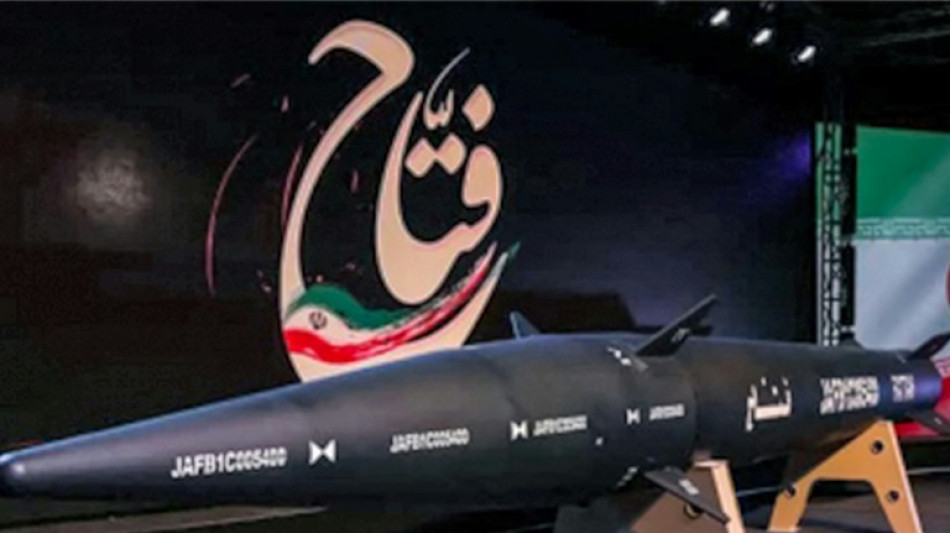
Iran unveils hypersonic missile hailing deterrent boost / Photo: - - SEPAH NEWS/AFP

 West must embrace 'national power' or face decline: Rubio

 Shell refining margins reach record highs as wars hit supply

 Former Spain, Barca winger Pedro retires from football

 Arteta signs new Arsenal deal until 2030

 Stocks decline as oil climbs on Mideast flareup

 Gauff says online abuse was 'draining' after China Open exit

 As sector struggles, Porsche puts luxury ahead of volume
 'It's personal': Fiji minister pushes better climate finance at pre-COP

 Russia glosses over dark Soviet past in reinvented museum

 UK tax body opened probe into Man City in 2018: FT

 Yemen's Houthis claim new attacks on Saudi airports as conflict deepens

 Germany factory production at highest level for 18 months

 Thailand floods death toll rises to 60 since mid-September

 US pushes Russia for information on plague reports

 Myanmar leader lands in Malaysia for migrant return talks

 Indian central bank hikes rates for first time since 2023

 US military on Okinawa face curfew, alcohol ban after murder case

 Fierce lobbying in EU over 'forever chemicals'

 Dodgers beat Braves and Padres avoid sweep in MLB playoffs

 Mourning, war and elections as Israel marks October 7

 Messi says Argentina retirement is 'saddest day of my career'
 Oil rises and stocks fall as Hormuz worries flare

 Pacific presses world for help 'surviving' climate change at pre-COP summit

 Verstappen revival to be put to the test in steamy Singapore
 US woman who survived botched execution is conscious, speaking: lawyers

Iran's Revolutionary Guards unveiled an intermediate range ballistic missile Tuesday capable of travelling at hypersonic speeds of up to 15 times the speed of sound, state television reported.
President Ebrahim Raisi hailed the new missile's hypersonic capability, saying it would boost Iran's "power of deterrence" and "bring peace and stability to the countries of the region".
The official IRNA news agency published photographs of the ceremony in a closed area it did not identify. Several top military commanders were present, including Guards chief General Hossein Salami.
"The range of the Fattah missile is 1,400 kilometres (870 miles) and its speed before hitting its target" is between 13 and 15 times the speed of sound, IRNA said.
Like slower ballistic missiles, hypersonic missiles can be equipped with nuclear warheads and Iran's announcement it was producing one in November prompted International Atomic Energy Agency chief Rafael Grossi to express concern.
But Grossi added he did not see the new missile "having any influence" on negotiations with Iran over its nuclear activities.
Talks between Tehran and major powers on reviving a 2015 nuclear deal that was left in tatters when Washington unilaterally abandoned it in 2018 and imposed renewed sanctions are currently stalled.
Iran has since suspended its implementation of the strict limits it agreed to on its nuclear activities and restricted IAEA monitoring in a policy it is only slowly reversing.
Unlike conventional ballistic missiles, hypersonic ones fly on a trajectory low in the atmosphere, enabling them to reach their targets more quickly and with less chance of being intercepted by modern air defences.
When the programme was announced last year, Guards aerospace chief General Amirali Hajizadeh said the system was developed to "counter air defence shields", adding that he believed it would take decades before a system capable of intercepting it is developed.
Iran's arch foe Israel, which is widely believe to have its own undeclared nuclear arsenal, has multiple air defence shields for countering subsonic and supersonic missiles.
North Korea's test of a hypersonic missile last year sparked concerns about the race to acquire the technology, which is currently led by Russia, followed by China and the United States.
Since March last year, Russia's Kinzhal hypersonic missile has been used multiple times in its war against Ukraine.
M.Qasim--SF-PST