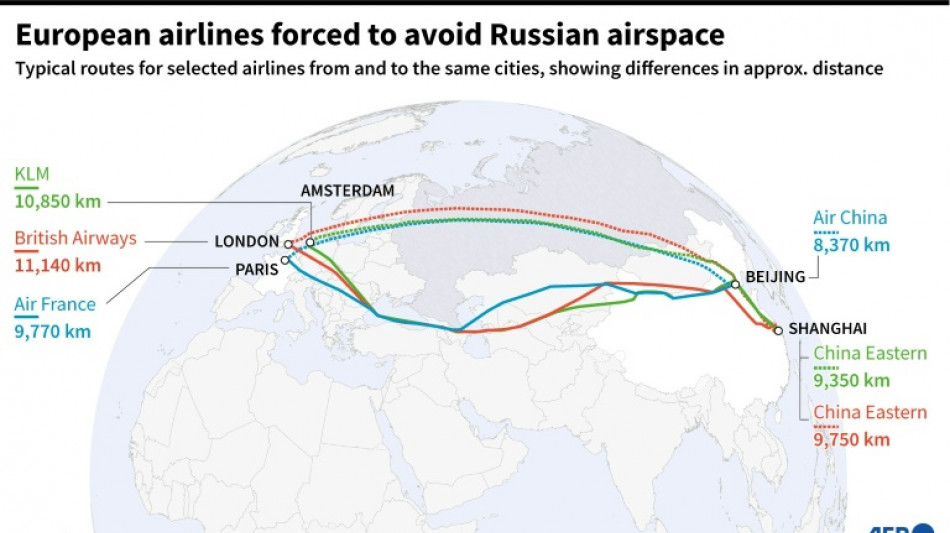
Russia fly-around a source of tension for airline industry / Photo: Julia Han JANICKI, Laurence SAUBADU - AFP

 West must embrace 'national power' or face decline: Rubio

 Shell refining margins reach record highs as wars hit supply

 Former Spain, Barca winger Pedro retires from football
 Arteta signs new Arsenal deal until 2030

 Stocks decline as oil climbs on Mideast flareup

 Gauff says online abuse was 'draining' after China Open exit

 As sector struggles, Porsche puts luxury ahead of volume
 'It's personal': Fiji minister pushes better climate finance at pre-COP

 Russia glosses over dark Soviet past in reinvented museum

 UK tax body opened probe into Man City in 2018: FT

 Yemen's Houthis claim new attacks on Saudi airports as conflict deepens

 Germany factory production at highest level for 18 months
 Thailand floods death toll rises to 60 since mid-September

 US pushes Russia for information on plague reports

 Myanmar leader lands in Malaysia for migrant return talks

 Indian central bank hikes rates for first time since 2023

 US military on Okinawa face curfew, alcohol ban after murder case
 Fierce lobbying in EU over 'forever chemicals'

 Dodgers beat Braves and Padres avoid sweep in MLB playoffs

 Mourning, war and elections as Israel marks October 7

 Messi says Argentina retirement is 'saddest day of my career'

 Oil rises and stocks fall as Hormuz worries flare

 Pacific presses world for help 'surviving' climate change at pre-COP summit

 Verstappen revival to be put to the test in steamy Singapore
 US woman who survived botched execution is conscious, speaking: lawyers

With travel between Asia and Europe booming the closure of Russian airspace is hobbling Western airlines while proving a boon for those from non-aligned nations not subject to Moscow's wrath.
For airlines on Russia's airspace blacklist, avoiding the country which straddles 11 time zones in Europe and Asia is an expensive proposition.
Travelling around Russia implies larger distances and longer flight times.
A Paris-Beijing flight path over Russia is some 8,400 kilometres (5,200 miles) while skirting Russia to the south is 9,800 kilometres, according to data from the Flightradar24 website.
That translates into two hours of additional flight time.
Between added expenditure on fuel and staff, "this costs much more," Air France-KLM's chief executive Benjamin Smith told AFP.
"It's a big issue for us," he added.
And it is an even bigger issue for Finnair as it has based its long-haul strategy on serving as an air bridge between Europe and Asia crossing Russian airspace.
"If you're Finnair, you had a large number of widebodies that were purchased in anticipation to serve a market, origin and destination pairs between Asia, Europe and North America," said Vik Krishnan, a partner at the McKinsey consultancy.
"Your calculus is quite different than if you're Lufthansa or Air France-KLM or British Airways," Krishnan added.
- 'Competitive disadvantage' -
The airspace restrictions are reciprocal, meaning that flights between Moscow and Havana have to skirt Norway to the north to avoid EU and NATO member countries which have banned Russian airlines following the invasion of Ukraine.
But these flights are insignificant compared to the 10 million Chinese tourists which visited Europe in 2019 before the coronavirus pandemic.
When Russia closed its airspace to airlines from nations it judged hostile at the end of February 2022, there wasn't much of an impact.
The continuation of pandemic restrictions in China meant air travel between Asia and the rest of the world was just a tenth of 2019 levels.
But with China having reopened, the situation has changed.
In April, passenger travel on these routes tripled from the same time in 2022, according to industry organisation the International Air Transport Association (IATA), which is holding its annual general meeting in Istanbul this week.
The issue found itself at the centre of talks between Beijing and Paris on increasing flights, a request of the French tourism industry, but which risks weakening Air France.
"We want that airlines which have the right to fly to France or the Netherlands respect the same regulations as us," said Smith, who warned Air France-KLM risked getting "squeezed out" on these routes.
The same complaint could be heard from US airlines, whose trade association Airlines for America warned that "some foreign carriers being able to fly over Russian airspace puts US carriers at a direct competitive disadvantage".
- IATA on the sidelines -
"It's a big issue for us," said United Airlines chief executive Scott Kirby, who noted that the closure of Russian airspace means they were no longer able to serve one of five destinations they had in India.
On the other hand, Russia overflights are also a potential risk for US airlines if a problem forces them to land.
"What's going to happen if an airline lands in Russia with some prominent US citizens on board?" he asked. "That is a potential crisis in the making."
That is an issue that helps counter the added cost and time of skirting Russian airspace, according to Lufthansa chief Carsten Spohr.
There are clients who don't want to be flying over Russia, he noted.
Other than Chinese airlines, those from the Gulf said Emirates and Qatar Airways continue to enjoy Russian overflight rights, as do those from Egypt and India, as well as Turkey which has hiked flights to the country in the wake of the Ukraine invasion.
IATA, which has member airlines that are blacklisted and those that continue to fly over Russia, is staying on the sidelines.
"We would like to have Russian airspace open to everybody," said IATA's director general, Willie Walsh, who previously ran International Airlines Group which contains British Airways.
"We would prefer to see everybody be in a position to be able to compete equally, but that is a political decision that can only be addressed once peace returns," he added.
M.AbuKhalil--SF-PST