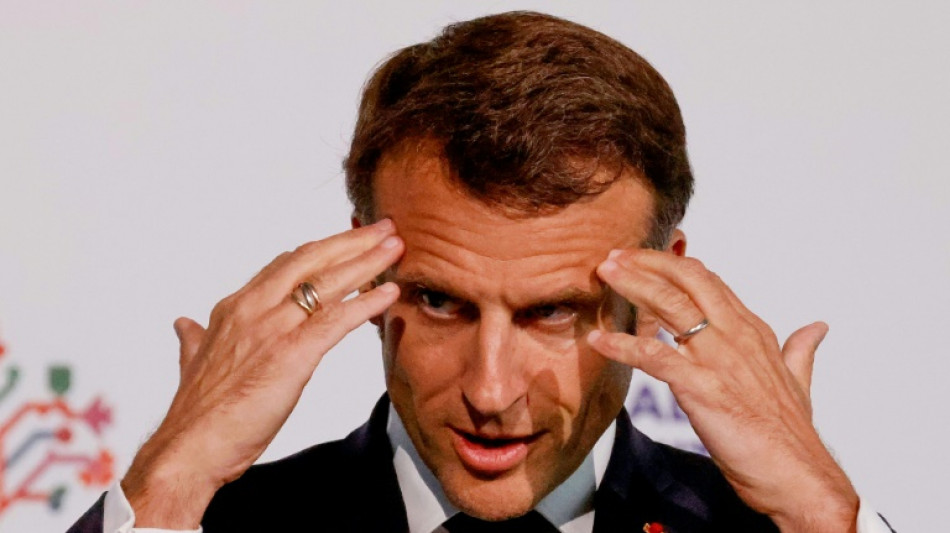
French debt in spotlight as ratings agencies sound alarm / Photo: LUDOVIC MARIN - AFP

 West must embrace 'national power' or face decline: Rubio

 Shell refining margins reach record highs as wars hit supply

 Former Spain, Barca winger Pedro retires from football

 Arteta signs new Arsenal deal until 2030

 Stocks decline as oil climbs on Mideast flareup

 Gauff says online abuse was 'draining' after China Open exit

 As sector struggles, Porsche puts luxury ahead of volume
 'It's personal': Fiji minister pushes better climate finance at pre-COP

 Russia glosses over dark Soviet past in reinvented museum

 UK tax body opened probe into Man City in 2018: FT

 Yemen's Houthis claim new attacks on Saudi airports as conflict deepens

 Germany factory production at highest level for 18 months

 Thailand floods death toll rises to 60 since mid-September

 US pushes Russia for information on plague reports

 Myanmar leader lands in Malaysia for migrant return talks

 Indian central bank hikes rates for first time since 2023

 US military on Okinawa face curfew, alcohol ban after murder case

 Fierce lobbying in EU over 'forever chemicals'

 Dodgers beat Braves and Padres avoid sweep in MLB playoffs
 Mourning, war and elections as Israel marks October 7

 Messi says Argentina retirement is 'saddest day of my career'

 Oil rises and stocks fall as Hormuz worries flare

 Pacific presses world for help 'surviving' climate change at pre-COP summit

 Verstappen revival to be put to the test in steamy Singapore
 US woman who survived botched execution is conscious, speaking: lawyers

France's surging national debt is causing increasing alarm with the country risking a fresh warning on Friday over its credit rating after a downgrade.
Leading ratings agency Fitch in April lowered its rating on France's debt, which is approaching three trillion euros ($3.2 trillion).
It pointed to the country's hung parliament and public protests as risks to plans by President Emmanuel Macron to cut government spending.
Influential rival S&P Global is set to update its advice on Friday, with the country risking further censure over its chronic overspending that last saw a government run a budget surplus in the 1970s.
"We will be uncompromising on the balancing of our public finances, on the reduction of our deficits and on the acceleration of the reduction of the debt," Finance Minister Bruno Le Maire told France Inter radio on Wednesday.
He said he had spoken with S&P Global and presented his analysis personally, aware of the influence global credit agencies have on financial markets where downgrades usually increase the cost of borrowing money for governments.
"Whatever happens with S&P, it won't change anything in terms of our determination to meet our targets for the public finances," Prime Minister Elisabeth Borne said on Thursday.
Macron came to power in 2017 promising to balance France's books and his first prime minister, Edouard Philippe, memorably told parliament that the country was "dancing on a volcano that is rumbling ever louder".
But unbudgeted tax cuts during Macron's first term following the so-called "Yellow Vest" anti-government revolt and the Covid-19 pandemic in 2020 have led to a sharp deterioration in the public finances since.
- Credibility questioned -
The country's debt currently stands at around 111 percent of gross national product (GDP), from just shy of 100 percent before Covid-19 when Macron put in place one of Europe's most generous social safety nets.
The government has brought the annual public deficit down from a whopping 9.0 percent of GDP in 2020 to a forecast 4.9 percent this year.
Its projections show it falling to below 3.0 percent by 2027 when Macron will leave office.
But ratings agencies and investors are increasingly concerned about the credibility of the 45-year-old centrist leader whose successful prior career in investment banking once saw him dubbed the "Mozart of finance".
He has pushed through a pension reform this year in the face of the biggest demonstrations in a generation, but the proposed savings will be lower than first expected because of concessions made to trade unions and opponents.
On top of multi-billion-euro subsidies packages and price controls last year aimed at easing a cost-of-living crisis sparked by the war in Ukraine, Macron has since promised further tax cuts of two billion euros for the middle classes.
Increased defence spending -- set to rise 400 billion euros over the next seven years -- is a further drag on the public purse.
The public finances "were already in a degraded state before the Covid-19 pandemic, but to our eyes they now call for urgent measures", the head of the national auditing office, Pierre Moscovici, said in March.
"Reforming the public finances... has to be a national priority," he argued.
The French central bank has issued similar warnings in milder language.
France has the highest level of public spending relative to the size of its economy of all countries monitored by the Organisation for Economic Co-operation and Development, a Paris-based economic institute.
Fitch lowered its rating by one notch on April 28 to "AA-".
Macron said the agency "was making a profound mistake in its political analysis" in comments to the l'Opinion magazine afterwards.
S&P Global currently ranks France at "AA" and is thought by analysts to be considering following Fitch's move. A statement is expected at 2100 GMT.
O.Mousa--SF-PST