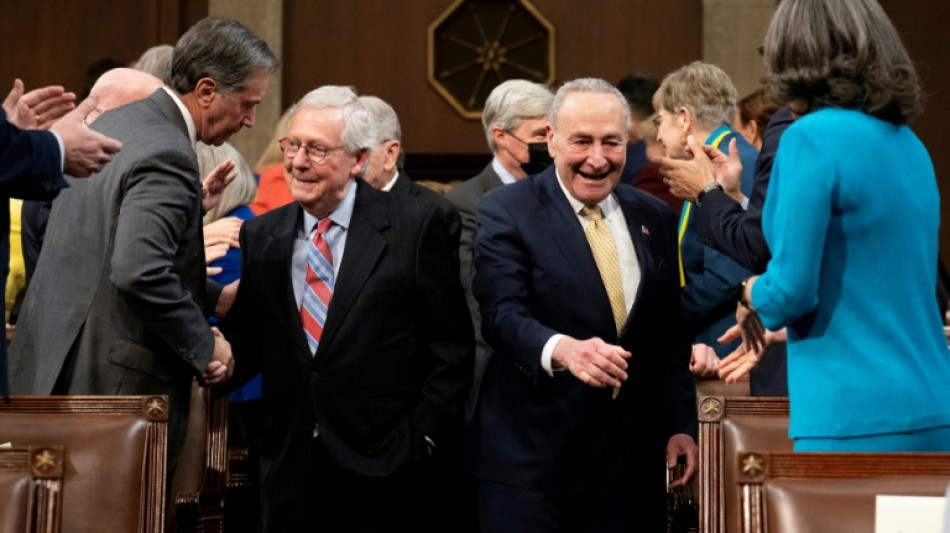
US averts first-ever default with 11th-hour debt deal
/ Photo: SAUL LOEB - POOL/AFP/File

 HSBC 'consults' over UK unit job cuts amid AI adoption

 UK court quashes five ex-traders' Libor rate rigging convictions

 XM Receives “Global Customer Experience Leader Award 2026” at the TrustFinance Performance Awards

 Stocks slide as oil climbs on Mideast flareup

 Heavy casualties in Ukraine after Russian strikes

 French wine harvest set to hit historic low

 Kyiv 'cannot agree' to EU membership limiting food exports: minister

 Arteta targets more Arsenal glory after signing new deal until 2030

 Russell hit with Singapore grid penalty for taking new power unit

 Spotify expands audiobooks to more than 180 markets

 French-Japanese duo wins chemistry Nobel for solving molecular 'mystery'

 England's Nations League surge helps heal World Cup wounds

 Mayor of opposition stronghold Izmir defects to Erdogan party

 Mertens beats Gauff to set up Swiatek clash at China Open

 Benin full of pride at role in Messi's last dance

 France suspends stun grenade use at student protests ahead of PM speech

 Indonesian court hears 'negligence' complaint against state over fires, haze

 Rubio in Greece to urge against Western civilisation 'decline'

 Micron workers at Taiwan plant vote in favour of strike

 In 'The Social Reckoning,' Jeremy Allen White takes on Facebook's 'frightening' ambition

 Chip industry activists call for South Korea to recognise cancer cases
 Famine-scarred southern Madagascar braces for El Nino

 How the EU regulates lobbyists

 I.Coast refuge offers lifelong care for youngsters scorned as 'sorcerers'

 Indian central bank hikes rates for first time in more than 3 years

US senators voted to suspend the federal debt limit Thursday, capping weeks of fraught negotiations to eliminate the threat of a disastrous credit default just four days ahead of the deadline set by the Treasury.
Economists had warned the country could run out of money to pay its bills by Monday -- leaving almost no room for delays in enacting the Fiscal Responsibility Act, which extends the government's borrowing authority through 2024 while trimming federal spending.
Hammered out between Democratic President Joe Biden and the Republicans, the bipartisan measure passed the Senate with a comfortable majority of 63 votes to 36 a day after it had sailed through the House of Representatives.
"America can breathe a sigh of relief because in this process we are avoiding default. From the start, avoiding default has been our North Star," Democratic Senate Majority Leader Chuck Schumer said.
"The consequences of defaulting would be catastrophic... But, for all the ups and downs and twists and turns it took to get here, it is so good for this country that both parties have come together at last to avoid default."
The bill -- which now heads to Biden's desk to be signed into law -- ended a day of intense back-and-forth between party leaders and rank-and-file members who had threatened the bill's quick passage with last-minute gripes about the detail.
Democratic leaders had spent months underlining the havoc that a first default in history would have wrought, including the loss of millions of jobs and $15 trillion in household wealth, as well as increased costs for mortgages and other borrowing.
- 'Behind the eight ball' -
The late evening drama came after a series of failed ballots on amendments sought mainly by Republicans who were threatening at one point to hold up the process, dragging it deep into the weekend.
Senators elected to offer 11 tweaks to the 99-page text, many objecting to funding levels for their pet projects -- from border control and Chinese trade to taxation and the environment -- and each requiring a vote.
Defense hawks upset at Pentagon spending being capped at Biden's budget request of $886 billion threatened at one point to derail the bill's passage entirely.
In the end they fell in line after being offered a commitment to a separate bill providing cash for Ukraine's defense against the Russian invasion, and promoting US national security interests in the Middle East and in the face of Chinese aggression against Taiwan.
"As currently written, this bill puts our military behind the eight ball... The first and most important dollars we allocate each year in the budget are those to protect and defend the United States and our interests," said South Carolina Republican Lindsey Graham.
America spends more money than it collects through taxation, so it borrows money via the issuing of government bonds, seen as among the world's most reliable investments.
Around 80 years ago, lawmakers introduced a limit on how much federal debt could be accrued.
- Politically toxic -
The ceiling has been raised more than 100 times since to allow the government to meet its spending commitments -- usually without drama and with the support of Democrats and Republicans -- and stands at around $31.5 trillion.
Both parties see raising the debt limit as politically toxic, although they acknowledge that failure to do so would plunge the US economy into a depression and roil world markets as the government missed debt repayments.
Republicans hoped to weaponize the extension to campaign against what they see as Democratic overspending ahead of the 2024 presidential election, although hikes in the debt ceiling only cover commitments already made by both parties.
Kevin McCarthy, the top lawmaker in the Republican-led House, had touted the bill he spent weeks negotiating as a big victory for conservatives, although he faced a backlash from hardliners on the right who said he had made too many concessions on spending cuts.
He fell one short of the 150 votes -- two thirds of his caucus -- he had promised to deliver in the lower chamber as he fought to quell a right-wing rebellion, and needed Democratic help to advance the bill to the Senate.
On the other end of Pennsylvania Avenue, the vote was being touted as a major victory for Biden, who managed to protect almost all of his domestic priorities from deep cuts threatened by Republicans.
V.AbuAwwad--SF-PST