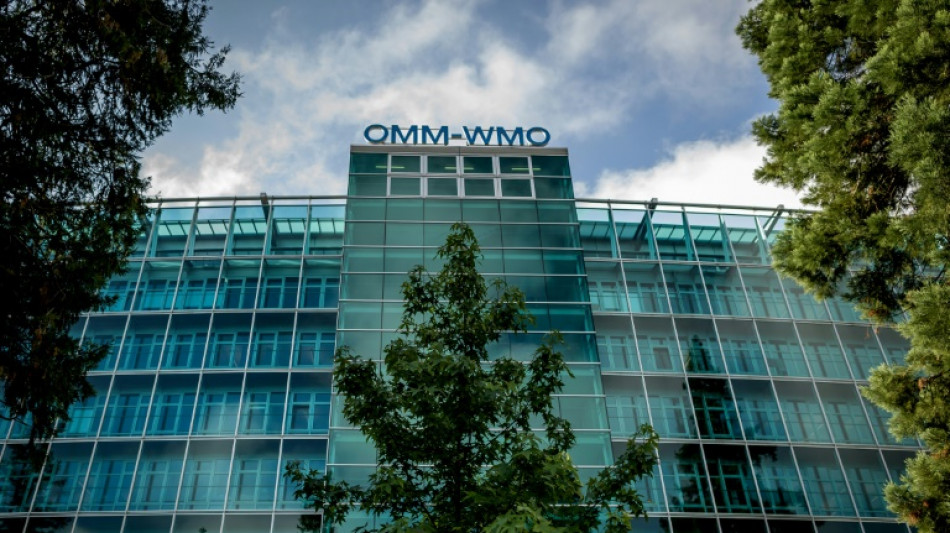
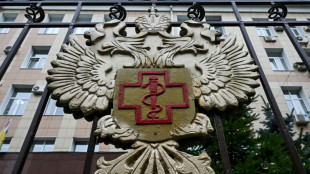
WMO: tracking the world's weather and climate / Photo: FABRICE COFFRINI - AFP

 HSBC 'consults' over UK unit job cuts amid AI adoption
 UK court quashes five ex-traders' Libor rate rigging convictions
 XM Receives “Global Customer Experience Leader Award 2026” at the TrustFinance Performance Awards
 Stocks slide as oil climbs on Mideast flareup
 Heavy casualties in Ukraine after Russian strikes
 French wine harvest set to hit historic low
 Kyiv 'cannot agree' to EU membership limiting food exports: minister

 Arteta targets more Arsenal glory after signing new deal until 2030

 Russell hit with Singapore grid penalty for taking new power unit

 Spotify expands audiobooks to more than 180 markets
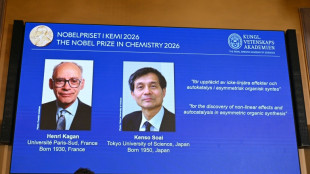 French-Japanese duo wins chemistry Nobel for solving molecular 'mystery'

 England's Nations League surge helps heal World Cup wounds

 Mayor of opposition stronghold Izmir defects to Erdogan party
 Mertens beats Gauff to set up Swiatek clash at China Open
 Benin full of pride at role in Messi's last dance

 France suspends stun grenade use at student protests ahead of PM speech
 Indonesian court hears 'negligence' complaint against state over fires, haze

 Rubio in Greece to urge against Western civilisation 'decline'
 Micron workers at Taiwan plant vote in favour of strike
 In 'The Social Reckoning,' Jeremy Allen White takes on Facebook's 'frightening' ambition
 Chip industry activists call for South Korea to recognise cancer cases
 Famine-scarred southern Madagascar braces for El Nino

 How the EU regulates lobbyists
 I.Coast refuge offers lifelong care for youngsters scorned as 'sorcerers'

 Indian central bank hikes rates for first time in more than 3 years
The World Meteorological Organization, which chooses its next leader on Thursday, is today at the forefront in monitoring climate change.
But the United Nations' specialised agency for weather and the climate can trace its roots back 150 years to the early days of shipping forecasts.
- Remit -
The WMO is dedicated to meteorology, operational hydrology and climatology -- weather, water and the climate. It covers related geophysical sciences such as oceanography and atmospheric chemistry.
- IMO forerunner -
The WMO was preceded by the International Meteorological Organization founded in 1873.
The shortcomings in using Morse Code to transmit weather reports and the lack of a uniform system for observations became the rationale behind setting up the IMO.
Now 150 years on, operations have moved from telegraphs and shipping forecasts to supercomputers and space technology. The average global temperature is more than one degree Celsius higher than when the IMO began.
The organisation reformed as the WMO in 1950 and became the UN's meteorological agency the following year.
It is the second-oldest agency in the UN fold after the International Telecommunication Union, set up in 1865.
- WMO -
The WMO issued its first statement on climate change in 1976, voicing concern that greenhouse gases emitted into the atmosphere by human activities would lead to major changes in the climate.
The Intergovernmental Panel on Climate Change was co-founded by the WMO and the UN Environment Programme. The WMO hosts the IPCC.
In 2007, the IPCC was jointly awarded the Nobel Peace Prize, along with former US vice president Al Gore.
Much of the WMO's work is in bringing together the work of national meteorological agencies.
More than 230 satellites, 10,0000 surface weather stations, 1,000 upper air stations, 7,000 ships, 1,100 buoys and 3,000 specially-equipped commercial aircraft measure key parameters of the atmosphere, land and ocean.
These observations are shared freely through the WMO system.
The WMO says today's five-day forecasts are as reliable as the two-day forecasts of 25 years ago, translating into "billions of dollars in economic gains".
- Headquarters -
The IMO was first based in Utrecht in the Netherlands, then in Lausanne from 1939.
After becoming the WMO, it moved to Geneva, where it was first housed in a modernist building now belonging to the World Intellectual Property Organization.
Its current glass-clad new headquarters, a 120-metre-long, elliptical nine-storey building, was inaugurated in 1999.
It is down the slope from the UN's Palais des Nations, overlooking Geneva's botanical gardens and the World Trade Organization.
- Members, budget and bosses -
The WMO has 193 member states and territories. The latest to join are South Sudan (2012), Andorra (2018) and Nauru (2019).
The WMO's budget for 2024-2027 is 278 million Swiss francs ($304.4 million). The United States and China have been the biggest contributors. The agency had 315 people on the payroll by the end of 2021.
The WMO has only had six secretaries-general since 1952, including Britain's David Arthur Davies (1956-1979) and Nigeria's Godwin Obasi (1984-2003), the first African to run a UN body.
Four senior figures from within the WMO are running to replace the current secretary-general, Petteri Taalas of Finland, after his second four-year term -- now the maximum.
- Top future projects -
The WMO wants everyone in the world covered by weather hazard early warning systems by the end of 2027.
This week it made the cryosphere -- the frozen world -- a top priority, given the impact of melting on sea levels.
It also said it would boost greenhouse gas monitoring with a new system integrating space- and surface-based observations.
And it wants to ramp up the tracking of where greenhouse gases emerge and end up, something it says could be possible on a one-square-kilometre grid within a decade.
- Records archive -
The WMO has a Weather and Climate Extremes Archive, containing a variety of records including temperature, air pressure, rainfall, wind speed, hail and lightning.
The four latest records, dating from 2020, were for the longest distance and longest duration lightning flash, and for the highest temperatures in the Antarctic region and above the Arctic Circle.
D.Qudsi--SF-PST