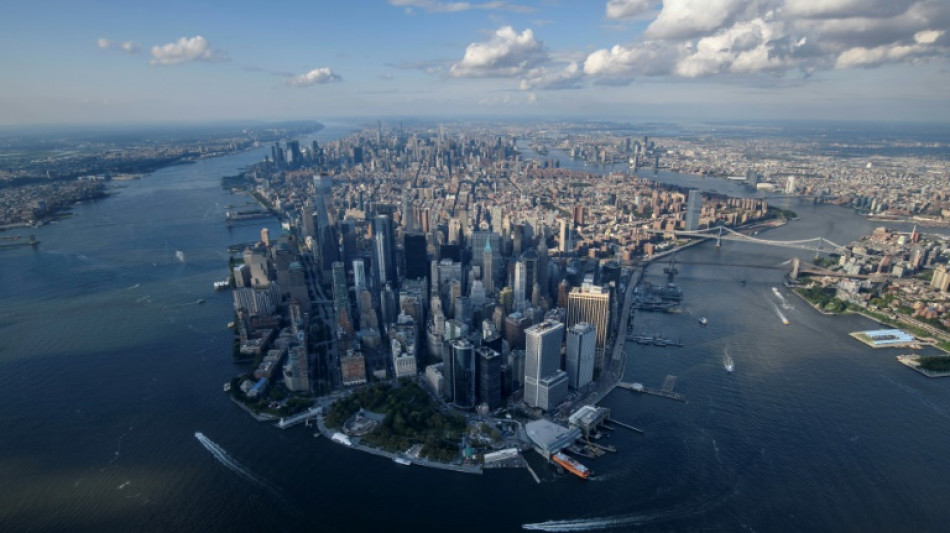
New York sinking under its own weight: study / Photo: Ed JONES - AFP

 HSBC 'consults' over UK unit job cuts amid AI adoption

 UK court quashes five ex-traders' Libor rate rigging convictions

 XM Receives “Global Customer Experience Leader Award 2026” at the TrustFinance Performance Awards

 Stocks slide as oil climbs on Mideast flareup

 Heavy casualties in Ukraine after Russian strikes

 French wine harvest set to hit historic low

 Kyiv 'cannot agree' to EU membership limiting food exports: minister

 Arteta targets more Arsenal glory after signing new deal until 2030

 Russell hit with Singapore grid penalty for taking new power unit

 Spotify expands audiobooks to more than 180 markets
 French-Japanese duo wins chemistry Nobel for solving molecular 'mystery'

 England's Nations League surge helps heal World Cup wounds

 Mayor of opposition stronghold Izmir defects to Erdogan party

 Mertens beats Gauff to set up Swiatek clash at China Open

 Benin full of pride at role in Messi's last dance

 France suspends stun grenade use at student protests ahead of PM speech

 Indonesian court hears 'negligence' complaint against state over fires, haze
 Rubio in Greece to urge against Western civilisation 'decline'
 Micron workers at Taiwan plant vote in favour of strike

 In 'The Social Reckoning,' Jeremy Allen White takes on Facebook's 'frightening' ambition

 Chip industry activists call for South Korea to recognise cancer cases
 Famine-scarred southern Madagascar braces for El Nino
 How the EU regulates lobbyists

 I.Coast refuge offers lifelong care for youngsters scorned as 'sorcerers'

 Indian central bank hikes rates for first time in more than 3 years

If New York is the city that never sleeps then how's this for keeping you up at night? It is also sinking.
The Big Apple is gradually going down partly because of the weight of the skyscrapers that make the concrete jungle famous, a new study has found.
The descent makes the metropolis more vulnerable to rising sea levels and coastal flooding caused by climate change, the researchers noted.
The paper, published this month in the Earth's Future journal, sought to estimate how the city's vast infrastructure impacts subsidence.
Subsidence is the sinking of land mass caused by either natural processes such as erosion or human activity like mineral extraction.
The geologists calculated that New York's more than one million buildings added up to a total mass of 1.68 trillion pounds (762 billion kilograms) of downward pressure on the earth.
CNN said that was equivalent to roughly 1.9 million fully fueled Boeing 747-400s.
The report concluded that America's financial capital is sinking at an average rate of one to two millimeters per year.
Some areas built on softer rock or artificial landfill were subsiding as much as four and a half millimeters per year, the study added.
But building fewer skyscrapers will not solve the problem, lead author Tom Parsons told AFP.
"The primary cause of subsidence in New York and along much of the Eastern Seaboard is tectonic and cannot be stopped," said the geophysicist at the US Geological Survey.
The subsidence is set to exacerbate the impact of sea level rise caused by warming temperatures and the melting of the world's ice caps.
The organization Sea Level Rise.org says water levels around New York are nine inches higher than they were in 1950.
The city's government predicts that surrounding waters will rise by between eight inches (20 centimeters) and 30 inches by 2050.
The state is spending billions of dollars building sea walls, raising roads and improving drainage to mitigate the risks.
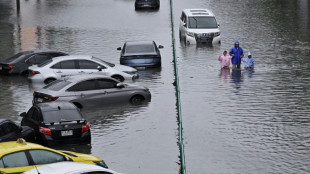
But low-lying areas have already felt the brunt of devastating floods caused by more intense storms.
Hurricane Sandy in 2012 killed more than 40 New Yorkers, destroyed approximately 300 homes and left tens of thousands of people without power.
Hurricane Ida in 2021 left more than a dozen people dead in New York City, many after they were unable to escape flooding basements.
Parsons said it was impossible to say when parts of New York will be under water but it will happen.
"It's too difficult to predict even a rough time because while city subsidence is relatively steady, forecasts for sea level rise are uncertain and depend on expected future rates of greenhouse gas emissions," he told AFP.
New York is not the only major world city that is sinking.
Subsidence and rising water levels have fueled fears that Venice may one day be entirely submerged.
And Jakarta is sinking at such an alarming rate due to the excessive extraction of groundwater that Indonesia is relocating its capital.
C.AbuSway--SF-PST