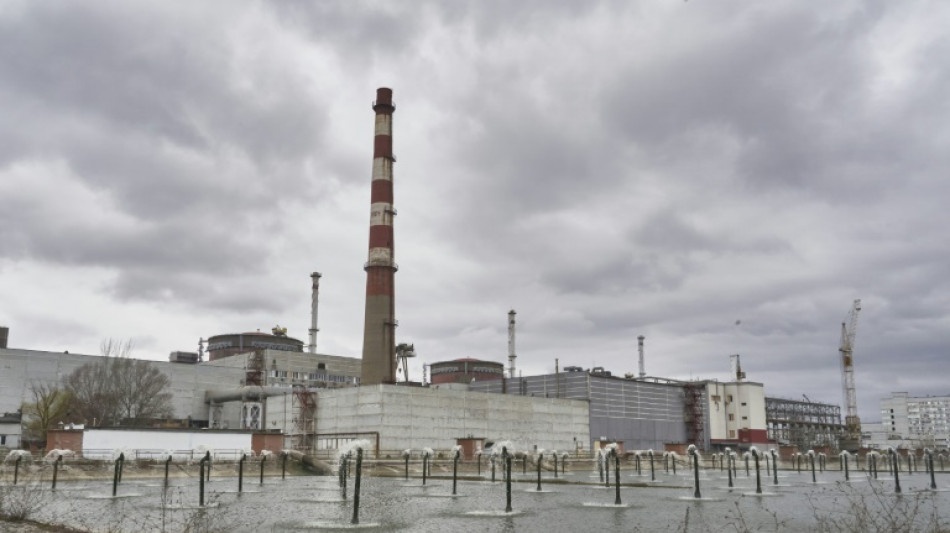
UN nuclear chief encouraged by Russia, Ukraine support of 'principles' / Photo: Andrey BORODULIN - AFP/File

 US woman who survived botched execution is awake and speaking
 From 1800s to modern pharma: a Nobel-winning chemistry quest

 Southampton boss Eckert given suspended ban over 'Spygate'

 Russia warns of 'false' information as second plague case reported

 IEA ready to release more oil reserves if necessary
 HSBC 'consults' over UK unit job cuts amid AI adoption
 UK court quashes five ex-traders' Libor rate rigging convictions

 XM Receives “Global Customer Experience Leader Award 2026” at the TrustFinance Performance Awards
 Stocks slide as oil climbs on Mideast flareup
 Heavy casualties in Ukraine after Russian strikes
 French wine harvest set to hit historic low

 Kyiv 'cannot agree' to EU membership limiting food exports: minister

 Arteta targets more Arsenal glory after signing new deal until 2030

 Russell hit with Singapore grid penalty for taking new power unit

 Spotify expands audiobooks to more than 180 markets

 French-Japanese duo wins chemistry Nobel for solving molecular 'mystery'

 England's Nations League surge helps heal World Cup wounds

 Mayor of opposition stronghold Izmir defects to Erdogan party
 Mertens beats Gauff to set up Swiatek clash at China Open
 Benin full of pride at role in Messi's last dance

 France suspends stun grenade use at student protests ahead of PM speech

 Indonesian court hears 'negligence' complaint against state over fires, haze

 Rubio in Greece to urge against Western civilisation 'decline'
 Micron workers at Taiwan plant vote in favour of strike
 In 'The Social Reckoning,' Jeremy Allen White takes on Facebook's 'frightening' ambition
UN nuclear watchdog chief Rafael Grossi said Tuesday he was encouraged by the reaction of Ukraine and Russia to "concrete principles" laid out by the body to prevent catastrophe at Ukraine's Zaporizhzhia nuclear plant.
The safety of Europe's largest nuclear power facility, located in Ukraine's southeastern region of Zaporizhzhia, has been a concern since Russian forces seized it over a year ago during Moscow's war on its neighbor.
It has been subject to frequent shelling that caused several outages of power that is vital to cooling the plant's reactors.
Ahead of an expected Ukraine counteroffensive, fears have increased that a nuclear disaster could occur amid increased military activity.
Grossi, director general of the International Atomic Energy Agency (IAEA), briefed the UN Security Council in New York on his proposals to ensure the plant's safety after months of negotiations.
"Today constitutes a step in the right direction when it comes to the safety and the security of the Zaporizhzhia nuclear power plant," Grossi told the council.
"We are encouraged by the expressions of support to our work, including on... the five principles that I have established today."
Chief among them, said the diplomat, "there should be no attack of any kind from or against the plant."
Grossi added that Zaporizhzhia "should not be used as storage or a base for heavy weapons," including rocket launchers, tanks or military personnel.
He also said "all efforts should be made to ensure that off-site power remains available and secure at all times."
And he stressed that all structures and components essential to the safe and secure operation of the plant "should be protected from attacks or acts of sabotage."
The IAEA intends to start monitoring the principles on-site, added Grossi, who visited the plant in March.
At a press conference later, he said he was encouraged that the principles were "widely supported and there was no voice opposing them."
The Russian and Ukrainian envoys at the United Nations blamed each other's countries for the crisis at Zaporizhzhia, although they did not reject the principles put forward by the IAEA.
"Mr. Grossi's proposals... are in line with the measures that we've already been implementing for a long time," said Russia's UN Ambassador Vassily Nebenzia, accusing Kyiv and its Western allies of creating "threats" to the plant's safety.
For his part, Ukraine's Ambassador Sergiy Kyslytsya said: "We take note of the director general's principles to help ensure nuclear safety and security" at Zaporizhzhia.
Kyslytsya had sought a "full demilitarization" of the area around the plant but the effort did not advance.
The IAEA's Grossi said he acknowledged the "different approaches" of the two sides.
But "the important thing is that the minimum common denominator, which are these basic five principles, have been widely supported and there was no voice opposing them."
Zaporizhzhia used to supply around 20 percent of Ukraine's electricity and continued to function in the early months of Russia's offensive despite frequent shelling, before halting power production last September.
None of its six Soviet-era reactors has since generated electricity, but the facility remains connected to the Ukrainian power grid for its own needs, notably to cool the reactors.
E.Aziz--SF-PST