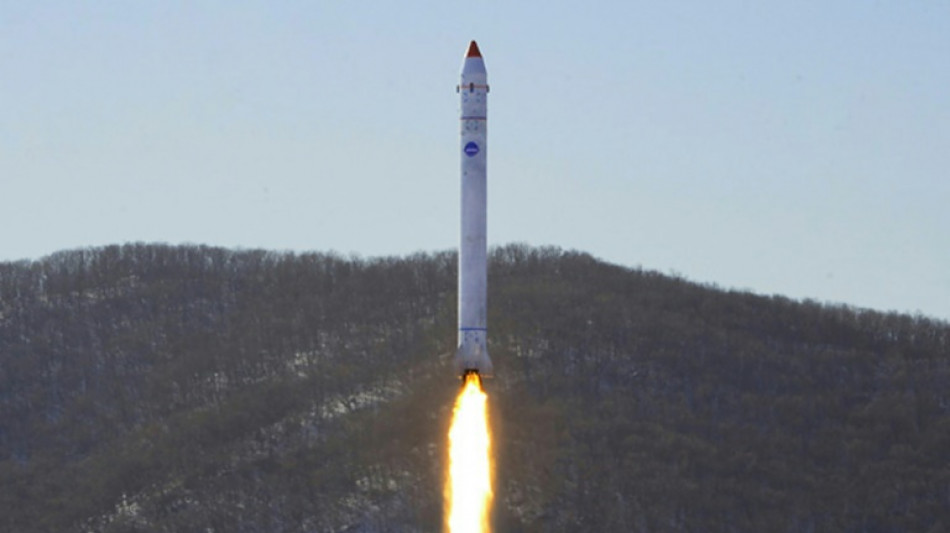
North Korea's military satellite launch: five things to know / Photo: STR - KCNA VIA KNS/AFP/File

 US woman who survived botched execution is awake and speaking

 From 1800s to modern pharma: a Nobel-winning chemistry quest

 Southampton boss Eckert given suspended ban over 'Spygate'

 Russia warns of 'false' information as second plague case reported

 IEA ready to release more oil reserves if necessary

 HSBC 'consults' over UK unit job cuts amid AI adoption

 UK court quashes five ex-traders' Libor rate rigging convictions

 XM Receives “Global Customer Experience Leader Award 2026” at the TrustFinance Performance Awards
 Stocks slide as oil climbs on Mideast flareup

 Heavy casualties in Ukraine after Russian strikes

 French wine harvest set to hit historic low

 Kyiv 'cannot agree' to EU membership limiting food exports: minister

 Arteta targets more Arsenal glory after signing new deal until 2030

 Russell hit with Singapore grid penalty for taking new power unit

 Spotify expands audiobooks to more than 180 markets

 French-Japanese duo wins chemistry Nobel for solving molecular 'mystery'

 England's Nations League surge helps heal World Cup wounds

 Mayor of opposition stronghold Izmir defects to Erdogan party

 Mertens beats Gauff to set up Swiatek clash at China Open

 Benin full of pride at role in Messi's last dance

 France suspends stun grenade use at student protests ahead of PM speech

 Indonesian court hears 'negligence' complaint against state over fires, haze

 Rubio in Greece to urge against Western civilisation 'decline'

 Micron workers at Taiwan plant vote in favour of strike

 In 'The Social Reckoning,' Jeremy Allen White takes on Facebook's 'frightening' ambition

North Korea said Tuesday that it would launch a military reconnaissance satellite by June 11, prompting concern from Seoul, Tokyo and Washington, which claim the move would violate UN sanctions.
Kim Jong Un has made developing such a satellite a top military priority for his regime, and has personally inspected it, approving its future launch.
AFP takes a look at what we know:
Is it banned?
Kim Jong Un's regime is barred from using any ballistic missile technology by a raft of UN sanctions, including one which specifically demands North Korea "not conduct any further nuclear test or any launch using ballistic missile technology".
Pyongyang regularly flouts these restrictions -- which it describes as an infringement on its sovereignty -- and has test-fired multiple intercontinental ballistic missiles already this year.
It never gives advance warning of missile tests, but -- in line with its idea of itself as a law-abiding global power, experts say -- has previously notified international authorities of planned satellite launches.
It told Japan on Monday it would launch one between May 31 and June 11.
The issue is that the technology used for both satellite launches and ICBMs is "essentially the same," said Choi Gi-il, professor of military studies at Sangji University.
Missiles & satellites are the same?
Both satellite launches and ICBMs use rockets and "require highly advanced expertise" in similar ways, experts say.
Ballistic missiles have internal guidance systems, allowing them to exit and then re-enter the atmosphere to hit specific targets on Earth.
With a satellite launch, the rocket simply carries it to an intended height in space then separates, leaving the satellite in orbit and falling back to Earth in a shower of debris.
"For ICBMs, mastering re-entry expertise is a must to ensure a warhead isn't burnt out before hitting a target," Han Kwon-hee of the Missile Strategy Forum told AFP.
"But for satellite rockets such re-entry technology isn't necessary, as its goal is to launch a satellite above the stratosphere."
The risk of debris from the rocket is why the North informed Tokyo of its pending satellite launch, Han said.
Have they done it before?
North Korea does not have a functioning satellite in space, experts say.
Since 1998, Pyongyang has launched five satellites, three of which failed immediately and two of which appeared to have been put into orbit -- but signals from them have never been independently detected, indicating they may have malfunctioned.
The most recent satellite launch was in 2016. The following year, Pyongyang successfully test-fired its first ICBM.
"Satellites launched by North Korea in the past were effectively ICBM tests disguised as normal satellites," An Chan-il, a defector-turned-researcher who runs the World Institute for North Korea Studies, told AFP.
"The upcoming launch is being advertised by Pyongyang as a state-of-the-art satellite," he said, adding it showed the North was eager to enter "the so-called 'military space era' before Seoul does".
So it's a space race?
South Korea is yet to develop a satellite "specifically and solely for military purposes", Seoul's defence ministry told AFP, adding it plans to launch one later this year on a SpaceX rocket.
Seoul did this month successfully launch its homegrown Nuri rocket, placing working satellites into orbit for the first time.
In response, "Kim Jong Un has likely increased pressure on his scientists and engineers to launch a North Korean spy satellite," Leif-Eric Easley, a professor at Ewha University in Seoul, told AFP.
It is doubtful North Korea "has the remote sensing technologies for a proper reconnaissance satellite. However, even a rudimentary eye in the sky could have military uses and would offer domestic political value for the Kim regime".
Will it work?
"North Korea is known to have failed a number of times," Choi of Sangji University said about ICBM re-entry into the atmosphere.
However, "it is rumoured there was a transfer of know-how from Russia and China to the North, though it is not officially confirmed," he said.
Even a failed satellite launch -- like in 2016 -- shows North Korea's "capability and intentions to develop longer-range ballistic missiles", the Washington-based Center for Strategic and International Studies said at the time.
This time, Pyongyang wants to get a closer look at Seoul's defence posture, Han of the Missile Strategy Forum told AFP.
"It is an attempt by Pyongyang to show it has the capability to keep Seoul's nuclear deterrent in check with a spy satellite. They are sending this message: 'We can see you through and strike anytime.'"
I.Saadi--SF-PST