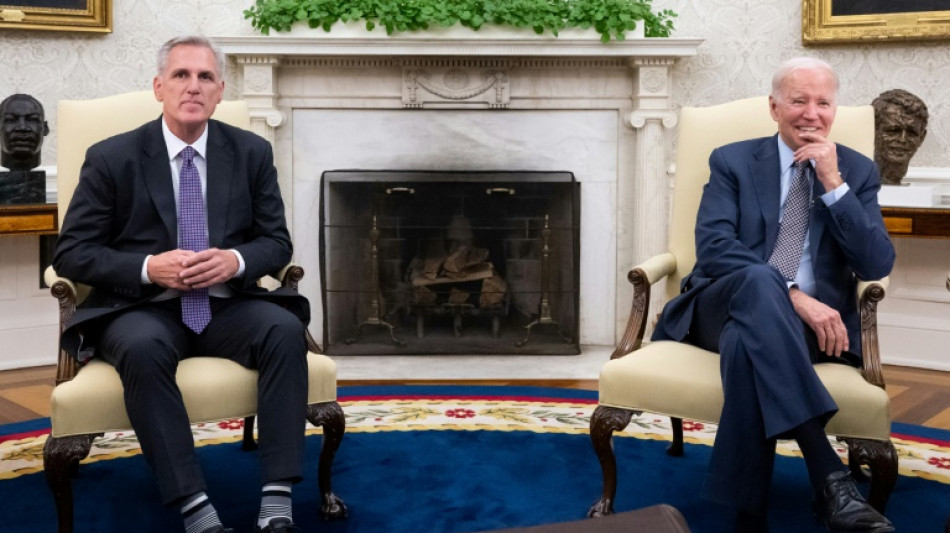
Biden cuts deal in principle with Republicans to avert catastrophic US default / Photo: SAUL LOEB - AFP/File

 India A vs Pakistan A Live Streaming: Asia Cup Rising Stars 2026 Match Details

 Lloyd’s Register Approves First Universal Classification Rules for Nuclear-Powered Maritime Units

 Luxembourg Hosts European Coalition Meeting on Crisis Resilience

 Grammy Winner Silvana Estrada Named Creative Chair for Latin Music at LA Phil

 Lotto Results for Saturday, November 21, 2026

 Meta Offices Vandalized in India Amid Protests Over Account Removals

US President Joe Biden and Republican lawmakers struck a deal in principle to raise the country's debt ceiling Saturday, in a crucial first step towards eliminating the threat of a disastrous default with just days to spare.
The government is expecting to hit its borrowing limit on June 5, raising the possibility of the world's largest economy failing to honor its repayment obligations for the first time and igniting a firestorm in global markets.
Party leaders now face a race against time to muscle the agreement through Congress, with hard-right Republicans and Democratic progressives both crying foul over concessions made to seal the deal.
The culmination of weeks of tense, high-stakes negotiations in Congress and the White House, the accord would permit the government to add to its $31 trillion-plus debt, avoiding a downgraded credit rating, likely recession and potentially millions of job losses.
And it goes some way towards appeasing fiscal hawks in the House of Representatives who have demanded significant rollbacks of Biden's domestic spending agenda as a condition of averting a default.
"I just got off the phone with the president a bit ago," McCarthy tweeted Saturday evening. "After he wasted time and refused to negotiate for months, we've come to an agreement in principle that is worthy of the American people."
- 'Manufactured crisis' -
Treasury Secretary Janet Yellen had warned of a possible default on June 1 if Congress failed to raise the ceiling on borrowing, but gave lawmakers some breathing room on Friday when she updated the estimate to June 5.
Even with the later deadline, the legislation will still have to clear Congress much more quickly than the normal timetable for even the most uncontroversial bills.
But it has rattled House conservatives angry that their leadership was yielding too much ground and worried Democrats, who complained that it was a betrayal of the voters who installed Biden on a progressive mandate.
Democrats have framed the standoff as a "manufactured crisis" forced upon the country by Republicans, as the debt ceiling has been raised dozens of times by both parties with no attached demands and little drama.
Meanwhile moderates have voiced frustration that they are being asked to swallow a deal they had no role in negotiating and that they fear will lose them vulnerable seats at the next election.
- 'Hold the line' -
McCarthy is hoping to bring a majority of the 222 House Republicans with him, but the deal is likely to face opposition from 35 far-right lawmakers who called on him to "hold the line" against any compromise on the party's debt limit package passed in April.
That bill was dismissed by leaders in the Democratic-majority Senate as "extreme."
"By handing his gavel over to the hard right, the speaker is giving the American people two terrible options: either default on the debt, or default on the country, with steep cuts to law enforcement, first responders, veterans, seniors, and even cancer research," Senate Majority Leader Chuck Schumer said after it advanced from the House.
There have been grumblings from the right flank of the Senate too, where Utah's Mike Lee said Thursday he would "use every procedural tool at my disposal" to stop any deal lacking "substantial" cuts.
Congress was adjourned for an extended holiday weekend but lawmakers will likely be called back to vote.
Congressional staffers will first have to turn the agreement into legislative text and then it would normally take another six days at minimum to advance from both chambers of Congress -- even without rebels gumming up the works.
The government doesn't actually miss loan repayments until mid-June but will likely have to halt $25 billion in social security checks and federal salaries if it loses borrowing authority earlier.
The drawn-out battle has been monitored closely by the major ratings agencies, with Morningstar and Fitch both warning that they could opt for a downgrade, even if crisis is averted.
When Barack Obama's administration narrowly averted a default 12 years ago, a ratings downgrade cost taxpayers more than $1 billion in higher interest costs.
K.AbuTaha--SF-PST